IN Brief:
- The Coffee Canopy Partnership will map coffee production across six East African countries covering 1.2 million sq km.
- Airbus will combine Pléiades and Pléiades Neo satellite imagery with AI models trained to identify coffee cultivation from space.
- The partners aim to expand to worldwide coffee-growing coverage in 2027, strengthening deforestation monitoring and supply chain transparency.
JDE Peet’s and Airbus Defence and Space are developing a satellite-based coffee mapping programme designed to build an open reference map of coffee plantations and improve deforestation monitoring across global supply chains.
The Coffee Canopy Partnership brings together JDE Peet’s with coffee traders and roasters including Louis Dreyfus Company, Sucden, Neumann Kaffee Gruppe, Touton, Sucafina, and Tchibo. The initiative is supported by the UK Foreign, Commonwealth & Development Office and the UN Food and Agriculture Organization, with Airbus selected as technical partner.
The first phase covers coffee-growing landscapes across Ethiopia, Tanzania, Kenya, Uganda, Burundi, and Rwanda, an area of more than 1.2 million sq km. Deliveries from the East Africa pilot are scheduled to begin in April 2026, with the full pilot dataset due by June 2026.
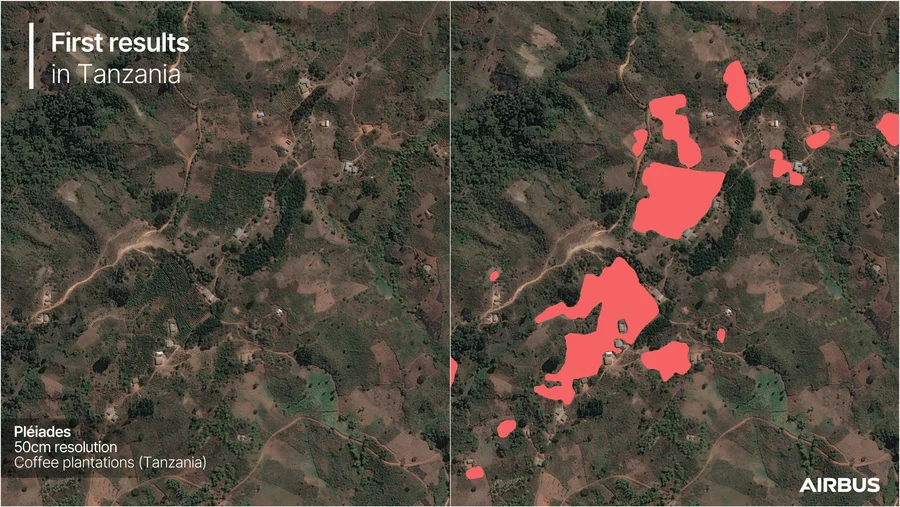
Airbus will use Pléiades satellite imagery at 50 cm resolution and Pléiades Neo imagery at 30 cm resolution, combined with artificial intelligence models trained on large datasets. The system is designed to identify and monitor coffee plantations in complex landscapes, including shade-grown and agroforestry systems where conventional crop mapping can misclassify productive land.
The partners aim to create the world’s first comprehensive open map of coffee plantations, giving governments, local communities, smallholders, and coffee companies access to a shared reference point for identifying deforestation risk, supporting restoration, and verifying cultivation zones.
Laurent Sagarra, VP engagement at JDE Peet’s, said: “The Partnership is designed to move beyond fragmented, company-led deforestation initiatives by fostering collaboration at a landscape scale – supporting efforts to map and safeguard coffee-growing regions, not just individual supply chains. This is not another certification scheme; it is a sector-led initiative aimed at strengthening collective action to help keep forests vibrant and reduce the risk of coffee-driven deforestation over time.”
Coffee supply chains are facing rising pressure from deforestation regulation, climate risk, smallholder traceability gaps, and weak origin-level data. Compliance is shifting from supplier declarations and certification paperwork toward geospatial evidence, batch-level traceability, and risk monitoring that can withstand closer regulatory and customer scrutiny.
The technical challenge is substantial. Coffee is frequently grown under tree canopy or in mixed agroforestry systems, where farm plots do not always resemble neatly bounded monoculture crops. If satellite mapping fails to distinguish coffee production from forest cover, compliant farms can be excluded from markets, while forest loss can go undetected. A common, science-based map gives the sector a firmer basis for remediation, sourcing decisions, and landscape planning.
Eric Even, head of Space Digital at Airbus Defence and Space, said: “Leveraging our very high-resolution Pléiades and Pléiades Neo satellite imagery combined with advanced AI capabilities, Airbus helps identify deforestation risk and protect our world’s forests, while simultaneously empowering food producers and smallholder farmers with the transparency and reliable data needed to strengthen their resilience and build a truly sustainable supply chain.”
The programme is part of a wider shift in commodity procurement. Coffee, cocoa, palm oil, soy, beef, and other high-risk raw materials are being drawn into data-led assurance systems, where documentation has to be backed by location intelligence and independent verification. Coffee’s fragmented smallholder base makes that harder, but it also increases the value of a shared mapping resource.
JDE Peet’s and its partners plan to scale the mapping capability globally in 2027 through further industry and institutional co-investment. A successful rollout would give coffee buyers a shared baseline for deforestation-free sourcing while reducing duplication across individual corporate programmes.
The next stage will depend on how well the open geospatial platform translates into practical decisions at origin: correcting inaccurate land classification, protecting market access for legitimate smallholders, directing restoration investment, and giving processors greater confidence that coffee entering production is backed by defensible supply chain evidence.