IN Brief:
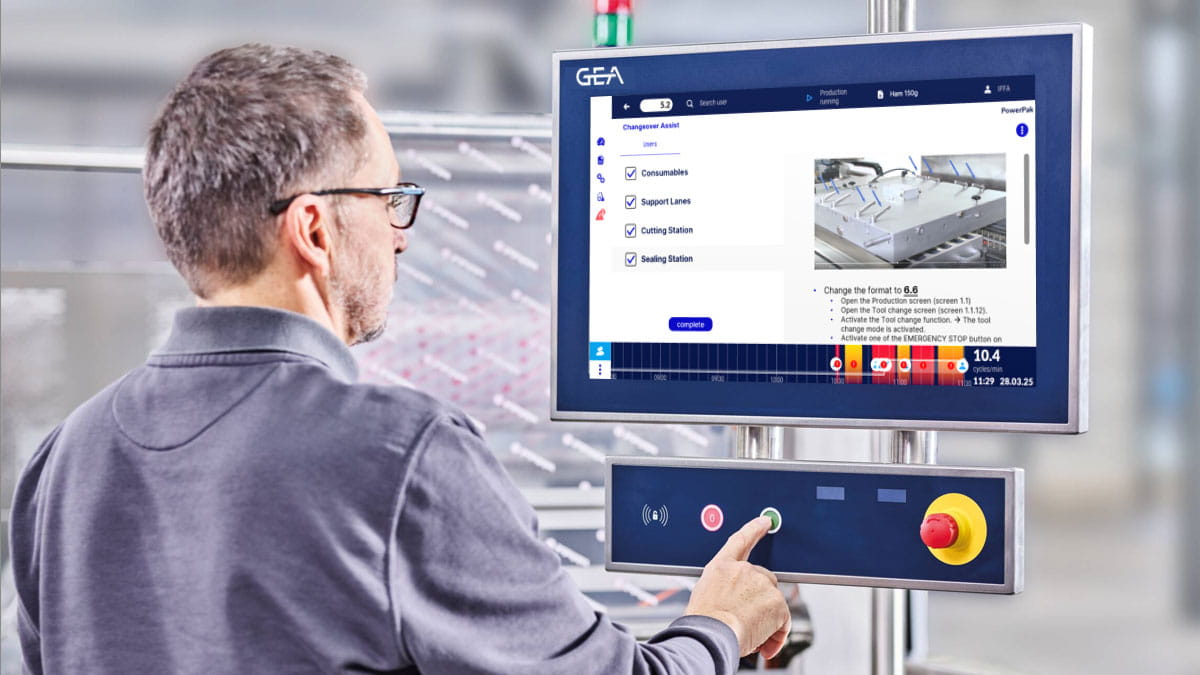
- Changeover Assist guides operators through recipe, product, and format changes using instructions displayed through GEA SmartControl.
- Initial applications cover PowerPak thermoformers and MaxiFormer equipment, with further machinery expected to follow.
- Centralised instructions and documented changeover steps are intended to reduce operating errors, waste, training demands, and avoidable downtime.
GEA has introduced Changeover Assist, a digital application designed to standardise product, recipe, and format changes on food-processing and packaging equipment while reducing reliance on individual operator knowledge during production changeovers.
The software delivers recipe-specific instructions through GEA’s SmartControl human-machine interface, showing the actions required for the selected change rather than asking operators to work through a generic procedure. Instructions can include images and video, while completed actions are confirmed and documented as the changeover progresses.
Initial applications cover GEA’s PowerPak thermoforming equipment and MaxiFormer drum forming technology. The company also plans to extend the system across additional machinery, including its OptiSlicer platform, creating a common approach to guided changeovers across a broader section of food production lines.
Product changeovers are increasingly frequent in plants handling wider SKU ranges, retailer-specific formats, different recipes, and shorter manufacturing runs. A switch can involve mechanical adjustments, tooling changes, cleaning, revised machine parameters, packaging components, and confirmation that the next recipe has been configured correctly before production restarts.
Even when each individual task is relatively simple, the accumulated cost of inconsistent changeovers can be substantial. Missed settings can result in poor seals, incorrect portions, product damage, wasted packaging, extended start-up periods, or repeated stops while production teams trace an error made during the preceding set-up.
Changeover Assist places the relevant procedure on the control interface already being used to operate the equipment. That reduces dependence on paper manuals, separate files, or instructions retained by a small number of experienced employees, while allowing less experienced operators to work through the required sequence without being presented with information unrelated to the current recipe.
The approach complements digital functions already being incorporated into GEA’s latest food equipment. Its PowerPak 5000 thermoformer, launched earlier this year, uses SmartControl for centralised machine operation and supports a range of vacuum, modified-atmosphere, skin, and other packaging formats across food categories including meat, dairy, bakery, seafood, ready meals, and plant-based products.
GEA demonstrated Changeover Assist on the PowerPak 5000 at interpack 2026, where the software was presented alongside step-by-step visual guidance and intelligent checklists. Rather than simply logging machine data after an event, the application is intended to influence the sequence of work before production resumes.
Machine monitoring and guided operating procedures solve different problems. Condition monitoring can identify abnormal temperatures, component behaviour, alarms, or changes in performance, whereas an incorrectly completed format change may leave the machine mechanically healthy but configured for the wrong product. Incorporating procedural checks into the HMI gives production teams a means of addressing that second source of variation.
GEA also links its food-processing equipment with the InsightPartner digital platform. Machine information and notifications can be managed through that environment, while changeover instructions can be maintained centrally rather than relying on separate local copies that risk becoming outdated as procedures change.
Consistency is particularly difficult where several shifts operate the same equipment. Experienced employees often develop practical knowledge that goes beyond a formal standard operating procedure, but that knowledge becomes harder to maintain when staffing changes or when temporary and newly trained operators are introduced. Digital instructions cannot replace competence, although they can reduce variation in how routine tasks are carried out.
The potential gain is not confined to the duration of the changeover itself. A line restarted with incorrect tooling, recipe values, or packaging settings can consume product and material before the error becomes obvious, meaning a relatively short mistake during set-up produces considerably more disruption afterwards.
GEA’s recent food and packaging machinery development has increasingly combined mechanical platforms with digital support. The PowerPak 5000, InsightPartner services, and Changeover Assist all place greater emphasis on repeatable operation across varied products rather than treating maximum rated speed as the sole measure of equipment performance.
Physical constraints remain. Cleaning still requires time, parts still have to be changed where formats differ, and complex machinery still depends on trained operators and maintenance personnel. Guided software does not remove those tasks; it aims to make their sequence more repeatable and easier to document.
Expansion of Changeover Assist beyond its first supported machines will determine how far that approach can be standardised across mixed GEA installations. On lines where product variety already creates several changes during a shift, the useful result will be measured less by the sophistication of the interface than by whether the next production run starts correctly first time.