IN Brief:
- UFlex’s Ain Sokhna plant is undergoing commercial trials before full production and commissioning.
- The $126 million facility adds annual capacity for 12 billion aseptic liquid packaging cartons.
- Printing, lamination, slitting, inspection, automated materials handling, and ERP integration are combined within the manufacturing operation.
UFlex is running commercial trials at its new $126 million aseptic liquid packaging plant in Ain Sokhna, Egypt, ahead of planned commissioning before the end of 2026.
The greenfield Asepto facility will add annual production capacity for 12 billion aseptic cartons, giving UFlex a second major manufacturing base for the format alongside its expanded operation in Sanand, Gujarat. Once the Egyptian plant enters commercial production, the combined nominal capacity of the two sites will reach about 24 billion packs a year.
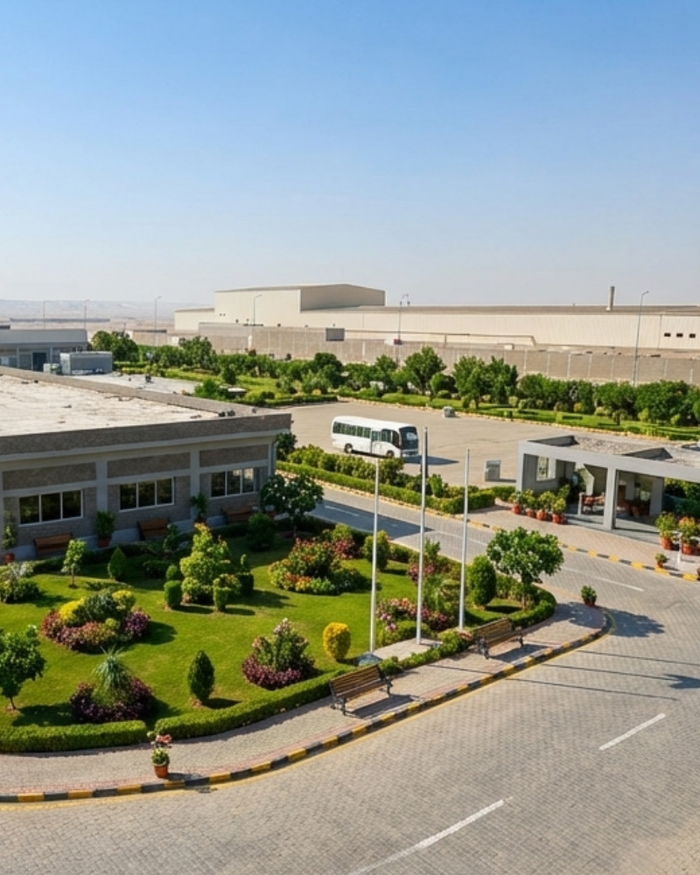
The Ain Sokhna factory is located in the Orascom Industrial Park within the Suez Canal Economic Zone. Current trials cover the complete production cycle before commercial output begins, allowing printing, converting, inspection, materials handling, quality systems, and plant controls to be tested together under operating conditions.
Production begins with a Heidelberg Boardmaster XL 1650 printing line designed for high speed work and rapid job transitions. The eight unit press can operate at up to 600 metres per minute and incorporates automated inspection and colour control systems. Aseptic carton production depends on consistent print registration and creasing because small dimensional errors can affect downstream conversion and filling performance.
Extrusion lamination is handled by an SML Triplex system, also rated at up to 600 metres per minute, with automatic inspection and electronic thickness control. Lamination creates the multi layer structure that gives aseptic cartons their mechanical strength, sealing properties, and barriers against moisture, oxygen, and light.
Converted material then passes through slitting equipment capable of running at up to 1,200 metres per minute. Automated web guidance, knife positioning, reel handling, and production data integration are intended to reduce manual intervention as material moves towards finished reel form. Madern Automation equipment is used downstream to move reels and finished materials through the plant, with the handling system rated for 160 reels an hour and delivery to 12 pallet stations.
The investment therefore extends well beyond extra printing capacity. Inspection, creasing, lamination, slitting, automated movement, testing, and enterprise resource planning are being connected across the operation. ABB L&W testing equipment is included in the quality infrastructure, while UFlex plans to establish local plate making capability as the site develops.
Asepto intends the plant to manufacture carton sizes ranging from small portion packs through to one litre family formats. Planned sizes include 65ml, 70ml, 90ml, 100ml, 125ml, 200ml, 250ml, 330ml, 500ml, and 1,000ml packs, covering dairy, juice, plant based drinks, and other liquid food applications.
That breadth of formats adds complexity to production planning. Smaller cartons place different demands on printing tolerances, cutting, creasing, reel preparation, and customer filling equipment from larger family packs. A nominal 12 billion pack capacity therefore does not translate into a fixed number of production hours because utilisation will depend on product mix, changeovers, reel dimensions, order length, and finishing requirements.
UFlex expects the facility to ramp progressively rather than reach full output immediately. Management has indicated a target of around 30% capacity utilisation in the first full year of commercial production, rising to about 70% in the second year and full nominal utilisation in the third. Those figures remain targets, but they indicate the scale of customer conversion required after commissioning.
The location is intended to support that ramp. Ain Sokhna sits close to the Suez Canal and associated port infrastructure, giving the factory maritime access to Europe, the Middle East, Africa, the CIS region, and longer distance markets. Asepto identifies those regions as core markets for the project.
A second manufacturing base also reduces dependence on serving every customer from India. Aseptic cartons are relatively light compared with rigid packaging, but moving large volumes of converted material across long distances still adds freight cost, inventory, and lead time. Production in Egypt shortens the supply route to several target markets and creates another source of cartons if one region experiences disruption.
Supply resilience only works if material remains consistent between factories. Cartons have to run through filling machines at speed while maintaining seal integrity, dimensional accuracy, barrier performance, and print quality. Customers qualifying material from Egypt will expect performance to match packs supplied from Sanand rather than treating the new plant as a separate specification.
The project has been under development for several years, with UFlex increasing capital expenditure as construction and equipment installation progressed. Asepto now describes the Egyptian site as approaching commissioning, while the current commercial trials show that the project has moved from construction into operating validation.
The final hurdle is sustained production rather than installed machinery. Printing, lamination, slitting, inspection, and automated handling must work as one process while quality remains stable across long runs and frequent customer changes. If the trials translate into commercial output by year end, UFlex will enter 2027 with substantially more aseptic carton capacity and a manufacturing base positioned closer to several of its largest target markets.