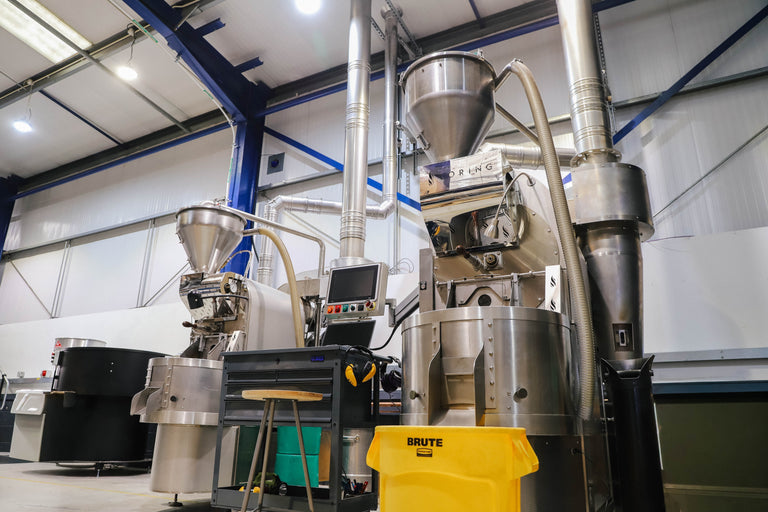
IN Brief:
- Rounton Coffee has relocated from The Granary to a larger production site in Thornaby.
- Mains gas, three-phase power, improved warehousing, and better production flow remove constraints at the former site.
- The additional space provides scope for production growth alongside training, cupping, and customer activity.
Rounton Coffee has relocated its roasting operation to Thornaby, replacing a rural production site that had become increasingly constrained as stock, equipment, and the workforce expanded.
The move takes the independent roaster away from The Granary near Northallerton, where the business had operated for more than a decade. Its new home provides greater production and warehouse space alongside infrastructure that founder David Beattie says was increasingly difficult to secure at the former site.
Among the most important changes are mains gas and three-phase electrical power. Rounton previously relied on bottled gas for roasting, while the stronger electrical supply gives the company a more suitable base for additional production, packing, extraction, handling, and other industrial equipment as the operation develops.
The new building also provides improved warehouse capacity and a production layout that reduces the space pressures experienced at The Granary. Rounton says stock had increasingly been stored externally, while pallets and equipment occupied much of the remaining floor area and made routine movement through the building progressively more difficult.
Those restrictions matter in coffee production because roasting represents only one part of the material flow. Green coffee has to be received, identified, stored, moved to production, roasted, cooled, packed, picked, and dispatched while different origins, blends, and batches remain traceable.
A larger roaster cannot deliver its full benefit if raw material has to be kept off site or finished product repeatedly crosses congested storage areas. Removing those handling constraints can increase usable capacity without changing the roasting process itself.
Rounton’s move therefore addresses infrastructure as much as nominal production volume. Trade reporting puts the new site at around 6,000 sq ft, approximately three times the company’s previous footprint, with current roasting capacity of about one tonne per day and additional headroom available for growth.
Green coffee storage silos have also been installed. Higher volume raw material handling can reduce repeated movement of sacks and simplify supply to production, although speciality coffee businesses still need careful lot control because origin, harvest, processing method, moisture, and quality influence how individual coffees are roasted.
The production challenge becomes more complicated as volume rises. Coffee is a batch manufacturing process in which beans with different physical characteristics have to be taken through defined temperature and time profiles. Increasing throughput without preserving those profiles risks turning additional capacity into greater inconsistency.
That makes process control as important as floor space. A larger building gives Rounton room to separate storage, roasting, packing, and dispatch more effectively, but the company still has to maintain repeatable roast development as production campaigns become larger or more frequent.
Permanent utilities should make that task easier operationally. Bottled gas adds a supply and handling requirement to a process whose heat source needs to remain reliable across scheduled production. Three-phase power similarly broadens the range of equipment that can be installed without adapting machinery around the limitations of a smaller property.
The relocation also changes working conditions for the production team. Rounton says the Thornaby site provides staff facilities better suited to the current business and is closer to home for several employees. Those points sit outside the machinery specification, but they become material as a small manufacturer adds shifts, staff, and more structured production routines.
Additional space will also be used for barista training, cupping sessions, equipment demonstrations, open days, and other customer activity. Those functions had become difficult to accommodate at The Granary as operational space was consumed by stock and equipment.
The expansion follows a familiar path for smaller food and beverage manufacturers. Production equipment can remain serviceable long after the building around it has become the limiting factor, particularly where warehousing, utilities, vehicle access, and staff facilities were never designed for industrial growth.
Rounton’s previous site helped take the company from a 10 kg roaster and a small founding team to an established speciality coffee business. Thornaby now has to provide the less romantic requirements of the next phase: reliable utilities, cleaner material flow, adequate storage, and enough physical headroom to increase production without rebuilding the operation around another undersized property.
The success of the move will be visible in ordinary factory measures rather than square footage alone. Higher output, shorter handling routes, reduced off-site storage, reliable utilities, and consistent roast quality will determine whether the additional space genuinely increases productive capacity.