IN Brief:
- The Tofoo Co has begun a new factory project at Malton Enterprise Park in North Yorkshire.
- The planned facility offers twice the initial production capacity and 3.5 times the productive space of existing premises.
- Construction began in September 2026, and the company expects to relocate when the site is completed in autumn 2027.
The Tofoo Co is developing a new manufacturing facility at Malton Enterprise Park in North Yorkshire that it expects to provide twice the initial production capacity of its existing premises. The purpose-built site is designed to offer approximately three and a half times the current productive space, accommodating factory operations alongside product development and future expansion. Construction began in September 2026, with completion expected in autumn 2027, when the company intends to move from its present buildings in Malton.
The investment supports a longer-term ambition to produce more than 10,000 tonnes of tofu annually by 2033 and to accommodate potential sales of around £73 million. The tonnage target and sales ambition apply to the period through 2033, not to current production or contracted revenue. The business currently operates in space-constrained leased premises, with agreements due to expire in 2028. Moving into a larger site before those leases end would provide a different operating base and allow the company to plan equipment and product development around a dedicated factory rather than its existing footprint.
Harrison Developments Malton LLP is leading construction, with HSBC UK supporting the investment alongside the company’s shareholders and Comitis Capital. The overall capital cost and machinery budget remain unspecified. The company’s forecasts distinguish two kinds of expansion: an initial doubling of production capacity and a building offering approximately 3.5 times the productive space of its current premises. The 3.5-fold increase in space should not be confused with a matching increase in initial production capacity. Part of the new footprint will accommodate storage, hygienic separation, staff circulation and technical work; only the production equipment and operating schedule determine achievable throughput. Finished-product capacity will depend on the lines installed and the time they can operate.
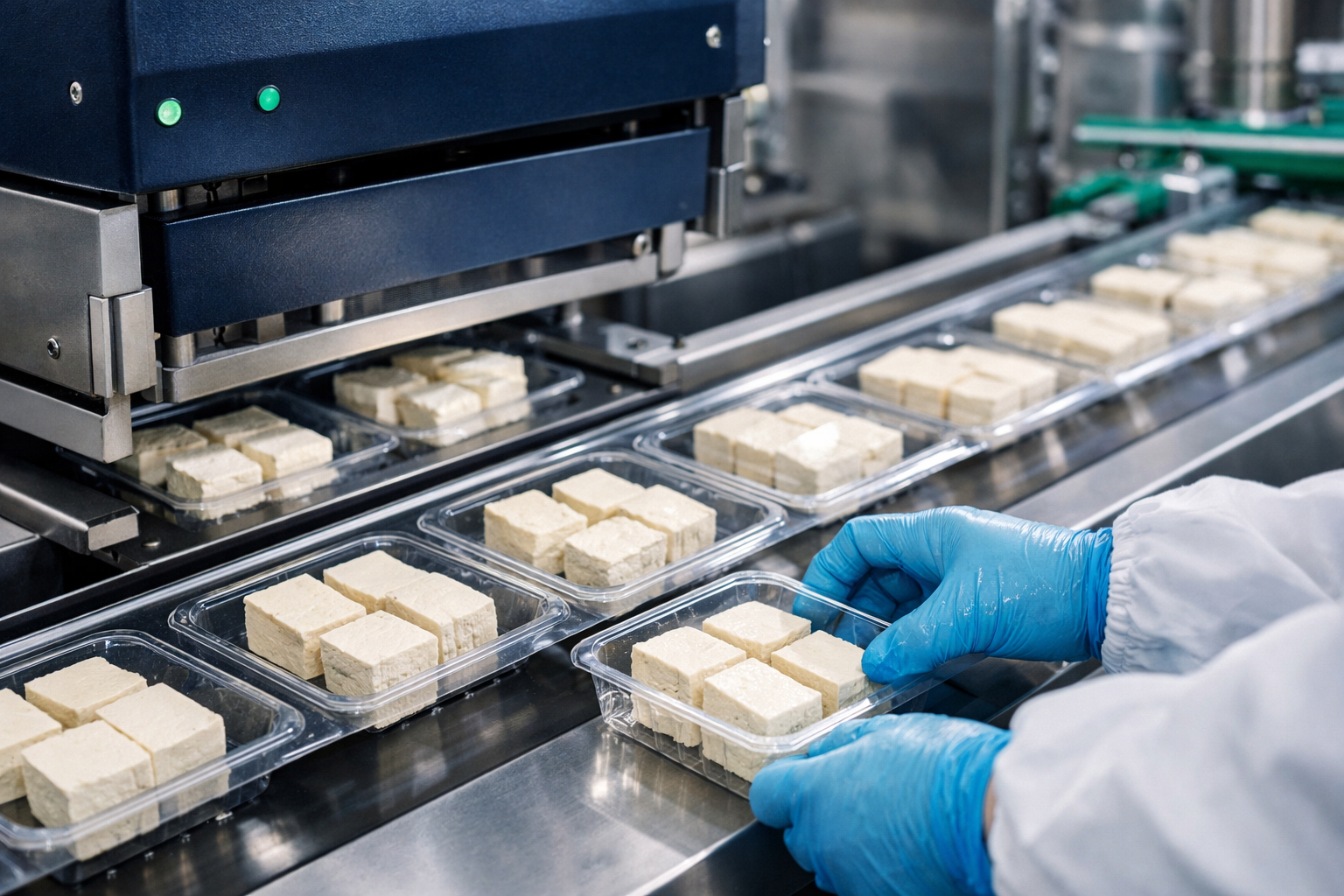
Tofu production typically begins with soaking and grinding soya beans, extracting and heating the soya liquid, then adding a coagulant to set its proteins. The resulting curd is formed or pressed according to the product style before cooling and packing, with hygiene and wastewater controls needed between wet processing stages. Individual recipes and plant designs vary, particularly for products with different textures. The Tofoo Co has not released a machinery schedule or process flow for the new factory, so neither the number of lines nor their individual throughput can be confirmed. A purpose-built site can arrange soya receipt, wet processing, cooled product handling and dispatch in a defined sequence, reducing unnecessary movement between hygiene zones. Actual improvement will depend on equipment selection, cleaning intervals and shift utilisation.
The development includes dedicated space for a development kitchen and pilot plant, allowing research and small-scale process work to be separated from routine production. A separate pilot area allows ingredient ratios, texture and packaging formats to be trialled without interrupting scheduled production runs. The company has also reserved approximately a quarter of the site’s unallocated space for future product development and expansion. Neither the capacity of the pilot plant nor the size and type of the main process lines has been disclosed, so forecasts about future individual products remain speculative.
Water and energy use are also part of the design, which includes provision for effluent treatment alongside opportunities for heat recovery, solar generation and electric vehicle charging. The company has described these features as intended infrastructure rather than measured reductions in consumption. Wet food processing depends on cleaning cycles and reliable wastewater handling, while recovered heat offers a benefit only where there is a suitable demand for it. Energy recovered from process heating can be reused only where a suitable heat demand and an effective recovery circuit are available. Wastewater treatment performance and electricity savings will depend on the final equipment specifications, discharge requirements and production hours; none has yet been quantified for the new operation.
The Tofoo Co also expects the factory to support its developing European business, following expansion into markets including France and Germany. Increased capacity in Malton could make room for more product ranges and export production runs, although customer contracts and volumes associated with the new facility remain unspecified. Nor does it anticipate an immediate increase in headcount purely as a result of the build. The company has not linked the building project to a fixed number of new jobs at opening, although a larger operation may require additional skills and staffing as utilisation rises.
Chief executive David Knibbs has linked the factory to demand in the UK and European markets, including France and Germany. The immediate sequence is construction, equipment installation, production validation and relocation from the existing Malton buildings. Completion is expected in autumn 2027, ahead of lease expiries in 2028. The company will need to coordinate that transition without interrupting established supply, although the detailed transfer arrangements have not been specified. The 2033 ambition of more than 10,000 tonnes per year will require subsequent production growth beyond the capacity envisaged at the initial factory opening.