IN Brief:
- Amcor’s revised 1kg UniPak combines pot and lid at 31.6g and targets high-volume dairy applications.
- The redesign keeps a mono-material PP structure, while tightening dimensions, tamper evidence, pallet use, and shared-lid compatibility.
- The launch reflects continued pressure on dairy packs to cut weight without disrupting filling, logistics, or recyclability.
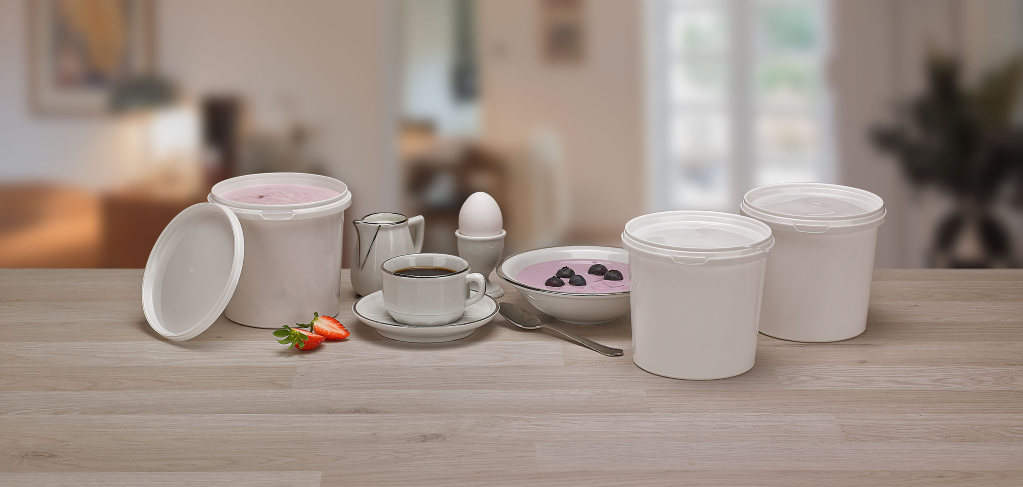
Amcor has introduced a lighter version of its 1kg UniPak pot for the dairy market, cutting material use while retaining the strength, filling-line compatibility, and handling performance expected in larger chilled formats.
The company said the new round container and lid have a combined weight of 31.6g in standard material. Against Amcor’s previous pack in this size, the redesign is expected to deliver up to a 9% reduction in carbon emissions based on anticipated production volume. The revised pack is made entirely from polypropylene, giving it a mono-material structure that is designed for recycling in markets with suitable infrastructure.
That construction matters in dairy, where lightweighting has increasingly been tied not just to material reduction, but to how easily a pack can move through established recycling streams and established filling operations. A lighter pot can look attractive on specification alone, but the format still has to hold up through denesting, filling, lidding, transport, retail handling, and repeated consumer use.
Amcor said the new UniPak has been engineered to keep that balance. The company said the lighter compression-moulded lid remains liquid-tight, offers high top-load strength, and stays fastened to the pot even in most cases of severe squeezing. Tamper evidence has also been improved, while the pack’s more compact dimensions are intended to make it easier to handle in the home.
Katrina Burrett, product line director, containers & reusables at Amcor Global Rigids Packaging Solutions, said: “The dairy sector is continuing to grow with, in particular, a strong showing in larger yoghurt formats. For dairy packaging, the 1 kg size is especially popular, and our new UniPak has been designed to enable brand owners to maximize opportunities with a high-performance solution that also supports their sustainability objectives.”
Beyond the headline weight reduction, Amcor is also pushing the format’s operational advantages. UniPak remains compatible with in-mould labelling and is available in round, square, rectangular, and oval variants, while shared lid diameters across different formats are intended to simplify stockholding and supply planning. The company also said the pack has been designed to optimise pallet utilisation, with a protective collar helping to improve lid protection and stability in transit.
That combination of changes is typical of how dairy packaging development is now being framed. Material reduction is still central, but it is being tied directly to format standardisation, pallet efficiency, recyclable mono-material construction, and the requirement to avoid disruption on installed lines. In larger yoghurt and cultured dairy packs, where margins are tight and volumes are high, those details tend to matter as much as the material saving itself.
Amcor’s existing 1kg yoghurt tub format is already positioned for applications including yoghurt, custard, crème fraîche, sour cream, cottage cheese, cream cheese, and cheese spreads. More on the format is available on Amcor’s 1kg yoghurt tub page.