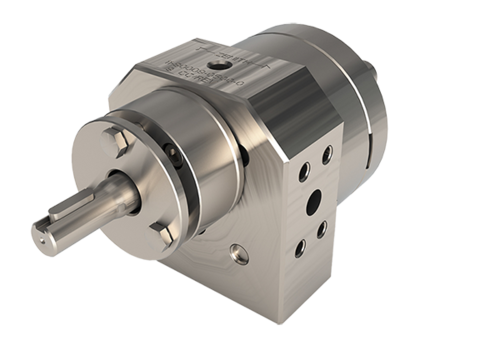
IN Brief:
- The Zenith C-9000 can remain installed while a production system completes a clean-in-place sanitation cycle.
- Its 316 stainless-steel construction supports flows up to 9,000 cc/min and pressures up to 70 bar.
- Integrating the pump into CIP can remove a manual cleaning step while retaining precision metering performance.
CIRCOR International has added clean-in-place capability to the Zenith C-9000 precision gear pump, allowing the unit to remain installed while a production system completes its sanitation cycle. The change is intended for food, beverage, and other hygienic manufacturing applications where accurate metering and cleaning time both influence line availability.
The operating benefit is straightforward: a pump that previously required separate manual attention can remain in the process during CIP. Removing a routine disconnection, cleaning, and reinstallation step can shorten sanitation activity and reduce manual intervention, provided the pump is incorporated correctly into the plant’s validated cleaning circuit.
CIRCOR’s C-9000 uses 316 stainless-steel construction and is rated for flows up to 9,000 cc/min, outlet pressure up to 1,000 psi or 70 bar, and operating temperatures up to 350°F. The model is the CIP-capable member of the company’s 9000 Series precision gear-pump range.
Those figures describe a metering pump rather than a conventional bulk-transfer unit. Precision gear pumps are used where a process needs a repeatable quantity of an additive, colourant, or other fluid delivered continuously or in controlled proportion, making stability of flow more important than moving the largest possible volume.
CIRCOR says the 9000 Series provides virtually pulse-free delivery and maintains stable, repeatable flow under changes in temperature, viscosity, and pressure. When paired with a drive and closed-loop speed controller, the company states that metering accuracy of approximately plus or minus 1% can be maintained.
That kind of repeatability matters in food processing because small dosing deviations can be repeated thousands of times during a production run. Ingredients such as colours, flavours, processing aids, and other liquid additions may be specified within relatively narrow limits, particularly where over-dosing increases cost and under-dosing changes finished-product performance.
Hygiene creates a different constraint. Food factories cannot extend production indefinitely merely to avoid cleaning downtime, so equipment has to be designed around the sanitation regime required by the product and process. If most of a line supports automated CIP but one component still has to be removed manually, that component can dictate how quickly the complete line is returned to service.
CIRCOR says the C-9000 can remain in place during the cleaning process, reducing the need for manual pump cleaning while retaining metering capability once production resumes. The company is positioning the design specifically around food and beverage, medical, and other manufacturing environments where sanitation cycles are routine.
CIP compatibility does not remove the need for process validation. Cleaning effectiveness still depends on variables including flow, cleaning chemistry, temperature, time, system geometry, drainage, and the soil left by the food product. The pump therefore has to be assessed as part of the complete circuit rather than regarded as hygienically validated simply because it can remain installed.
The design can also be specified with a magnetic-drive sealing option. CIRCOR says this eliminates shaft leakage and reduces reliance on mechanical seals and buffer fluids, potentially lowering another source of maintenance intervention. Whether that option is suitable still depends on the fluid and operating conditions of the individual application.
Reducing manual dismantling has maintenance implications beyond the duration of a cleaning cycle. Components that are repeatedly disconnected and reassembled require labour and disciplined procedures, and every intervention creates another opportunity for incorrect assembly or avoidable wear. A validated in-place process can reduce those routine touches without eliminating planned inspection and maintenance.
The C-9000 consequently addresses two engineering objectives that often compete for attention in food plants. Production teams want accurate dosing and high equipment availability, while hygiene teams need cleaning procedures that remain robust regardless of production pressure. Designing the pump around both requirements makes more practical sense than maximising metering performance and leaving sanitation as an afterthought.
For plant engineers, the useful comparison will not be between CIP and no cleaning; it will be between two ways of achieving the same required sanitation standard. If leaving the pump installed produces a validated clean while reducing dismantling and lost production time, the operational gain is measurable without altering the hygiene requirement itself.
The latest C-9000 configuration is therefore a relatively focused equipment development rather than a new processing technology. Its relevance lies in removing one potential interruption from a hygienic production line while retaining the precision characteristics expected from a metering pump. In plants where sanitation windows constrain available production hours, eliminating even one manual cleaning operation can be more valuable than another marginal increase in maximum flow.