IN Brief:
- GEA has introduced the MultiJector 500 for small- to mid-capacity marination and curing lines.
- The machine is built around configurable needle setups and modular filtration to improve consistency and cleanability.
- The launch reflects continued demand for flexible, hygienic equipment across multiple protein categories.
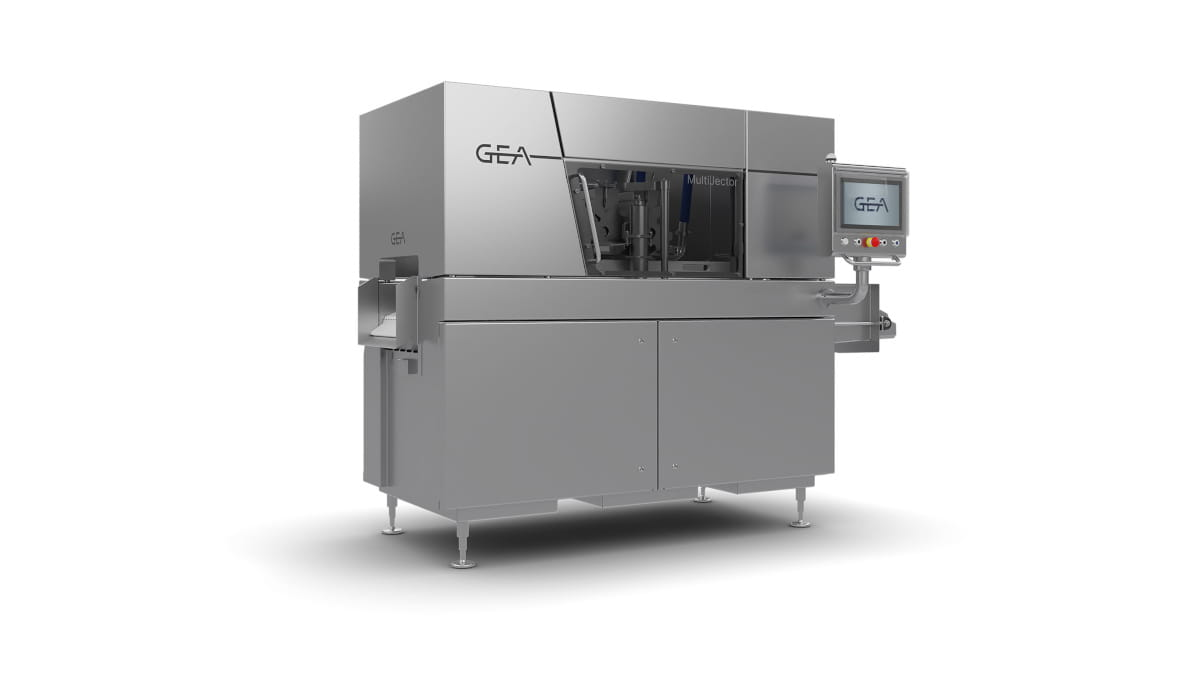
GEA has launched the MultiJector 500, a new brine injection system for small- to mid-capacity lines handling ham and deli meats, bacon, poultry, and fish, as protein processors continue to favour equipment that offers tighter control without locking plants into a single application profile.
The MultiJector 500 joins GEA’s existing injector range in the 450 mm width category and is designed around application-specific needle configurations. Processors can select 2 mm or 4 mm OptiFlex needles depending on product type and injection requirement, while a modular filtration concept is intended to support more stable brine quality, consistent distribution, and easier sanitation.
Injection systems sit close to some of the most commercially sensitive points in protein processing. Small variations in brine delivery can alter yield, texture, cure consistency, and final appearance, while poorly handled changeovers and difficult cleaning routines can quickly erode available production time. Processors running a broad product mix need machines that can move between specifications without turning every adjustment into a maintenance exercise.
That need has become more pronounced as plants balance retail, foodservice, and private-label work across shorter runs and wider portfolios. Mid-sized lines in particular are being asked to do more than before. Instead of being reserved for one straightforward application, they often switch between different proteins, cut sizes, pickup targets, and customer standards over the course of a week. Equipment that can keep pace with that variability without giving away consistency has become more attractive than pure nameplate capacity.
Sanitation remains central to those purchasing decisions. Marination and injection equipment operate in a wet, residue-heavy part of the process where hygiene failures can escalate quickly. Components that are awkward to clean, hard to inspect, or slow to return to service cost more than labour time; they create avoidable production risk. GEA’s emphasis on filtration, needle choice, and simpler cleanability points to that reality. The focus is as much on predictable operation as it is on processing performance.
There is also a clear commercial case for suppliers to serve this part of the market more precisely. Not every processor wants or needs a very high-capacity system. Many are looking for equipment that improves retention, repeatability, and uptime on smaller or mixed-use lines that remain central to plant output. That part of the installed base still carries plenty of value, especially where businesses are expanding cautiously and demanding stronger returns from mid-tier assets.
The MultiJector 500 fits neatly into that operating environment. It is aimed at plants that need flexibility, hygiene discipline, and application control across several protein categories rather than a single-volume push. In meat processing, machines that reduce variability and wasted time tend to prove their value faster than those built around headline speed alone.