IN Brief:
- PMMI and FPSA have released the inaugural 2026 Processing State of the Industry Report.
- The US food and beverage processing machinery market reached $6.2bn in shipment value in 2025.
- Growth is being shaped by automation, sanitation, food safety, AI, data-led inspection, protein demand, and operational efficiency.
PMMI and the Food Production Solutions Association have released the inaugural 2026 Processing State of the Industry Report, setting a new baseline for the US food and beverage processing machinery market.
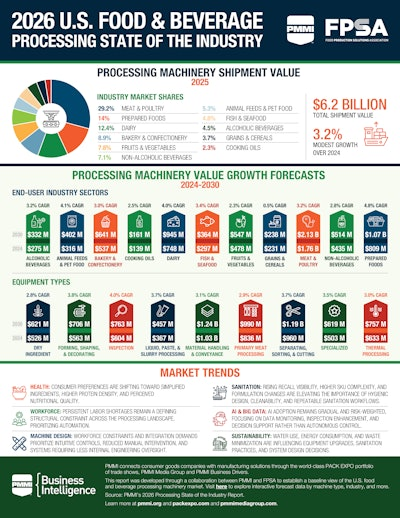
The report values the US food and beverage processing machinery market at $6.2bn in shipment value in 2025, representing 3.2% growth over 2024. The market is projected to reach $6.7bn by 2027, with demand broken down by end-user industry and equipment category.
Meat and poultry accounted for the largest share of the market at 29.2%, followed by prepared foods at 14% and dairy at 12.4%. Pet food, inspection equipment, and prepared foods are identified among the strongest growth areas through 2030.
Developed jointly by PMMI and FPSA, the report identifies several forces shaping machinery demand. Automation is being pulled forward by workforce shortages, while sanitation and food safety remain central because of recall visibility and tighter compliance expectations. AI and data-led technologies are gaining ground in monitoring and inspection, while health-focused and protein-rich food production is reshaping equipment requirements across multiple categories. Sustainability and operational efficiency are also moving further into capital investment decisions.
The findings give structure to a trend already visible across recent food plant investment. Manufacturers are buying machinery for labour reduction, consistency, cleanability, traceability, inspection performance, and waste control, not only for additional capacity. Equipment demand is increasingly tied to whether a line can run with fewer interventions, less downtime, better data, and stronger hygiene performance.
That direction closely matches IN Food’s recent coverage of sanitation by design in food equipment buying, which highlighted PMMI research showing the growing role of hygienic materials, cleanable surfaces, access, drainage, and sanitation-safe automation. The new processing machinery report broadens that picture from hygienic design into the wider capital equipment market.
Meat and poultry’s leading share reflects a category that is equipment-intensive, labour-sensitive, and exposed to food safety scrutiny. Processors need cutting, grinding, forming, marinating, cooking, chilling, packaging, inspection, and material handling systems that can maintain volume while supporting hygiene and traceability. Labour shortages in meat plants have also accelerated interest in automation and robotics, even where product variability still makes full automation difficult.
Prepared foods are also well placed for machinery growth. The category involves multiple ingredients, short production runs, complex recipes, high hygiene requirements, and packaging diversity. Chilled and frozen meals, ready-to-cook formats, soups, sauces, and meal components require flexible systems that can manage changeovers without excessive downtime. As product portfolios become more fragmented, machinery has to absorb complexity as well as increase output.
Dairy’s 12.4% share reflects a sector balancing mature high-volume processing with innovation in protein drinks, functional dairy, ambient formats, and specialised nutrition. IN Food recently covered Danone’s move into shelf-stable Oikos protein shakes, which showed how protein-led product development can create new processing and packaging demands beyond traditional chilled dairy.
Inspection equipment’s expected growth is one of the more revealing findings. As plants generate more data and operate at higher speeds, quality control has to move closer to the line and become more automated. Metal detection, X-ray, checkweighing, vision, seal inspection, foreign-body detection, and data logging are increasingly part of integrated line control rather than separate compliance stations. The same pressure is visible in coding, traceability, and connected packaging systems.
AI is entering food processing in practical increments. Its early value is likely to come from anomaly detection, predictive maintenance, inspection improvement, production optimisation, and decision support for operators. Adoption will depend on data quality, integration with existing control systems, cyber resilience, and whether plant teams trust the outputs enough to act on them.
The report also captures a difficult capital investment environment. Manufacturers need more automation and better data, yet many are making decisions under higher borrowing costs, tariff uncertainty, energy pressure, and uneven consumer demand. Equipment suppliers able to show measurable improvements in labour use, yield, sanitation time, waste reduction, and uptime will be better placed than those selling capacity alone.
Projected growth to $6.7bn by 2027 is steady rather than spectacular, but the composition of that growth is more revealing than the headline figure. Processing equipment is becoming more strategic, more connected, and more closely tied to risk management. The next investment cycle will be judged by how much operational uncertainty a machine can remove, as well as by what it can produce.