IN Brief:
- PMMI’s 2025 sanitation research suggests food manufacturers are tightening SSOPs, leaning on internal teams, and continuing to invest in sanitation-ready equipment.
- Hygienic design is moving further up the buying agenda, with food-grade materials, cleanable surfaces, drainage, and easier access all carrying operational weight.
- Automation can reduce manual intervention and improve traceability, but poor access, trapped moisture, and weak sanitation execution remain stubborn plant-level problems.
For food manufacturers, sanitation has traditionally been treated as a plant discipline — a matter of procedures, shutdowns, training, and audit readiness. That is no longer sufficient. As cleaning chemicals become harsher, labour remains tight, and compliance expectations keep rising, the design of machinery itself is becoming part of the sanitation strategy. PMMI’s 2025 Food Safety and Sanitation Trends research underlines that shift: 73% of end users said they rely only on internal teams for sanitation, 75% use both wet and dry sanitation processes, and 86% use a combination of CIP and COP methods.
That operational burden is feeding directly into equipment buying decisions. PMMI found that, when evaluating food safety features on new equipment, end users place particular weight on food-grade materials, hygienic design, and smooth, non-porous surfaces. The same report also points to a market that is still spending despite the pressure, with 93% of end users expecting to spend the same or more on food-safety and sanitation equipment or services in the coming year, and 68% anticipating purchases of compliant equipment within three years.
The regulatory backdrop remains uncompromising. HSE guidance on the Supply of Machinery (Safety) Regulations states that machinery used for food must be designed and constructed to avoid any risk of infection, sickness, or contagion, and that contact surfaces should be smooth, have minimal edges and recesses, and be capable of being cleaned before each use. EHEDG’s hygienic design guidance makes the industrial point just as plainly: poorly designed equipment is often difficult, or impossible, to clean effectively, raising the risk of microbial growth and cross-contamination.
That is why the language of hygienic design has become more practical and less cosmetic. In food plants, it increasingly comes down to geometry, drainage, materials, access, and serviceability. Self-draining surfaces, sealed hollow sections, continuous welds, rounded edges, corrosion-resistant construction, and tool-less access are not aesthetic refinements. They determine whether sanitation teams can clean thoroughly, validate quickly, and return lines to production without extending downtime or creating new harbourage points.
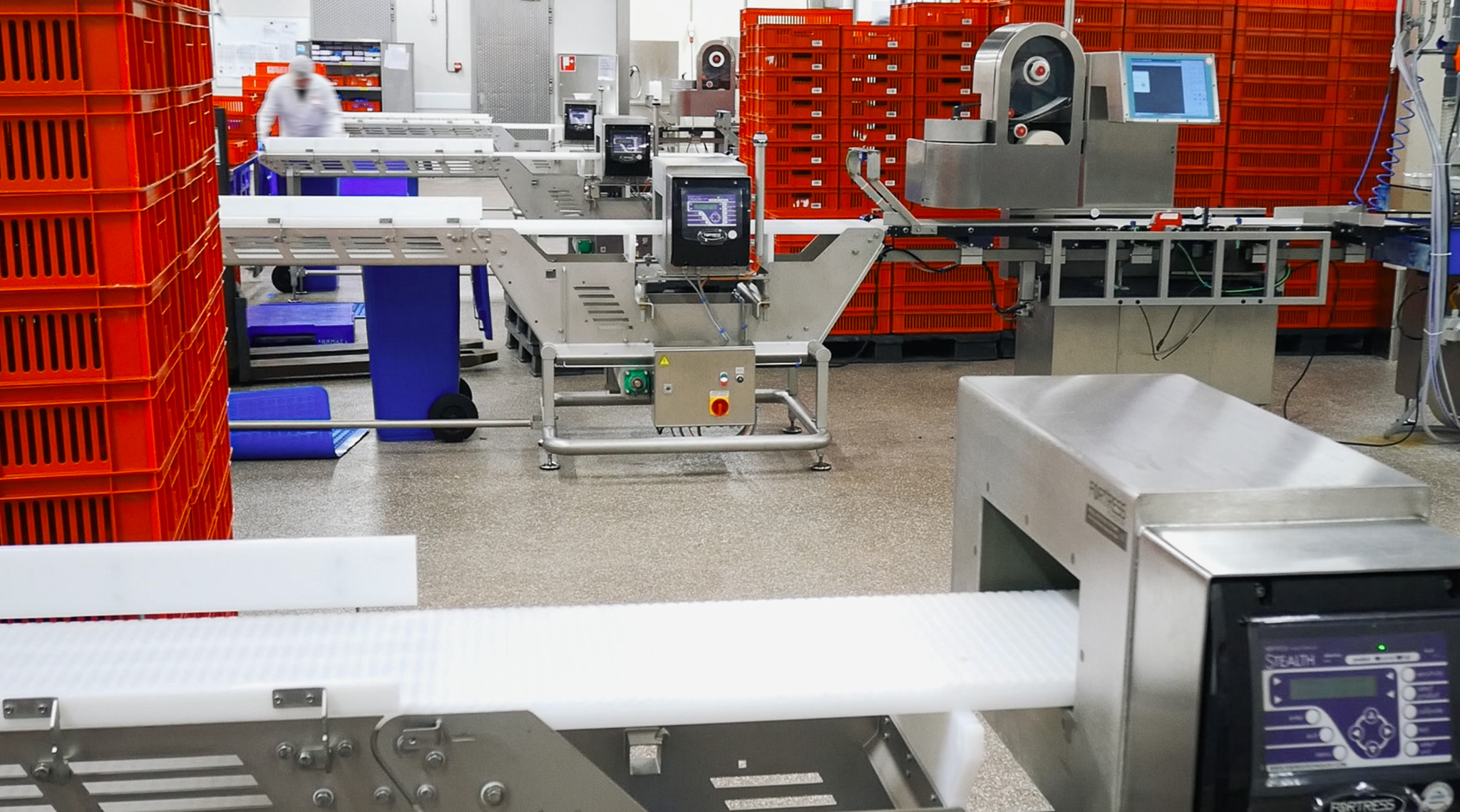
Fortress Technology is among the suppliers arguing that this design-led approach is becoming central to inspection equipment. Phil Brown, European Sales Director at Fortress Technology, says: “These hygienic design principles extend to critical inspection equipment such as metal detectors, checkweighers, X-ray and combination systems, all of which must be built to withstand harsh washdown conditions and prevent residue or debris accumulation. In an industry where a single recall can redefine a brand’s future, excellence in hygiene is foundational to business resilience.”
The PMMI data suggests processors would agree with much of that diagnosis, even if the challenge is broader than any one supplier’s product range. The report found that labour shortages and employee turnover were the top macro trend affecting end users, cited by 61%, while 65% said getting employees to properly and consistently follow SSOPs was a challenge. Among the most persistent machine-level sanitation headaches were small parts and components, validating sanitation effectiveness, and condensation, pooling, and trapped moisture.
Automation still has limits
Automation is part of the answer, but only part. PMMI found that OEMs expect to add more automated or self-cleaning functions, sanitation-safe HMI/PLC logging, and digital integration for sanitation processes. That speaks to a clear direction of travel: fewer manual interventions, better data capture, and more reliable validation. Yet those gains only go so far if the underlying machine is awkward to open, hard to drain, or vulnerable to chemical wear. PMMI’s research also found that 63% of end users said sanitation procedures had at least a moderate impact on machine wear, while 82% of OEMs and suppliers backed the idea of a standardised chemical-resistance classification system for machinery.
The processor case study supplied by Fortress gives that argument some practical footing. Huuskes, the European convenience meal supplier, has built part of its production model around hygienic inspection systems and washdown-ready equipment. As Geert Dimmendaal, Convenience Manager at Huuskes, puts it: “Food safety and cleaning efficiency are crucial for our consumer’s needs. Given that we work with meats, vegetables and cooking oils, all our equipment must be easy to clean and disinfect.”
That final point is probably where this market is heading. Food plants are still buying performance, throughput, and detection capability, but those metrics now sit alongside another one that procurement teams can no longer afford to treat as secondary: how easily a machine can be cleaned, validated, maintained, and returned to service. In a sector where contamination risk, labour pressure, and uptime now collide daily, sanitation has moved upstream into the design brief.