IN Brief:
- Southern Glazer’s has expanded Corvus One autonomous inventory drones across nine distribution centres after an 18-month rollout.
- The system is being used for reserve inventory checks inside active beverage warehouses without interrupting case-picking operations.
- Reported gains include more frequent validation, higher cases per hour, and reduced manual counting time at site level.
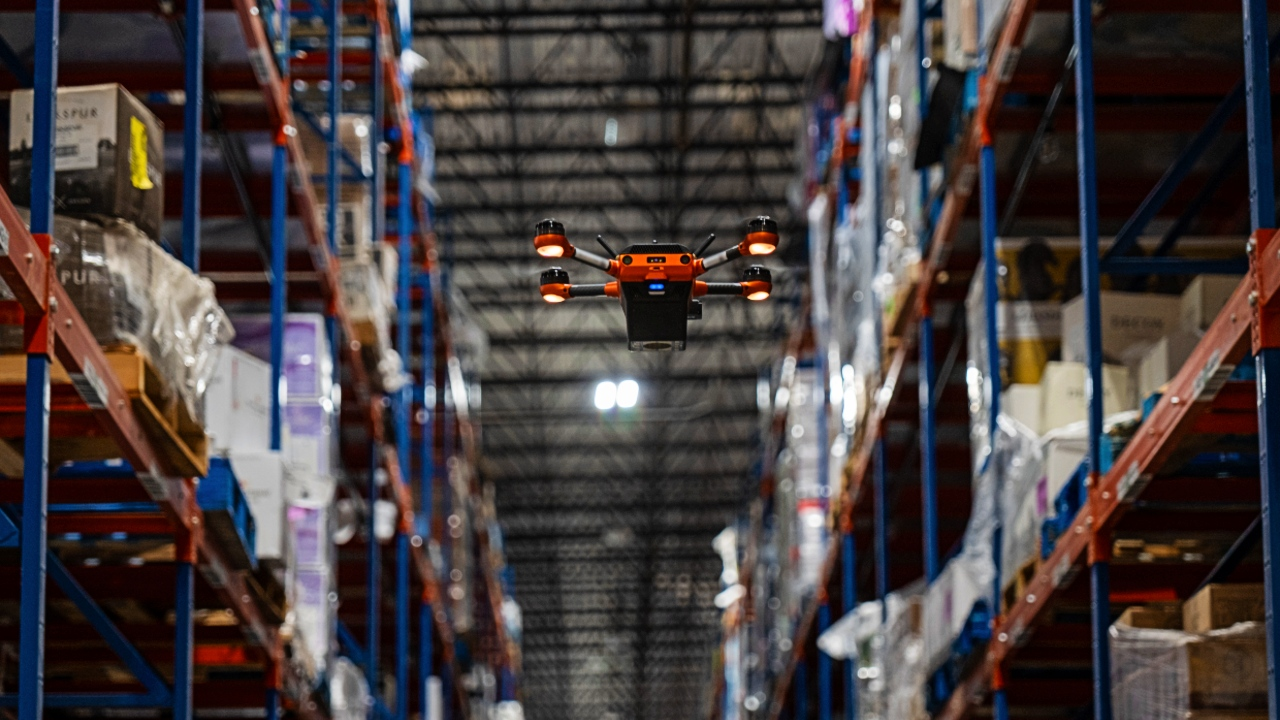
Southern Glazer’s Wine & Spirits has expanded its use of Corvus Robotics’ autonomous inventory drones across nine distribution centres, turning what began as a technology deployment into a broader operating model for beverage warehousing. More than 40 Corvus One units have now been rolled out across the network, with the system being used to scan reserve storage locations and feed validated inventory data back into warehouse management workflows.
The deployment sits in the overlap between beverage logistics and food distribution, where warehouse accuracy has a direct effect on fill rates, picking efficiency, and dispatch performance. Southern Glazer’s says the drones operate continuously in active facilities, flying aisles without interrupting case-picking activity. Over roughly 18 months, the system has completed around 5,000 flights and identified more than 35,000 verified discrepancies across the sites in use.
The operational effect appears to be less about headline robotics and more about cadence. Southern Glazer’s says it has moved from quarterly reserve counts to biweekly validation turns, increasing the frequency at which pallet and location errors are identified before they spill into outbound orders. It also reports a 100-basis-point improvement in cases per hour and says 60 to 70 labour hours per week per site have been reallocated from manual cycle counting to other operational work.
That matters for food and beverage distribution because reserve inventory errors rarely stay in reserve. A misplaced pallet, a bad location, or a missing label can quickly become a short shipment, a delayed order, or a reactive search on the floor. Systems that can audit storage locations more often, without stopping live operations, offer a route to tightening service performance without adding more manual counting back into already busy sites.
The visual record built into the Corvus system is also part of the value. Searchable images, scans, and historical footage tied to specific pallet positions make it easier to isolate root causes and coach corrections at site level. For warehouse operators managing dense SKU profiles and time-sensitive beverage volumes, that shifts inventory control from periodic checking toward a more continuous exception-management model.
The broader read-across for food distribution is straightforward: autonomous validation is moving beyond pilot-stage novelty and into routine warehouse control, particularly where accuracy, labour availability, and service-level pressure are all hard constraints.