IN Brief:
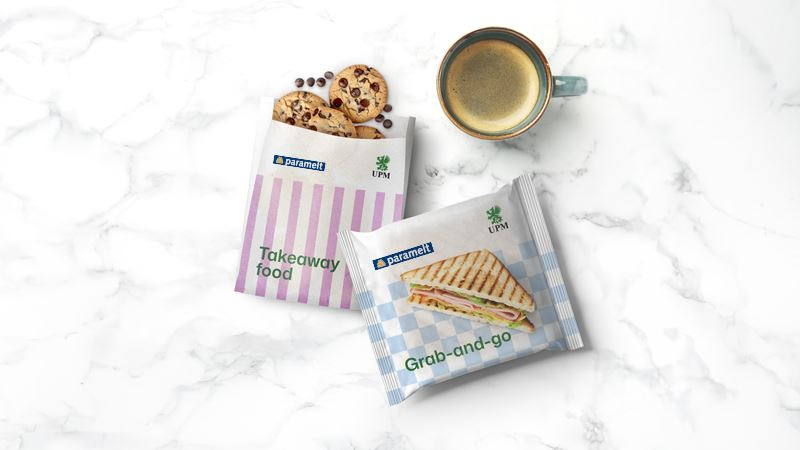
- UPM Specialty Materials and Paramelt have developed a paper-based food packaging concept for bakery, convenience, and other greasy food applications.
- The structure combines barrier base papers with a water-based bio-coating designed for low coat weights and compatibility with existing lines.
- If scale-up holds, the concept could support fibre-based conversion without the usual capex penalty attached to new materials.
UPM Specialty Materials and Paramelt have introduced a paper-based food packaging concept aimed at bakery, fast food, and convenience applications, built around strong grease resistance and compatibility with existing converting equipment. The companies say the structure can run on standard coating processes and current vertical form-fill-seal lines, addressing one of the more stubborn barriers to material change in food packaging.
The concept combines UPM Solide Lucent or UPM Prego barrier base papers with Paramelt’s Aquavate Bio SB 2383, a water-based coating formulated from biodegradable components. According to the companies, the system delivers grease protection and sealing performance at low coat weights, while keeping the packaging suitable for a wide range of dry and greasy goods. That low-coat-weight point matters because it has often been where paper-based concepts begin to lose either functional performance or processing consistency.
The industrial promise here is not only the material itself, but the claim that it integrates into existing production. Food manufacturers and converters have seen plenty of fibre-based concepts that read well in sustainability terms but trigger new hardware requirements, line-speed compromises, or a fresh round of sealing and shelf-life validation. A structure that holds performance while limiting capital disruption will get more serious attention than one that simply replaces fossil-derived content on paper.
UPM said the demonstrated packaging materials are certified recyclable under Cepi/4evergreen v2, while the individual components have been validated as home compostable. The coating itself is described as 90% biobased, and the companies said internal testing had shown the coated paper meeting disintegration requirements associated with home-compostability protocols. That makes the concept notable for end-of-life credentials, but the commercial test will still be whether converters can reproduce the claimed line behaviour at scale.
The most obvious near-term applications sit in bakery and grab-and-go, where grease resistance, heat sealing, and runnability are all non-negotiable. Those are also areas where plastic reduction pressure has been rising, particularly as pack developers look for fibre-led formats that do not demand a complete redesign of the filling operation.
Samples will be shown at Interpack 2026, with the companies exhibiting in Hall 8A and Hall 7 respectively. More detail is available in UPM’s release on the concept. The harder question comes after the exhibition cycle: whether paper-based barrier structures can finally move from pilot interest to routine industrial use without asking manufacturers to rebuild the line around them.