IN Brief:
- The Cold Chain Federation has published a white paper on cold chain resilience and UK food security.
- The report calls for cold chain infrastructure to be recognised as Critical National Infrastructure.
- Energy instability, cyber risk, labour shortages, climate impacts, and global disruption are increasing pressure on temperature-controlled food supply.
Cold Chain Federation has called for the UK’s temperature-controlled logistics network to receive stronger recognition in national food security planning, with cold stores, refrigerated vehicles, and controlled-temperature distribution positioned as essential food infrastructure.
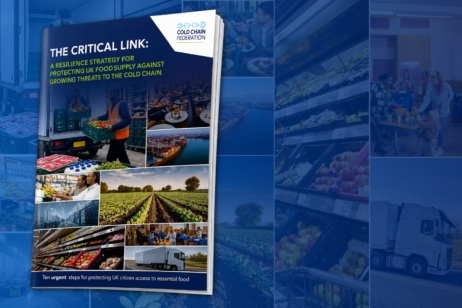
The federation’s white paper, The Critical Link, sets out ten recommendations to strengthen cold chain resilience and preparedness. Central to the report is a call for the sector to be recognised as Critical National Infrastructure, reflecting its role in protecting chilled and frozen food availability across retail, foodservice, public institutions, and home delivery.
More than half of the food consumed in the UK relies on the cold chain. The sector supports supermarkets, restaurants, schools, foodbanks, hospitals, manufacturers, wholesalers, and online grocery services, while contributing £14bn to the economy, supporting 184,000 jobs, and generating £3.7bn in annual tax revenue.
Temperature-controlled logistics is often treated as background infrastructure, yet chilled and frozen food supply depends on it at every stage. If cold stores, refrigerated fleets, distribution hubs, or freezer networks fail, the consequences extend beyond delayed deliveries. Food safety, shelf life, availability, cost, and waste all move together when temperature control is disrupted.
The federation identifies energy instability, cyber-attacks, climate impacts, labour shortages, and global supply-chain shocks as key pressures. Each risk affects cold-chain operators differently, but all can undermine the same basic requirement: maintaining temperature integrity from production through storage, transport, and final delivery.
Food resilience planning has already moved higher on the policy agenda, with recent industry calls for a national food resilience plan placing farming, water, cooling, logistics, and manufacturing continuity inside the same climate adaptation debate. The Cold Chain Federation’s white paper narrows that wider discussion onto one of the most energy-intensive and operationally critical parts of the food system.
Energy remains the most direct cost and resilience challenge. Cold stores and refrigerated vehicles depend on stable, affordable power, while decarbonisation is pushing operators toward lower-emission refrigeration, improved building performance, smarter energy management, and cleaner transport technologies. Those upgrades have to be delivered without weakening temperature compliance or service reliability.
Climate change raises the load on refrigeration equipment and increases the consequences of failure. Higher ambient temperatures, flooding, heatwaves, and disrupted transport routes can all place pressure on chilled and frozen supply. Stronger resilience depends on back-up power, maintenance discipline, real-time monitoring, trained staff, and contingency plans that are tested before disruption occurs.
Cybersecurity has become part of the same risk profile. Modern cold chains rely on warehouse management systems, telematics, route-planning software, temperature sensors, automated reporting, and customer portals. A cyber incident affecting scheduling, temperature records, access control, or transport coordination could quickly develop into a food safety and availability problem.
Recognition as Critical National Infrastructure would not solve those risks alone, but it would place cold-chain assets more clearly inside emergency planning, energy policy, food security strategy, and investment decision-making. For a food system built around chilled and frozen availability, resilience is increasingly defined by the strength of the infrastructure that keeps products within safe temperature limits.