IN Brief:
- The German facility supports trials with ATEX-compliant machines and broader raw material testing.
- Customers can run process development, product optimisation, and operator training on ystral systems.
- Remote livestream access, particle-size analysis, density measurement, and viscosity testing are included.
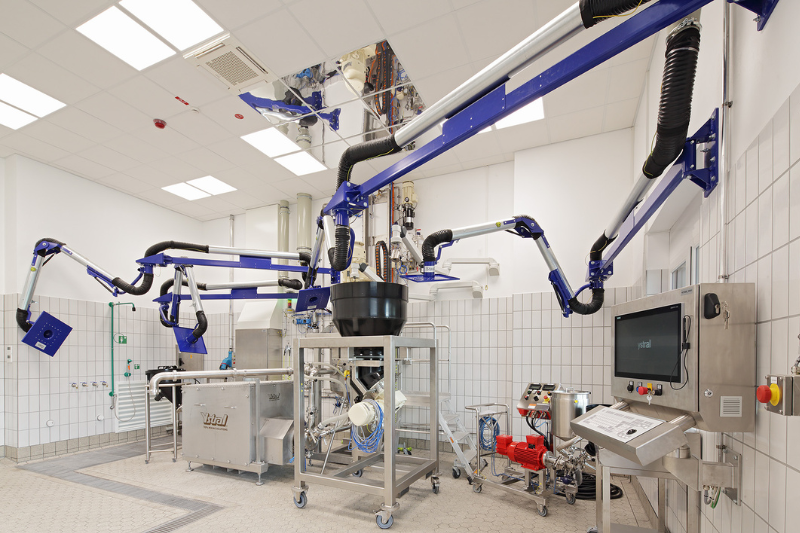
ystral has opened a new ATEX-compliant trial centre at its headquarters in Ballrechten-Dottingen, Germany, expanding its capacity for customer process development across food, pharmaceutical, coatings, chemical, household, and cosmetics applications.
The facility gives manufacturers a controlled environment for developing and optimising processes on ystral mixing, dispersing, and powder wetting systems. Trials can now be run with a wider range of raw materials, including flammable or explosive media after case-by-case assessment, while the installed machinery complies with statutory explosion protection and water protection requirements.
For food manufacturers, that capability is relevant where powders, liquids, oils, flavour systems, emulsions, stabilisers, or fine ingredients introduce handling risks or process uncertainty. Trial work can be used to assess dispersion, hydration, particle reduction, viscosity behaviour, homogenisation, and formulation stability before production-scale investment.
Customers can follow trials remotely by livestream, allowing technical, operations, and engineering teams to observe process development without every stakeholder being on site. Samples can also be analysed in-house using optical microscopy, density measurement, particle-size analysis, and viscosity testing under different temperature and shear conditions.
Combining trial runs with measurable sample data helps close a common gap in equipment specification. Mixing and dispersion decisions are often made under pressure from product development schedules, capital expenditure limits, and line availability. A new sauce, beverage base, bakery filling, dairy alternative, nutritional blend, or powder-liquid formulation may work at bench scale but become unstable, slow, aerated, lumpy, over-sheared, or energy-intensive when scaled.
Food production is becoming more ingredient-complex, particularly as manufacturers work with plant proteins, fibres, hydrocolloids, starch systems, emulsifiers, sugar reduction tools, cocoa alternatives, flavour encapsulates, colours, and functional ingredients. Many of those materials are difficult to wet, disperse, hydrate, or keep stable, especially where batch time, temperature, shear, and powder addition method are constrained.
Powder handling remains a practical bottleneck across many food plants. Poor incorporation can create dust, agglomerates, longer mix cycles, inconsistent hydration, rework, cleaning burden, and operator exposure. In high-value ingredients, inefficient dispersion can also push up formulation cost if manufacturers compensate by over-dosing functional materials. Equipment selection therefore affects product quality, cost control, and plant safety.
The new centre also strengthens the role of application engineering in capital equipment decisions. Food manufacturers rarely buy mixing technology in isolation. They buy a process outcome: shorter batch time, more stable texture, lower ingredient loss, safer powder handling, more repeatable viscosity, or improved cleanability. Demonstrating those outcomes with a customer’s own materials gives process teams stronger evidence before equipment reaches the production hall.
Food processing equipment development is moving toward higher hygiene standards, stronger process validation, and greater automation. As product changeovers become more frequent and formulations become harder to manage, trial infrastructure gives manufacturers a way to reduce commissioning risk and avoid locking production lines into equipment that cannot handle future product variation.
The German site has been planned with expansion in mind, with space available for an additional building on an adjacent open area. That suggests application testing and customer process support will continue to sit close to machinery development. Supplier capability is increasingly judged by what can be proven under process conditions, not only by what appears in a machine specification.
Mid-sized and specialist food manufacturers may gain particular value from access to controlled trials. Many do not have extensive internal process engineering facilities, yet they face the same formulation complexity as larger producers. A trial centre can help narrow equipment choices, validate scale-up assumptions, train operators, and identify formulation problems before capital is committed.
As ingredients become harder to process and production runs become more varied, process testing is becoming part of manufacturing discipline. The new ystral facility gives food producers another route to test the relationship between raw materials, equipment settings, product structure, and factory performance before the cost of a wrong decision reaches full scale.