IN Brief:
- Mondi’s concept combines a corrugated outer box with laser-marked flexible packaging.
- Artwork is marked during converting, removing conventional decorative printing plates from the selected formats.
- Potential applications include pet food and bag-in-box systems, although broader commercial deployment remains under development.
Mondi has developed a packaging concept combining a corrugated outer box with laser-marked flexible material, removing conventional decorative printing plates from selected pouch, bag, and bag-in-box formats. The company is exploring commercial use in pet food, home and personal care, and e-commerce, but has not announced a completed mainstream food-production deployment.
The marking is applied directly to the flexible packaging during converting. A digital file controls the artwork, allowing a design to be changed without preparing and installing another physical printing plate. Mondi says the approach can shorten lead times, support personalisation, and provide greater flexibility when products or graphics change.
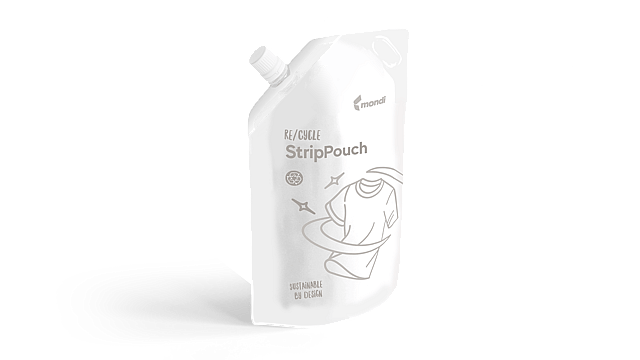
The concept can be supplied as reel material or converted into formats including the re/cycle StripPouch and larger re/cycle FlexiBag. Mondi is also presenting the development as part of a complete bag-in-box offer, bringing the corrugated outer case and flexible inner packaging together through one supplier.
Removing printing plates changes the economics of short production runs. Conventional printing generally becomes more efficient as volume rises because plate preparation, setup, colour control, and cleaning costs are distributed across more packs. Seasonal products, language variants, test launches, and customer-specific designs can carry a disproportionate setup burden when each version needs another physical plate.
Laser marking moves more of that change into the digital workflow. A revised file can be introduced without manufacturing a replacement plate, potentially reducing the delay between artwork approval and converted packaging. The advantage is most credible where portfolios contain many stock-keeping units or where decorative changes occur more frequently than long conventional print campaigns can accommodate economically.
Faster artwork changes also increase the need for disciplined file control. The approved version, market, language, product, and material order must remain aligned before the job reaches the converter. A digital error can be reproduced as quickly as a correct file, while weak permissions or naming conventions can allow obsolete artwork to return to production.
Decorative graphics and mandatory food information may follow different workflows. Ingredients, allergens, nutrition panels, durability dates, batch codes, and market-specific statements remain subject to regulatory and customer controls. Some information can be fixed during converting, while variable production data may still need to be applied and verified on the packing line.
The division of responsibility needs to be explicit. Converter-applied artwork, factory coding, vision inspection, and enterprise records must agree on which data is fixed, which is variable, and which system provides the authoritative version. A flexible marking method offers little benefit if it introduces duplicated or conflicting information.
Laser performance must also be validated against the selected material structure. Contrast, legibility, marking speed, heat input, barrier performance, seal behaviour, and abrasion resistance can vary between films and laminate constructions. A mark that appears clear immediately after converting must remain readable through filling, transport, storage, and consumer handling.
Mondi says bio-based feedstocks or post-consumer recycled content can be incorporated depending on the application. Those options require product-specific assessment because food-contact requirements, odour, migration, barrier performance, mechanical strength, and recycling compatibility differ between structures and markets.
The company’s internal Product Impact Assessment indicates lower carbon impact for a specified bio-based, laser-marked StripPouch compared with a conventional fossil-based printed and laminated polyethylene stand-up pouch. The comparison relates to those defined structures and should not be treated as evidence that every laser-marked pack will outperform every printed alternative.
A complete assessment needs to include pack weight, converting losses, energy, transport, filling performance, product protection, and the likely end-of-life route. Reducing printing inputs does not compensate for higher product waste, while a heavier structure may be justified when it improves shelf life or prevents damage.
The bag-in-box proposition could simplify procurement by bringing the flexible and corrugated components under one commercial arrangement. The physical system still has to work as a unit. The inner pack, outer case, filling equipment, sealing process, handling system, pallet pattern, and distribution environment all affect performance.
Equipment compatibility will determine whether the concept progresses beyond awards and development trials. Existing pouch or form-fill-seal machinery may accept the material without major modification, but web handling, friction, static, sealing windows, registration, coding, and inspection settings must be established through line trials.
The concept received a 2026 German Packaging Award in the sustainability category. Mondi has not published commercial order volumes, food-line speeds, scrap rates, or quantified lead-time reductions from a production deployment. Those figures will determine whether the digital flexibility outweighs any additional converting cost.
Laser marking is therefore more likely to complement established printing than replace it across all flexible packaging. Short runs, frequent revisions, and digitally managed variants present the clearest case, while stable high-volume products may continue to favour conventional processes. The technology addresses a real source of packaging complexity, but its industrial value will be established only when commercial customers publish operating results from converting and filling lines.