IN Brief:
- Raptor Tritek will make its UK exhibition debut, combining metal detection, checkweighing and label vision in one 2.5 m frame.
- Big Bag, Stealth and gravity systems will show inspection configurations for heavy packs, end-of-line applications and free-falling products.
- Halo automatic testing and Contact 4.0 will demonstrate automated verification and centralised inspection data across connected machines.
Fortress Technology will use PPMA 2026 to demonstrate four connected food inspection systems on Stand E36, bringing metal detection, checkweighing, label vision, automatic verification, and centralised production data into one exhibition setup.
The Birmingham show runs from 22 to 24 September at the NEC. Fortress will give the Raptor Tritek its first UK exhibition appearance alongside a Big Bag Combination System, a standalone Stealth metal detector, and a gravity-fed detector, with the machines linked through the company’s Contact 4.0 data platform.
The Raptor Tritek is not a new product launch: Fortress introduced the system internationally at Interpack earlier in 2026. Its PPMA appearance is instead the first opportunity for a UK exhibition audience to see the three inspection functions combined in one frame. The 2.5 m stainless-steel system integrates metal detection, checkweighing, and top-and-bottom label vision rather than placing the functions on separate conveyors.
That layout is designed to reduce the number of interfaces between inspection machines and keep the overall footprint down. Fortress says the Raptor Tritek is at least 40% shorter than a comparable modular arrangement, while a single HMI manages the metal detection and checkweighing functions. The system can also continue prioritising metal detection when weight control is not required.
The vision element checks label presentation as packs leave the weighing section, giving the line an additional control over label defects alongside weight and foreign-body inspection. For manufacturers producing multiple SKUs, bringing those checks into one frame can reduce the amount of line space occupied by end-of-line quality control, although the practical gain depends on changeover speed, cleaning access, reject handling, and how the combined machine fits with existing conveyors.
Jodie Curry, European Commercial Manager at Fortress Technology, said: “The industry is rapidly moving away from fragmented machinery toward cohesive equipment that prioritises productivity and supports operator free running.”
The second combination system at PPMA is aimed at heavier applications. Fortress says its Big Bag configuration can combine metal detection with case weighing for products of up to 25 kg, covering sacks, bulk ingredients, cases, and other large-format packs. The equipment shown at PPMA is expected to measure less than 1.7 m without its heavy-duty reject conveyor and around 2.5 m with the reject section installed.
Large-pack inspection creates a different engineering problem from checking retail-sized packs. Wider apertures, higher product mass, conveyor loading, and vibration can all affect system design, while weight verification has to remain stable as bulky products transfer between conveyor sections. Fortress already supplies large-bag systems for dry ingredients in the 25–50 kg range, with heavy-duty conveying and reject options intended for bulk production environments.
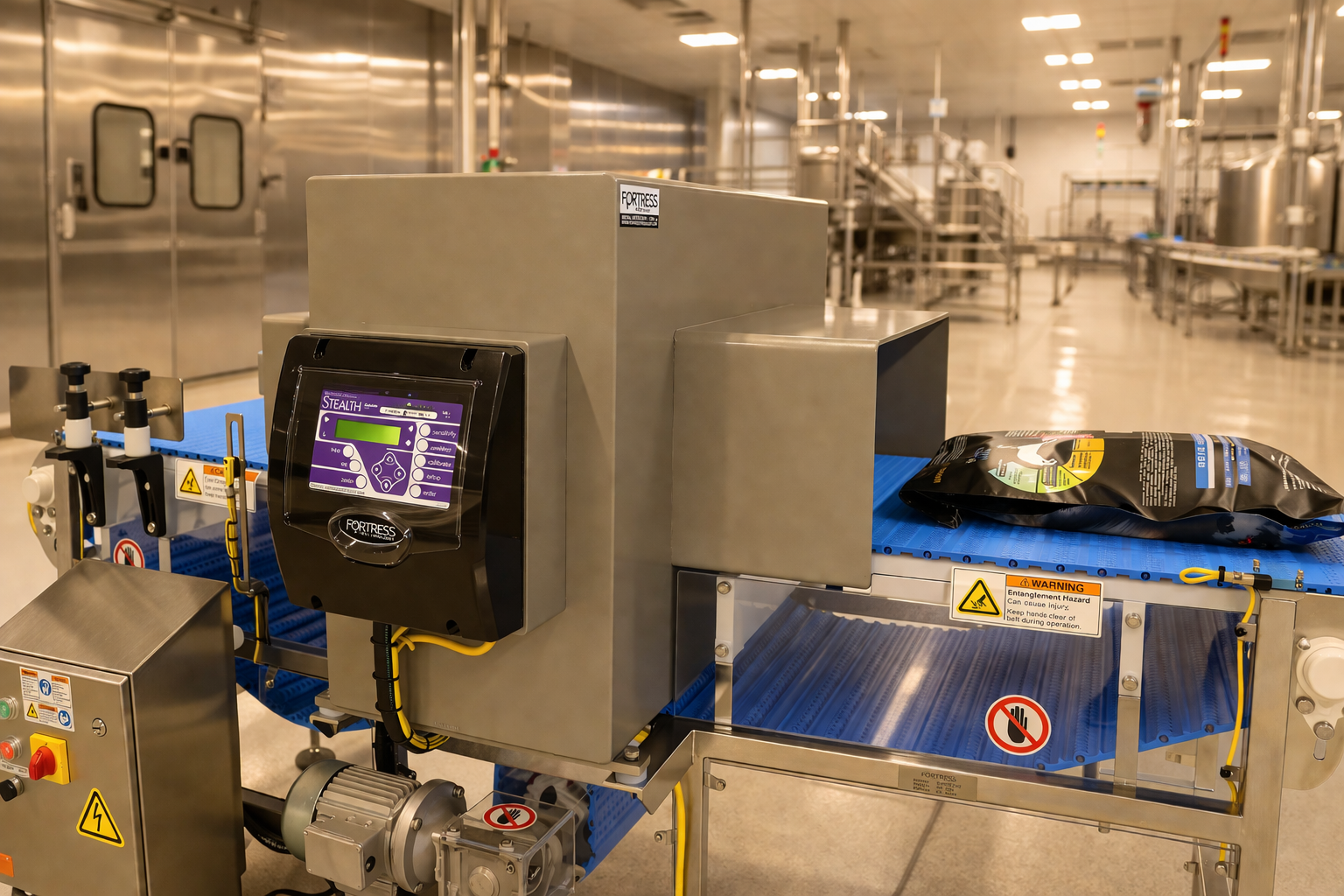
A standalone Stealth metal detector will represent the more conventional end-of-line configuration. Fortress builds these systems around specific line heights, widths, apertures, and reject arrangements, allowing them to be inserted into existing packaging lines without requiring the surrounding equipment to be replaced. That remains relevant where a plant needs to upgrade a critical control point but cannot justify rebuilding an entire line around a new combination machine.
The gravity detector addresses inspection further upstream. Designed for free-falling powders, grains, and bulk materials, the system can be installed between chutes and hoppers and configured for restricted spaces. Fortress also offers hazardous-location configurations, while its gravity systems can be paired with automatic testing where manual access to the detector aperture is awkward or disruptive.
Automatic verification will be another part of the PPMA demonstration. Fortress says all four machines can be supplied with its Halo Automatic Testing system, which reproduces the signal disturbance associated with ferrous, non-ferrous, and stainless-steel test samples. The objective is to reduce the frequency of manual test-piece passes while retaining a documented check of detector and reject performance.
For plants operating multiple metal detectors, that can have a measurable effect on routine quality-control workload. Manual verification interrupts production, requires operators to recover test pieces correctly, and creates additional records that have to be maintained for audits. Automated testing does not remove the need for a defined verification programme, but it can make repeated checks more consistent and reduce the time spent stopping lines solely to challenge the detector.
Contact 4.0 provides the data layer across the demonstration. The web-based system collects live events, status information, performance checks, and reports from connected Fortress metal detectors and checkweighers, allowing quality teams to view several inspection points through one interface rather than exporting records from individual machines.
The value of that connectivity depends on the quality of the underlying data and the discipline around alarms, user access, and reporting. Linking inspection machines can shorten the time needed to identify recurring rejects or failed checks, but it also makes configuration and data governance part of the food-safety system. A central dashboard is useful only if each connected detector is correctly set, tested, and maintained.
PPMA therefore gives Fortress a UK showcase for a broader inspection architecture rather than a single new machine. The Raptor Tritek brings three functions into one compact frame, the Big Bag system addresses heavier packs, the Stealth and gravity units cover different line positions, and Halo and Contact 4.0 connect verification and reporting across the group. The practical question for manufacturers will be how much of that integration can be adopted without adding unnecessary complexity to existing production lines.