IN Brief:
- Farmsort.one uses two or three IDS USB3 Vision cameras across a 1.5-metre inspection section.
- The system sorts washed and unwashed potatoes into up to five grades at a maximum throughput of two tonnes per hour.
- IDS reports practical throughput of 1.4–1.7 tonnes per hour, with 73% of users eliminating manual re-sorting.
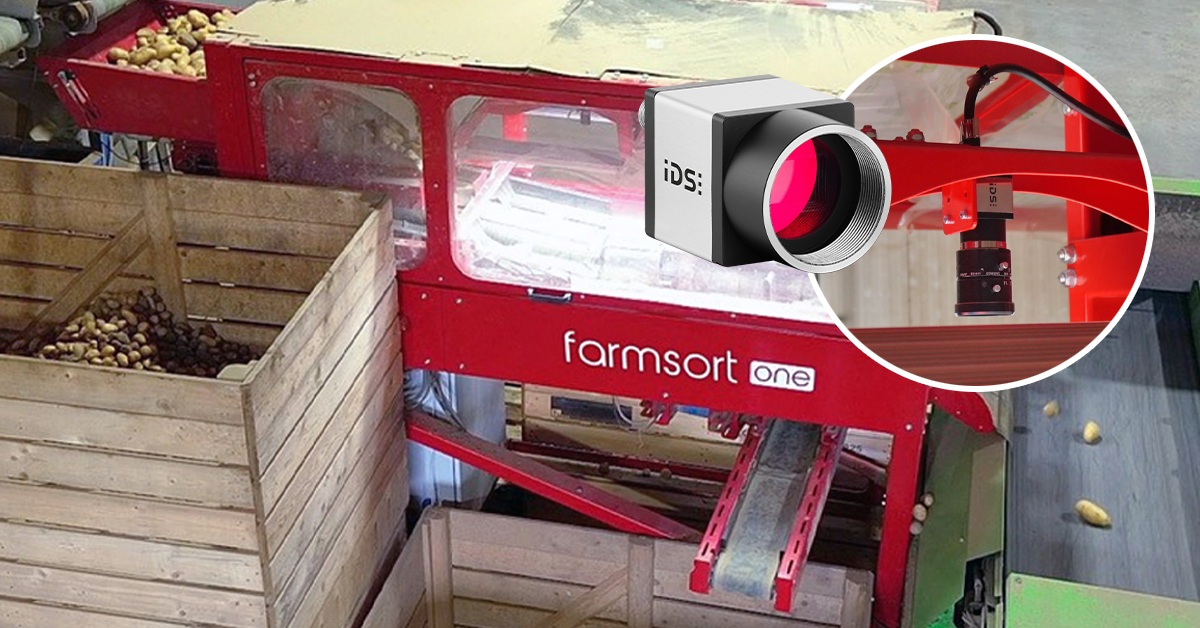
IDS Imaging Development Systems is supplying the industrial cameras used by Farmsort.one, a compact optical potato sorting system designed to classify produce by both size and quality during a single pass. Developed by schmiede.one within the Grimme Group, the machine combines repeated optical inspection with controlled electric conveying and can divide washed or unwashed potatoes into as many as five grades.
The inspection takes place across a 1.5-metre section rather than at one isolated imaging point. Depending on the system configuration, two or three IDS U3-3270CP Rev. 2.2 USB 3.0 Vision cameras capture potatoes several times from different positions as the crop moves through the machine.
That repeated view is intended to reduce dependence on every individual tuber presenting an ideal face towards one camera. Potatoes can arrive with irregular shapes, soil, surface defects, or foreign objects mixed into the stream, so the sorter combines multiple observations with controlled product movement rather than expecting free rotation to expose every relevant surface.
Jan Kiwitt, Project Manager at schmiede.one, said the development team wanted “a controlled inspection over a defined distance” rather than the spot assessment used by some conventional systems. The mechanical and vision architecture are consequently designed together, with the conveyor keeping product movement predictable while the cameras build enough visual information for classification.
One camera can classify objects and identify foreign material such as stones alongside defects including wireworm holes. A second camera tracks individual potatoes through the conveyor path, working with a rotary encoder so that the control system knows where each classified object is when it reaches the relevant sorting outlet.
That tracking stage is critical. Detecting a defect in an image is of little practical value if the machine cannot associate the classification with the correct potato several moments later. Encoder-based position data provide the connection between visual inspection and the mechanical action that separates the product.
The system can produce up to five grades rather than relying on a simple accept-or-reject decision. In one typical arrangement, defective potatoes leave through the first outlet, oversized product through another, while Grade A potatoes remain in the main stream. Additional outlets can be configured where growers need more detailed commercial grading.
Maximum throughput is stated at two tonnes per hour. IDS says practical installations frequently operate at around 1.4–1.7 tonnes per hour while maintaining sorting accuracy, which gives a more useful indication of normal farm conditions than the headline maximum alone.
The mechanical transport system is fully electric and conveyor based. Rather than using pneumatic ejection as the principal means of handling the crop, Farmsort.one guides potatoes through the process on a controlled track, an arrangement intended to improve positioning while reducing wear and energy consumption.
Stable handling becomes more important with unwashed crop. Soil, plant residue, stones, and variations in harvested material can make optical sorting less predictable if objects move freely or obscure one another, while a guided conveyor creates a more repeatable relationship between the product, lighting, cameras, and sorting outlets.
The system uses IDS peak SDK for camera integration and parameterisation. Camera mounting, focus, exposure, and consistent settings all influence the reliability of machine vision, particularly on equipment expected to operate for long periods during seasonal production rather than in a controlled laboratory environment.
Jürgen Hejna, Product Manager for 2D Machine Vision at IDS, has emphasised reliable interfaces, long-term hardware availability, and reproducible camera settings as central requirements for this type of embedded inspection. A farm sorter that stops during a short harvest or grading window creates a very different operating problem from a demonstration system that can simply be restarted later.
Labour availability is one of the commercial drivers. Manual grading can require several operators to inspect product continuously, and performance can vary with fatigue, lighting, crop condition, and individual judgement. IDS says up to 73% of Farmsort.one users have eliminated manual re-sorting entirely after installation.
That figure does not mean every farm can dispense with manual inspection. Crop varieties, defect types, customer specifications, and harvest conditions vary, and automated classification still has to be configured around the quality standard the grower wants to achieve.
The modular architecture gives users scope to expand those requirements. Farms can begin with a smaller configuration before adding cameras or sorting outlets, while the controls support 24 V signals and FlowControl. Optional remote monitoring allows parameters to be reviewed and adjusted away from the machine.
More than 50 farms are already using Farmsort.one, according to IDS. That installed base gives the technology a useful operating reference beyond prototype testing, although long-term comparisons of maintenance, accuracy, crop losses, and labour savings will determine how broadly the approach transfers between different potato operations.
Development work is also looking beyond standard visible-light imaging. Monocular depth analysis and multispectral inspection in the near-infrared and short-wave infrared ranges are being investigated as possible routes to recognising additional characteristics that conventional colour cameras cannot reliably identify.
Those methods remain future development areas rather than standard capability on every current machine. The present system already combines several technologies more commonly associated with industrial inspection lines — machine vision, encoder tracking, programmable classification, and controlled conveying — in equipment sized for professional and family-run farms.
The attraction is straightforward: a potato only creates full value if the sorter can identify its commercial grade accurately without adding an expensive second inspection step. Farmsort.one puts the cameras, tracking, and mechanical separation into one line; its longer-term performance will depend on keeping those three elements aligned as crop conditions change from season to season.