IN Brief:
- BoMill and T H WHITE Installation will pursue UK milling, malting, grain storage and terminal projects.
- BoMill InSight uses near infrared transmission spectroscopy to analyse individual kernels internally.
- The partnership follows commissioning of BoMill’s first UK installation.
BoMill has formed a UK collaboration with T H WHITE Installation to combine individual kernel analysis with engineering, installation and commissioning for flour mills, maltings, grain stores and terminals.
BoMill supplies the InSight sorting platform, while T H WHITE will support the surrounding grain handling project from design through to installation and aftermarket service. The arrangement follows commissioning of BoMill’s first UK installation.
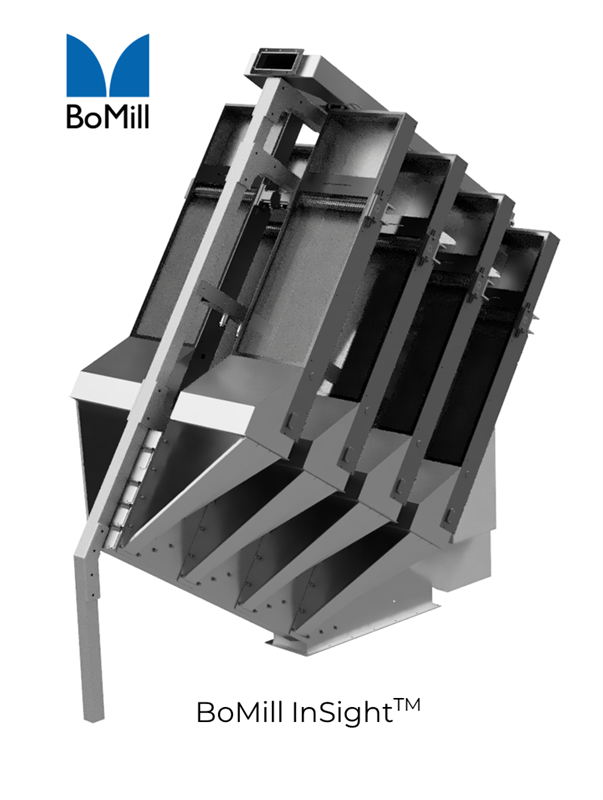
InSight analyses kernels using near infrared transmission spectroscopy. Light passes through each grain and the resulting spectrum is assessed against calibrated models before the machine directs the kernel into one of two output fractions.
Internal measurement allows the sorter to work on characteristics that cannot be identified reliably from the surface alone. Protein content is one example, giving processors the option to separate grain with different internal quality even where kernels appear similar to a conventional camera system.
Optical sorters usually inspect reflected light to identify colour, shape, foreign material and visible defects. Near infrared transmission adds a different measurement layer, so the technologies can be used for separate purposes within the same grain preparation process rather than competing for exactly the same task.
A wheat lot may meet an average specification while containing substantial variation between individual kernels. Sorting part of that intake by protein can create fractions suited to different milling or product requirements instead of accepting the average value of the whole load.
The commercial return depends on how much useful variation exists. A uniform intake provides little opportunity to create higher value fractions, while a variable batch may contain enough grain above or below a target specification to justify the extra handling and sorting cost.
BoMill offers different InSight configurations according to throughput. Its compact InSight Single handles approximately two tonnes an hour, while modular systems extend to substantially higher capacities. The company has also developed higher throughput configurations for bulk grain environments.
The sorter cannot deliver its rated capacity if the surrounding plant feeds it inconsistently or cannot remove the separated fractions quickly enough. Elevators, conveyors, bins and controls therefore have to be sized around the selected machine and the number of product streams being created.
T H WHITE’s role covers those interfaces. A retrofit may require changes to grain routes, structural steelwork, electrical infrastructure, aspiration, controls and storage allocation before the sorter can be incorporated into an existing site without creating new bottlenecks.
Separating two quality fractions also changes downstream storage. Each output needs an available route and destination, while controls have to prevent grain from different grades being mixed again before milling, malting or dispatch.
Calibration adds another operating requirement. Near infrared models have to remain appropriate to the crop and quality characteristic being measured, while grain must pass through the sensing zone consistently enough for each spectrum to be interpreted before the mechanical separation stage acts.
Harvest variation means those conditions will not remain identical through the year. Moisture, protein distribution, variety and growing conditions can alter the composition of incoming loads, so processors may need to adjust sorting priorities or calibration as the raw material changes.
The technology is therefore most useful where separation leads to a defined downstream decision. Removing lower protein kernels from a premium fraction, recovering higher value grain from a mixed intake or protecting a tightly controlled malting specification can create a measurable benefit, while sorting without a clear use for both outputs simply adds another process stage.
BoMill’s first UK installation gives the partnership a domestic reference from which to develop further projects. Neither company has disclosed the customer or operating configuration, leaving future installations to be designed around the throughput and quality requirements of each site.
The collaboration places analytical sorting inside a wider plant engineering offer rather than treating it as a standalone machine sale. Its success will depend on whether the quality information generated at kernel level can be translated into useful product fractions without slowing the grain handling system around it.