IN Brief:
- Dudley Pallet has agreed to pay £25,000 to settle the latest proceedings with Bakers Basco.
- Bakers Basco says GPS data linked bakery equipment to an Anne Road site in Smethwick.
- The disputed conduct was resolved through settlement rather than determined at trial.
Bakers Basco has reached a £25,000 settlement with Dudley Pallet Ltd, concluding the latest legal proceedings involving reusable bakery equipment and an industrial site on Anne Road in Smethwick.
The proceedings followed earlier action that resulted in a court order in 2021 concerning possession or processing of Bakers Basco equipment at the site. Bakers Basco later alleged that activity covered by those restrictions had resumed, leading to further legal action.
The £25,000 payment resolves the latest proceedings without a trial determining the new allegations. Claims about the movement, possession or destruction of equipment therefore remain Bakers Basco’s allegations rather than findings made by a court.
Bakers Basco says its investigations team used GPS trackers hidden within selected Omega bread baskets alongside surveillance and site visits. Tracking data indicated that some equipment moved from retailers including Iceland, The Food Warehouse and Farmfoods to the Anne Road premises.
The company also says some trackers stopped transmitting after reaching the site and that a visit supported by police recovered dismantled bakery equipment and plastic chippings consistent with its baskets. Those claims formed part of the dispute resolved by the settlement.
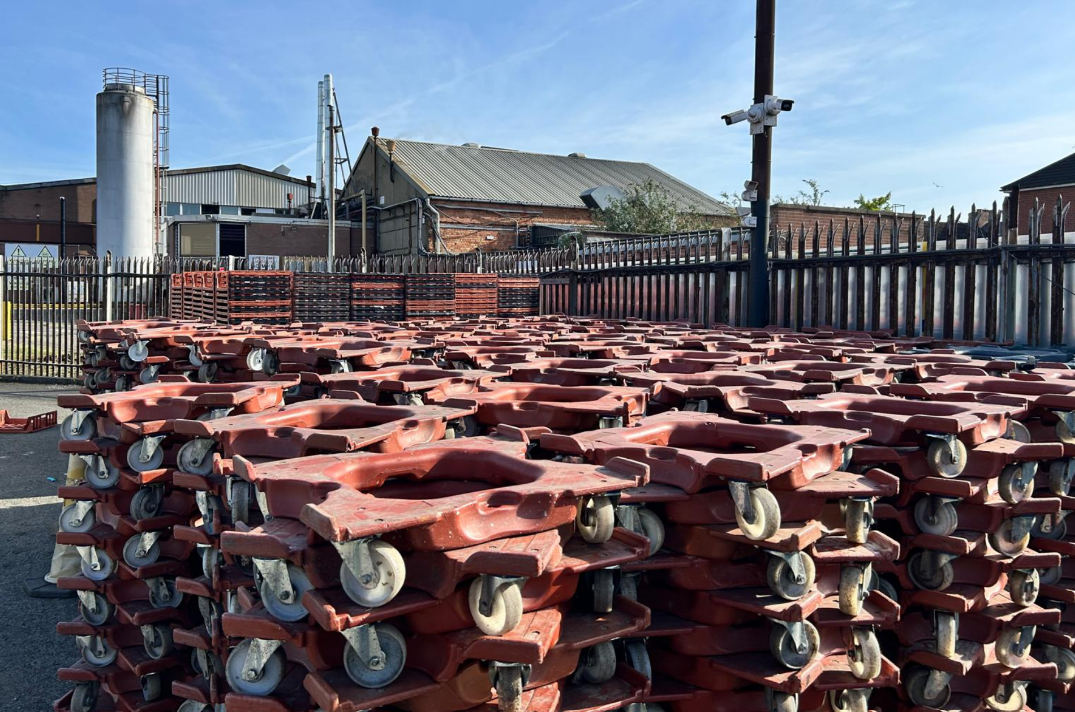
Omega baskets and wheeled dollies operate as a pooled transport system used to move wrapped bread between bakeries, distribution operations and retailers. The assets are intended to complete repeated delivery cycles before returning to the pool for reuse.
Bakers Basco says it now manages more than five million Omega baskets and 500,000 dollies on behalf of its bakery members. The size of the pool means even a relatively small loss rate can create substantial replacement demand when multiplied across millions of movements.
A missing basket creates an operational problem before it becomes a legal one. Equipment outside the authorised circulation route is unavailable for subsequent bakery deliveries, so additional assets may be needed even if the original basket remains physically usable somewhere else.
GPS tracking allows a sample of equipment to be followed through the network. Trackers are installed discreetly inside selected assets, producing location data that can reveal unexpected routes, repeated destinations or extended periods away from normal bakery and retail circulation.
The data identifies where an asset travels but does not establish by itself why it reached a location or what happened afterwards. Bakers Basco combines tracking with physical investigation, recovery work and legal action where it believes further evidence supports intervention.
The same location information can reveal ordinary logistics problems. Delayed collections and equipment accumulating at legitimate customer sites also reduce circulation speed, so tracking supports management of the pool as well as investigations into unauthorised possession.
Earlier recovery work on the Isle of Man and Isle of Wight returned 342 baskets and dollies to circulation, showing how equipment can collect outside routine routes even across comparatively small geographic areas. Similar investigations elsewhere have involved higher tracker deployment where Bakers Basco has identified repeated losses.
The Smethwick case involved the additional complication of an earlier legal agreement. Bakers Basco says evidence gathered from August 2025 onwards led it to believe activity had restarted despite the restrictions already in place.
Wilkin Chapman Rollits advised Bakers Basco during the latest proceedings. The settlement closes the dispute between the parties without requiring the court to determine every allegation advanced during the case.
Reusable transport equipment derives much of its value from service life. A basket that completes hundreds of delivery cycles spreads the material and manufacturing cost across repeated uses, while one removed early from circulation has to be replaced before the end of that intended life.
Physical destruction creates the same problem more directly. Once a reusable basket has been dismantled or reduced to plastic material, its remaining service life disappears and another unit has to take its place in the pool.
The £25,000 settlement ends the latest Dudley Pallet proceedings, while Bakers Basco’s tracking and recovery operation continues across the wider bakery network. Maintaining the pool depends on keeping millions of reusable assets moving through their intended delivery routes quickly enough to be available for the next production cycle.