IN Brief:
- EvoDECO Next supports partial labels that reduce label surface area by up to 75% in Sidel's illustrated 90-degree configuration.
- The platform combines Cutter 2.0, Smart Buffer, Smart Camera and redesigned changeover components for high-speed beverage production.
- Sidel models potential annual savings of 208.4 tonnes of BOPP film and approximately €723,000 in material costs for a specified production scenario.
Sidel has introduced EvoDECO Next, a roll-fed labelling system that applies partial labels to PET beverage bottles, reducing packaging material consumption while retaining the cutting, transfer and production control capabilities required for high-volume bottling.
Announced on 14 October 2026, the platform combines a redesigned rotary cutter, film buffer, camera system and dedicated changeover components. It extends conventional roll-fed labelling beyond wraparound decoration, allowing smaller sections of film to be applied while leaving more of the bottle visible.
Roll-fed labelling normally involves unwinding a continuous film, cutting individual labels and transferring them onto containers moving through the machine. Wraparound labels cover most or all of the bottle circumference, with hot-melt adhesive securing the film to the container.
Partial labels change the dimensions and handling characteristics of the material passing through this process. A shorter label must be cut and transferred accurately without losing synchronisation with the container, while the adhesive application and control systems must accommodate a smaller area of film.
EvoDECO Next addresses these requirements through an integrated architecture rather than a conventional labeller modified solely to accept shorter labels. Sidel has brought film feeding, cutting, transfer and control into a coordinated design intended to maintain consistent handling at industrial production speeds.
The manufacturer says a 180-degree partial label reduces surface area by 50% compared with a conventional wraparound format, while its illustrated 90-degree configuration achieves a reduction of up to 75%. Actual material consumption depends on container dimensions, the chosen label design and the information that must remain on the pack.
Sidel has also published a modelled production example based on a line operating at approximately 61,000 bottles per hour and producing 459 million bottles annually. In this scenario, label surface area falls from 20,160mm² to 5,040mm² per bottle.
Using the manufacturer’s assumptions, the change would save 208.4 tonnes of biaxially oriented polypropylene film annually, reduce associated carbon dioxide emissions by approximately 346 tonnes and generate €723,000 in raw material savings. These figures are calculated estimates rather than verified results from an identified customer installation.
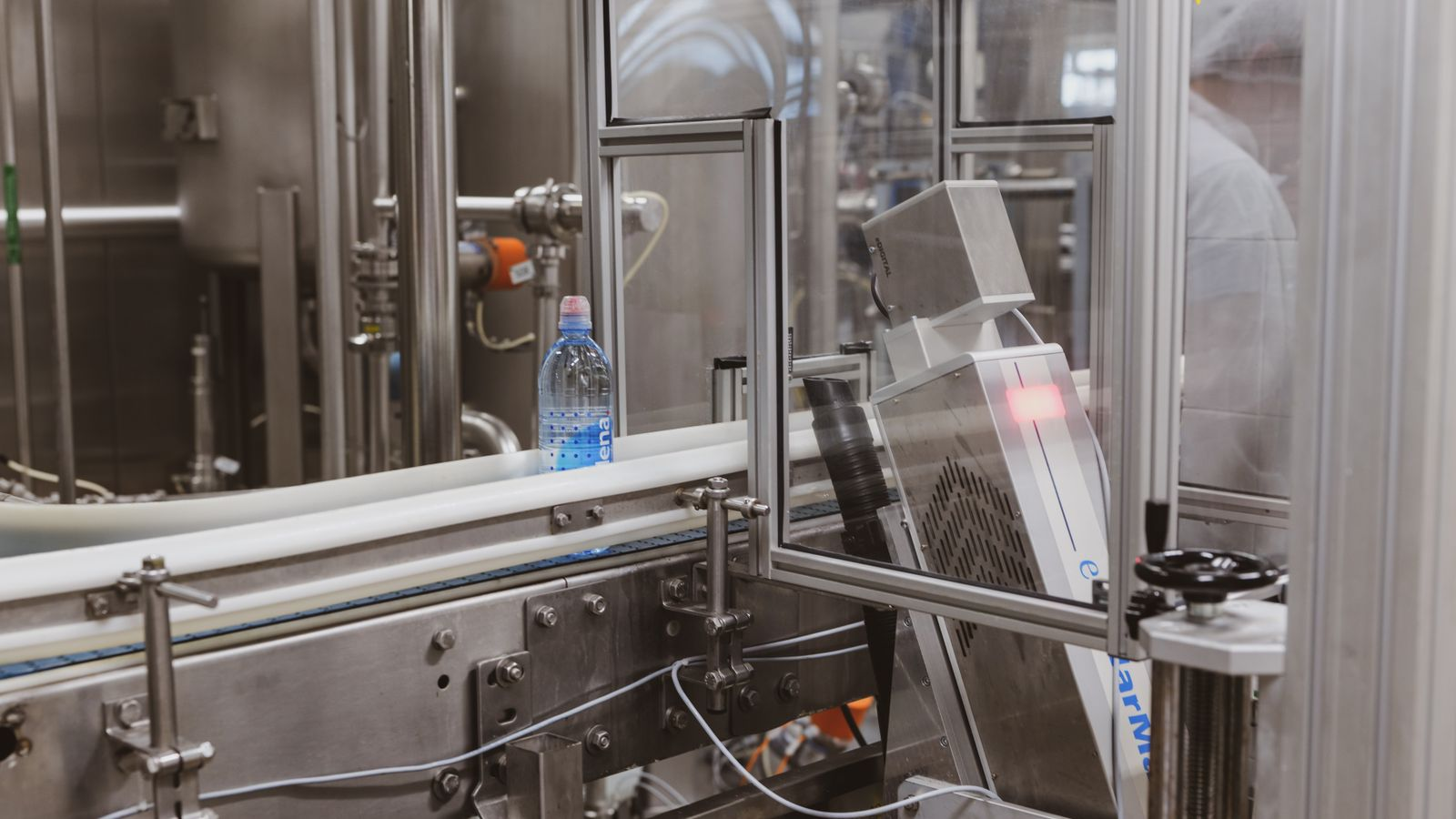
The reduction in film consumption requires machinery capable of repeatedly processing the shorter label format. EvoDECO Next uses Cutter 2.0, a rotary cutting mechanism positioned directly on the transfer drum. Its two-blade arrangement is designed to handle shorter label sections while maintaining the timing needed for accurate placement.
Locating the cutting mechanism within the transfer assembly reduces the separation between cutting and handling operations. The label must reach the bottle at the correct moment, with its position and orientation controlled throughout the transfer sequence.
Errors in this relationship can produce misplaced decoration, rejected containers or interruptions while the machine is adjusted. The challenge becomes particularly demanding as cutting frequency increases, since each label passes through the transfer operation within a shorter period.
Film supply introduces another source of potential interruption. When a reel approaches its end, the machine must maintain material delivery while a replacement reel is joined to the existing film. Any mismatch between incoming film supply and material consumption can affect the labeller’s ability to maintain production.
Sidel’s Smart Buffer is designed to accommodate this process without changing nominal line speed during a reel splice. The company says the buffer uses the standard film path and requires no additional machine footprint, reducing the need to allocate further space around the labelling station.
Accurate print registration remains necessary because labels must be cut in the correct position relative to the artwork. Conventional systems can use printed reference marks and reserved areas of film to establish that position, but these become less attractive when the available label surface is substantially reduced.
The Smart Camera system supports label management without conventional reference marks or associated clear zones. Its software provides automatic correction, homing and diagnostic functions, allowing the machine to control cutting and positioning while freeing more of the film for printed information or decoration.
Removing the reference marks does not eliminate the requirement for reliable detection and positioning. Film movement, printing consistency and the relationship between the cutter and transfer drum still influence whether the finished label is applied correctly.
Additional changes concern glue application and mechanical contact with the film. Sidel has redesigned sliding surfaces and introduced an air-blade arrangement intended to reduce adhesive contamination and stress on the label during handling.
Adhesive deposits can increase cleaning requirements and interfere with the movement of thin packaging materials. Mechanical stress can also cause deformation or inconsistent transfer, particularly where shorter labels provide less material for the handling system to control.
Sidel says the redesigned components can extend machine autonomy by up to five times under its specified conditions. The announcement does not establish a universal reduction in downtime, since maintenance intervals and interruptions will depend on the machine configuration, materials and production environment.
The platform can also be combined with CoboREEL automated reel management, providing integrated traceability and automated handling of up to 18 reels. The arrangement is intended to reduce operator intervention associated with supplying label material, although available running time will depend on reel dimensions and consumption.
Partial decoration affects other aspects of beverage packaging operations. Mandatory information, barcodes and product identification must still be accommodated on the finished container, potentially requiring artwork changes or a different allocation of printed information.
Inspection equipment must also be configured to recognise the intended decoration pattern. Systems designed to detect missing wraparound labels may require revised inspection settings so that deliberately exposed PET is not mistaken for an application fault.
The environmental performance of the completed package depends on more than the quantity of label film used. Adhesive characteristics, label material, bottle composition and the behaviour of the components during sorting and recycling all influence the outcome. Reducing film area does not independently establish that the entire package is recyclable.
EvoDECO Next introduces a new material-saving option within Sidel’s existing beverage labelling portfolio. Its operational value will depend on the ability to maintain cutting accuracy, adhesive application, print registration and equipment availability while processing smaller labels at the speeds required by individual bottling plants.