IN Brief:
- Ingredion's starch-based barrier technology has been combined with UPM paper and Paramelt's functional heat-seal coatings.
- The partners evaluated UPM Solide Lucent 78 gsm and UPM Asendo 65 gsm substrates for food packaging applications.
- A Solide Lucent prototype passed Part 1 recyclability testing at Western Michigan University; complete commercial qualification remains outstanding.
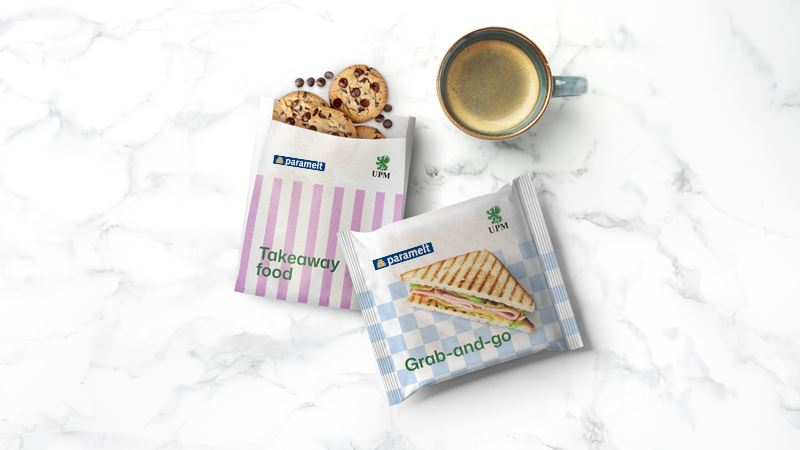
UPM, Ingredion and Paramelt have developed a coated paper structure for food packaging that combines a starch-based grease barrier with heat-sealing functionality. The collaboration brings together UPM’s speciality papers, Ingredion’s plant-based coating technology and Paramelt’s functional coatings, with an initial recyclability test completed on one of the resulting constructions.
The partners have evaluated materials based on UPM Solide Lucent 78 gsm and UPM Asendo 65 gsm papers. Their work addresses applications in which a fibre-based package must resist grease while maintaining the ability to form a reliable seal. A prototype using Solide Lucent has passed Part 1 recyclability testing at Western Michigan University, although the companies have not published complete results for every material under evaluation.
Paper is an established packaging substrate, but its untreated fibre structure does not necessarily provide the protection required for foods containing fats and oils. Grease can penetrate through pores and around fibres, leaving visible marks or compromising the intended barrier. The required degree of protection varies with the food, its temperature, contact time and the way the package is handled.
Ingredion’s contribution is a starch-based barrier formulation intended to improve resistance to grease. Starches are widely used in food manufacture, but their chemistry and processing characteristics also allow them to serve industrial functions, including surface treatment and coating. In the new construction, the starch-derived material belongs to the packaging structure rather than the food formulation.
Applying a barrier to paper involves controlling the properties of both the coating and the substrate. A porous sheet can absorb liquid coating unevenly, making surface preparation and the quantity applied important factors. The coating must create sufficient protection without introducing excessive material, unwanted changes to flexibility or difficulties during subsequent converting operations.
Paramelt contributes heat-seal technology alongside its wider experience of functional barrier coatings. The ability to form a seal is distinct from resistance to grease: a coating may limit oil penetration without allowing two packaging surfaces to bond under the temperatures and pressures available on a production line. Combining the functions allows converters to investigate a coated paper structure suitable for filling and sealing operations.
Heat-seal performance depends on the full material construction and the equipment being used. Temperature, contact pressure and dwell time influence how a seal forms, while the paper’s thickness, surface properties and coating distribution affect the resulting bond. Insufficient sealing can compromise pack integrity; excessive heat or pressure may damage the material or cause difficulties in processing.
The partners have not disclosed coating weights, minimum sealing temperatures or comparative seal-strength data for the latest prototypes. Those measurements would be needed before a converter could determine whether the material operates within the conditions available on a particular machine. The successful combination of the component technologies establishes a development result, not a universal specification for all food packaging equipment.
The choice of UPM substrate also influences the structure. Solide Lucent and Asendo are speciality papers developed for packaging and converting applications, and the two grades assessed in the collaboration have different stated basis weights. Their finished performance cannot be inferred from weight alone because barrier behaviour also depends on surface characteristics, coating formulation and the way the structure is converted.
Recyclability is another property that must be assessed at the level of the completed material. Coatings can affect the release and recovery of fibres during repulping, while residual non-fibre substances may create processing or product-quality problems. A material that contains predominantly paper is therefore not necessarily compatible with every recycling facility or collection stream.
The prototype based on Solide Lucent 78 gsm passed Part 1 recyclability testing at Western Michigan University. This provides an identified assessment result for that structure but should not be represented as a blanket certification for all versions of the technology. The companies have not supplied the complete test report, including results for every proposed coating combination or finished packaging configuration.
Additional components may also affect the outcome. Printing inks, adhesives, closures and other packaging materials can change how a finished pack behaves during recycling. A converter adopting the technology would need to evaluate the actual configuration supplied to the food producer, rather than assuming that the assessment of a preliminary sample applies automatically to a different completed package.
The October programme extends work that UPM and Paramelt were already undertaking earlier in 2026. Their previous collaboration combined UPM barrier base papers with Paramelt’s Aquavate Bio SB 2383 coating for bakery, convenience food and other applications requiring grease resistance. That concept was designed for compatibility with existing converting and packaging systems, including vertical form-fill-seal equipment.
Ingredion’s involvement adds a separate starch-based barrier approach and a new combination of material technologies. The current result is therefore distinct from simply repeating the earlier UPM and Paramelt concept. It examines how the paper, grease-protection layer and heat-seal coating can be combined, while subjecting one resulting structure to recyclability assessment.
Food-contact compliance is a further requirement before widespread commercial use. Materials intended to contact food must be evaluated against applicable rules and their expected conditions of use, taking account of the complete material structure. A plant-derived coating does not automatically satisfy those requirements, and the partners have not announced a universal approval covering every food category or processing condition.
Samples of the developed materials are being displayed at PACK EXPO International in Chicago from 18 to 21 October. The partners have not identified a commercial food producer using the new structure or supplied a timetable for its introduction into volume packaging production.
Further testing will determine whether the required grease resistance, seal performance and fibre recovery can be maintained when the material is converted into finished packaging at commercial operating speeds. The completed Part 1 assessment is an important measurement within that development process, while the wider qualification of the new coated paper structures remains to be established.