IN Brief:
- The new two-colour closure is made from polypropylene using a bi-injection manufacturing process.
- An integrated valve regulates sauce flow across a range of Choví products.
- Amcor manufactures the component in Spain for the long-standing Spanish sauce customer.
Amcor has developed a bespoke flip-top closure for Spanish sauce producer Choví, combining a polypropylene body with an integrated flow-control valve and local production in Spain.
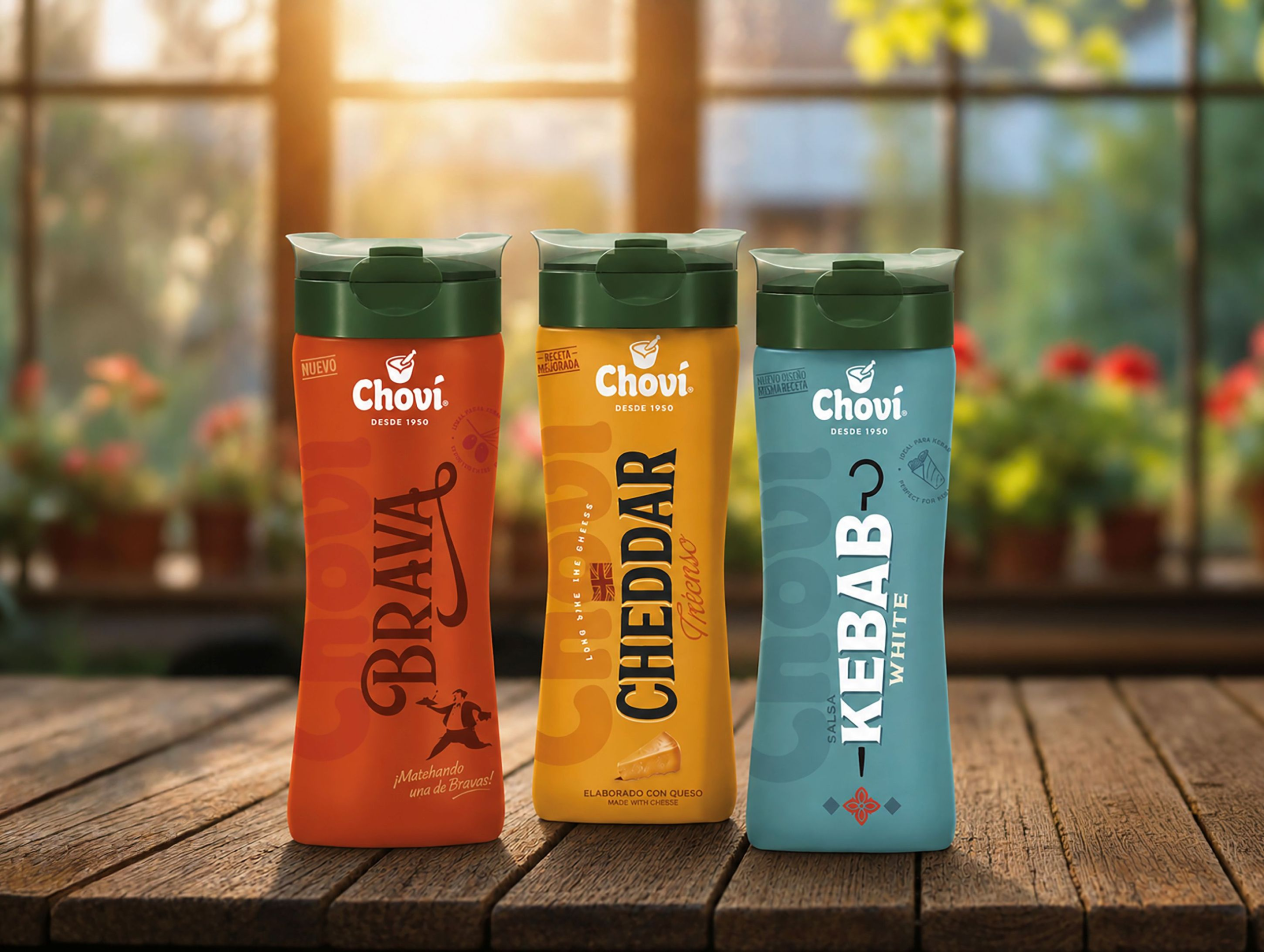
The closure is being used across a range of Choví sauces for salads, barbecues, and snacks. Products include Allioli, La Brava, Cheddar, Kebab White, Ajonesa, Barbacoa, Ketchup, César, Yogur, and Miel y Mostaza.
Amcor produces the two-colour component using a bi-injection process. The main closure is made from polypropylene, while the valve is designed to regulate the way sauce leaves the bottle rather than allowing the product to discharge unrestricted when the pack is inverted or squeezed.
The curved closure geometry also changes the appearance of the pack, although its production role extends beyond shelf presentation. Caps and closures have to feed consistently into capping equipment, locate correctly on the container, apply at controlled torque, and retain seal performance through transport and repeated use.
Those requirements become more demanding when one closure is used across products with different viscosities. A relatively fluid sauce and a thick allioli do not necessarily behave in the same way through the same dispensing aperture, particularly at different temperatures or after storage.
Controlling flow through the valve gives the packaging system another variable with which to manage that difference. The objective is a predictable dose without requiring the consumer to adapt significantly between products in the same range.
Choví has worked with Amcor previously and selected the packaging supplier for the new project partly because of its closure expertise and Spanish manufacturing operation. Keeping development and production within the same market can shorten the practical loop between samples, line trials, dimensional changes, and final approval.
Packaging development commonly requires repeated physical testing before a component is released. A closure may meet the drawing specification while still creating problems during feeding, application, sealing, transport, or consumer use, so commercial qualification normally depends on how the complete pack behaves rather than on moulded dimensions alone.
Bi-injection production also has to remain stable at industrial scale. Colour boundaries, component geometry, moulding conditions, cycle time, and dimensional control have to be repeated over large production runs without introducing defects that later affect the capping line.
A sauce producer will be particularly sensitive to variation around the neck and sealing surfaces. Small dimensional changes can alter application torque, closure retention, or leak performance, while an inconsistent dispensing valve can create a visibly different consumer experience from one bottle to another.
Amcor’s local manufacturing base gives the project a comparatively short connection between packaging production and the Spanish customer. That can simplify technical support and replenishment, although location alone does not determine reliability; tooling condition, process control, resin consistency, inspection, and supply planning remain central to commercial performance.
The closure also illustrates the amount of engineering concentrated in a relatively inexpensive packaging component. Bottles receive most of the attention in primary-pack design, but the closure frequently controls opening force, reclose performance, dispensing, leak resistance, cleanliness after use, and a substantial part of the consumer’s physical interaction with the product.
For the filling plant, the closure becomes part of line efficiency. A design that feeds poorly or requires slower capping speeds can offset improvements elsewhere in the package, while a robust component that runs reliably can reduce minor stoppages and adjustment.
The breadth of the Choví range creates another production consideration because the closure has to operate across several product variants while maintaining a common packaging identity. Standardising the closure can reduce component complexity compared with using separate cap designs for individual sauces, provided the valve performs consistently with each formulation.
Product viscosity, bottle squeeze characteristics, fill temperature, headspace, and storage conditions can all affect dispensing behaviour. Qualification therefore has to extend beyond the closure itself to the interaction between sauce, bottle, valve, and consumer use.
Amcor describes the project as a collaborative development rather than the supply of a standard catalogue component. That distinction is visible in the combination of the shape, colour treatment, valve, and manufacturing process selected for Choví’s existing range.
The resulting pack is unlikely to alter the economics of a sauce plant on its own, but closures are precisely the kind of high-volume component where small improvements or recurring problems accumulate quickly. Reliable feeding, sealing, dispensing, and supply matter because every finished bottle depends on the same part performing correctly.