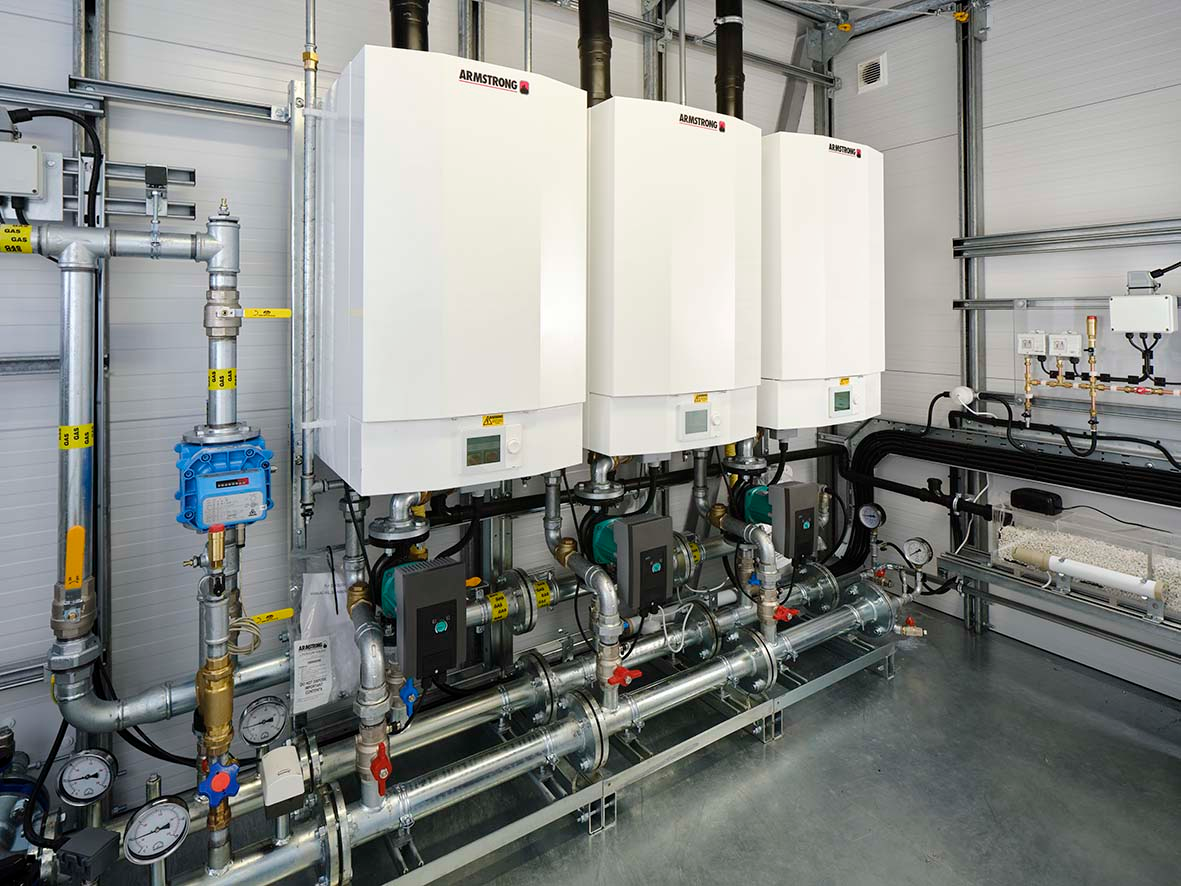
IN Brief:
- Armstrong offers wall hung and floor standing boilers for industrial heating duties.
- Multiple units can be combined with pumps, valves, controls and pressurisation equipment.
- The boilers provide 6:1 turndown and up to 98.2% gross efficiency when condensing.
Armstrong Industrial has added individual gas boilers to its industrial heating range, allowing units to operate independently or in modular systems that increase or reduce active capacity with process demand.
The boilers are available in wall hung and floor standing configurations. Armstrong can integrate multiple units with pumps, valves, pressurisation equipment, electrical systems and controls inside packaged plant rooms assembled and tested before delivery.
Food and beverage production is one of the industrial applications identified for the range, alongside manufacturing, pharmaceuticals, chemicals and water treatment. Hot water can support process heating, cleaning and other thermal duties whose demand changes as production and sanitation cycles start and stop.
A modular installation responds to that variation by sequencing several smaller boilers. Fewer units operate when demand is low, with additional boilers brought into service as the required heat load rises.
Redundancy can be built into the same arrangement where production cannot tolerate the complete loss of hot water. One boiler can be isolated for maintenance while other units continue supplying part or all of the required load, depending on how much spare capacity has been designed into the system.
Each boiler provides a 6:1 turndown ratio through a fully modulating burner. A unit can therefore reduce output substantially below its maximum firing rate before it has to switch off completely.
Reducing firing rate helps the boiler follow smaller changes in demand without repeatedly cycling between full operation and shutdown. Frequent cycling can waste energy during start and stop periods and adds thermal stress to equipment that would operate more steadily under modulation.
Armstrong quotes gross efficiency of up to 98.2% when the boiler is condensing. That operating condition depends on the temperature of water returning to the boiler, because water vapour in the combustion products must condense before its latent heat can be recovered.
High return temperatures reduce or eliminate that condensation, preventing the installation from reproducing its maximum efficiency even when the boiler itself carries the same rating. Heat exchanger selection, system flow and operating temperatures therefore determine how often the plant reaches its most efficient condition.
Sequencing also affects efficiency in a multi boiler system. Controls have to decide how many units should run and at what firing rate, avoiding situations in which several boilers remain active at unnecessarily low loads when fewer machines could meet demand more effectively.
Armstrong’s control system monitors performance and adjusts boiler output around the heat requirement. Remote diagnostics provide access to operating information and can support identification of faults before they interrupt production.
Factory assembly changes the installation programme as well as the equipment layout. Pipework, electrical components, controls and other parts of the boiler package can be assembled and tested away from the production site before the plant room is delivered for connection.
Existing food factories often have limited shutdown windows for work on utilities. Moving more fabrication away from the site reduces the amount of assembly that has to be completed around live production, although final connection and commissioning still have to prove performance against the customer’s actual heating circuit.
Later expansion is possible where the original system has been designed with sufficient spare capacity. Adding another boiler does not by itself increase usable output if gas supply, pumps, headers, flues, electrical infrastructure or controls cannot accommodate the additional load.
Designing that headroom from the start creates its own cost decision because oversized supporting infrastructure requires capital before the extra boiler capacity is needed. The modular approach therefore gives operators options over the timing of boiler investment without removing the need to plan the surrounding system.
Gas combustion continues to produce direct carbon emissions, so improved efficiency reduces fuel use rather than eliminating the source. The actual saving depends on the heat load, return temperature, sequencing and proportion of operating time spent in condensing conditions.
Armstrong’s new range extends that control from a single boiler to complete modular packages. The performance available from the equipment is defined by its 6:1 modulation and condensing capability, while plant design determines how much of that performance can be realised during day to day food production.