IN Brief:
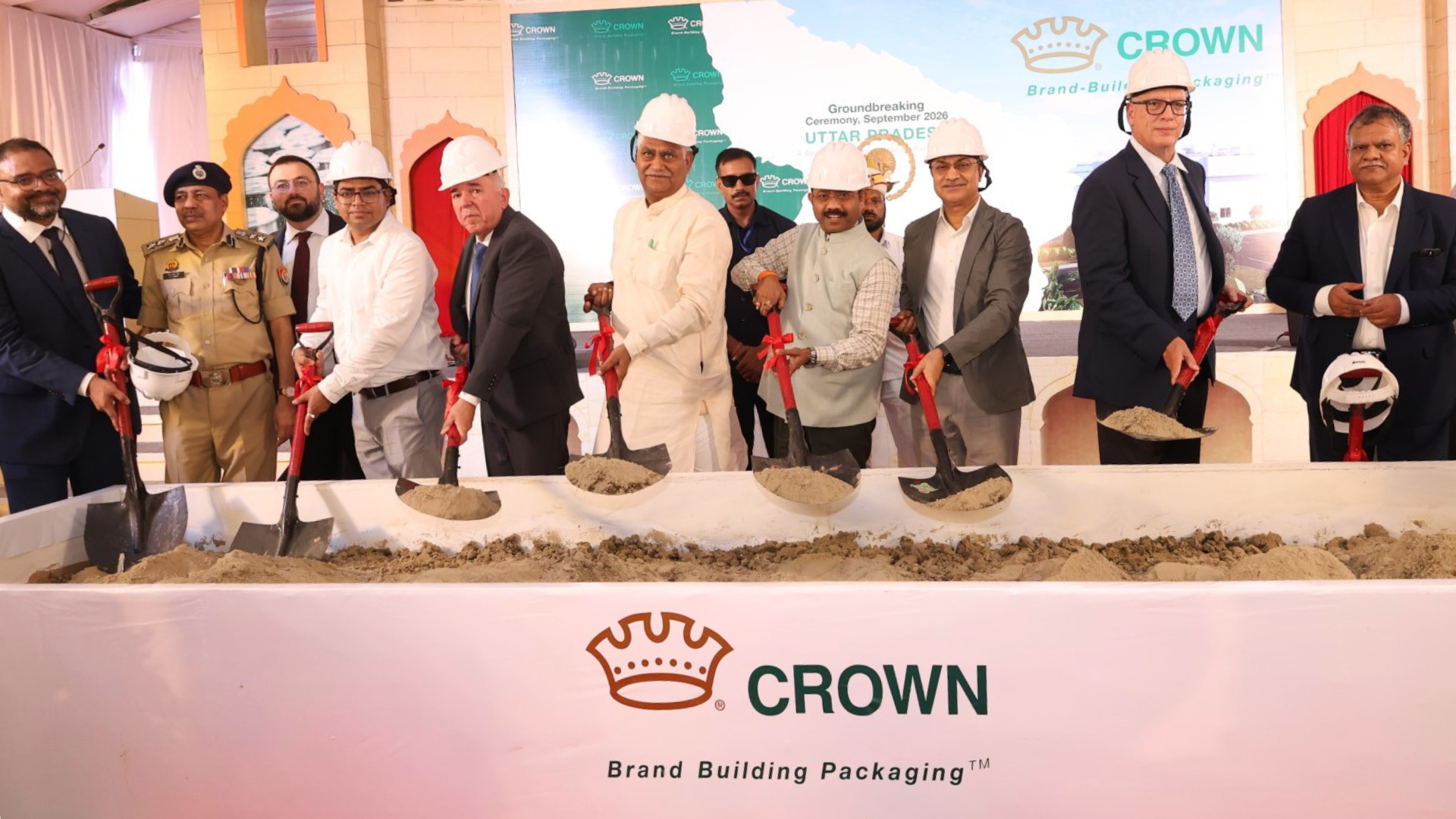
- Crown broke ground on its first Indian beverage-can factory in Unnao on 9 September.
- Two production lines are designed for approximately 2.2 billion aluminium cans annually.
- Commercial operation is scheduled to begin during the second half of 2027.
Crown Holdings has broken ground on its first beverage-can manufacturing facility in India, starting construction of a two-line plant in Unnao, Uttar Pradesh, with annual capacity of approximately 2.2 billion aluminium cans.
The company marked the start of construction on 9 September, following the project’s original announcement in April. Operations are scheduled to begin in the second half of 2027, giving Crown a defined commissioning window for its first Indian production base.
The plant is intended to serve both alcoholic and non-alcoholic beverage categories. Crown says it will incorporate advanced manufacturing technology, quality controls, and resource-management measures as the company builds a local operation around one of Asia’s faster-growing beverage markets.
A 2.2 billion-can annual design capacity places the facility firmly in high-volume industrial production. Beverage-can manufacturing links cup forming, drawing and ironing, trimming, washing, internal coating, curing, printing, necking, inspection, conveying, and palletising into a process where small reliability losses can remove millions of units from annual output.
Crown is entering India without an existing domestic canmaking plant, so the project involves more than installing production equipment. The company must establish local maintenance, quality, warehousing, logistics, supplier, technical-service, and workforce capability around the lines while qualifying output with customers.
The official groundbreaking also included receipt of the project’s land-allotment letter following meetings with the Uttar Pradesh government. That provides another formal development milestone beyond the April investment announcement and confirms that the project has moved into physical delivery.
India’s drinks market gives the plant a varied production brief. Beer, carbonated soft drinks, energy drinks, and other ready-to-drink products can require different can sizes, internal coatings, ends, decoration, filling conditions, and pasteurisation performance. Efficient production depends on balancing that variety against the long campaigns needed to keep high-speed lines productive.
Empty-can logistics reinforce the case for regional manufacturing. The containers are low in weight but high in volume, so transport economics can become unfavourable over long distances. A domestic plant closer to filling operations can reduce the amount of empty space moved by road and provide additional resilience when seasonal demand or new beverage launches increase requirements quickly.
Local conversion capacity still depends on upstream metal supply. Recent coverage of aluminium-market volatility has shown how metal prices, premiums, tariffs, freight, conversion charges, and physical availability can alter the delivered cost of beverage packaging. Crown’s new plant will add conversion capacity, but it will still need can sheet, coatings, inks, ends, and specialist spares to arrive reliably.
Commissioning will be a staged process. Mechanical completion is followed by dry and wet testing, line tuning, quality validation, customer trials, and controlled ramp-up before the plant can approach its designed annual output. Early production normally carries higher unit costs while crews learn the equipment and reliability teams remove initial failure modes.
Customer qualification adds another layer. Filling lines are sensitive to dimensional consistency, seam performance, coating integrity, decoration, pallet condition, and damage accumulated during transport. A plant capable of producing billions of cans is commercially useful only when customers have approved its specifications and can run them at normal filler speeds without additional losses.
Crown’s construction timetable now has to bring building works, utilities, line installation, recruitment, training, qualification, and supply-chain preparation together before the planned second-half 2027 operating date. The production target remains an expected start rather than confirmation that both lines will immediately operate at full design capacity.
The competitive environment is also moving. Ball Corporation has announced a separate two-line facility in Uttar Pradesh for operation in 2029, while existing suppliers continue to expand around Indian beverage demand. Crown will therefore enter a market where new capacity is arriving in stages rather than through a single isolated investment.
An earlier commissioning date gives Crown the opportunity to establish operating history and customer qualifications before later projects come online. That advantage will depend on execution: construction progress, line reliability, workforce development, can-sheet availability, and customer ramp-up all have to align before designed capacity becomes saleable output.
The Unnao project is now past the point of being a future investment concept. Construction has started, the land allotment is in hand, two lines are specified, and the company has put a second-half 2027 date against production. The next milestones will be operational, as equipment installation and qualification determine how quickly 2.2 billion cans of theoretical annual capacity can be converted into dependable supply.