IN Brief:
- Hampton Grocer is recalling two 8oz Lacnola Lactation Granola lots distributed nationwide through online channels.
- The recall followed notification that an ingredient supplier had obtained a positive Salmonella result involving organic moringa powder.
- No illnesses have been reported, but production has been suspended while FDA and the company investigate the source of the problem.
The Hampton Grocer has suspended production of Lacnola Lactation Granola after an ingredient supplier reported that a sample of a product containing organic moringa powder had tested positive for Salmonella.
The Montauk, New York, company is recalling two lots of 8oz granola sold nationwide through its own mail-order operation and Amazon. Distribution ran between 21 October 2025 and 12 August 2026, leaving affected packs potentially in consumers’ homes long after the relevant production runs were completed.
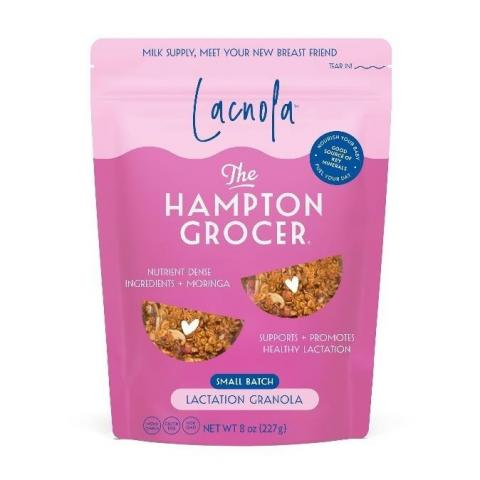
The recall covers lot HGLC-102125, with an expiry date of 21 October 2026, and lot HGLC-021326, expiring on 13 February 2027. Both are sold in a pink stand-up pouch carrying UPC 850035324554.
No illnesses had been reported in connection with the product when the company announcement was posted by FDA on 14 August. Production has nevertheless been suspended while Hampton Grocer and the regulator continue investigating the source of the problem.
The sequence shows how an upstream ingredient result can become a downstream manufacturing event without an illness cluster or confirmed positive result in the finished food. Once a supplier identifies a potential pathogen issue, the customer has to determine which incoming lots were received, where they were stored, which production batches used them, and where the resulting finished goods were distributed.
That process depends on traceability operating in both directions. Hampton Grocer needs records connecting the implicated ingredient to finished Lacnola lots, while the ingredient supplier needs enough distribution information to identify every manufacturer that received material associated with the positive result.
Accurate lot linkage allows a recall to remain narrow. Where receiving, batching, or production records cannot establish clear boundaries, manufacturers may have to include more finished product because they cannot demonstrate that other batches were unaffected.
Moringa powder presents a useful example of why dry ingredients require formal microbiological control. Low-moisture foods do not support bacterial growth in the same way as wet foods, but Salmonella can survive for extended periods in dry ingredients and production environments.
That becomes particularly important when an ingredient is incorporated into a ready-to-eat product that receives no reliable pathogen-reduction step afterwards. If contaminated material enters after roasting or another lethality treatment, subsequent blending and packing can carry the organism into the final pouch without changing the product’s appearance.
Supplier approval therefore has to extend beyond price, flavour, and nutritional specification. Depending on the ingredient risk, manufacturers may need microbiological limits, process information, certificates of analysis, audit evidence, supplier change notifications, traceability data, and agreed corrective-action procedures.
Documentation still has to connect to the physical ingredient in the plant. A certificate retained in a supplier file is of limited use during a recall if receiving staff and production records cannot link it to the exact lot issued into a batch.
The Hampton Grocer recall also demonstrates the different traceability demands created by e-commerce. A conventional retail recall can focus heavily on distributor warehouses and store stock, while direct-to-consumer orders may leave individual packs dispersed across thousands of addresses over a long period.
Order histories, marketplace records, email communications, website notices, and customer-service systems therefore become part of recall execution. A buyer who ordered a pouch months earlier may no longer have the delivery packaging or remember the purchase date, making the lot code and expiration date printed on the product especially important.
FDA’s notice identifies where those codes appear on the back of the pouch. Clear coding gives consumers and distributors a straightforward way to distinguish affected stock from other production without relying solely on product photographs or approximate purchase dates.
Production suspension is the more consequential manufacturing measure. A recall removes existing packs from use; stopping production prevents additional goods being made while the business establishes whether the ingredient route, remaining inventory, or manufacturing environment requires corrective action.
The current announcement does not say that finished Lacnola granola itself has tested positive, and it does not identify contamination inside Hampton Grocer’s production operation. The trigger was notification from an ingredient supplier, so the investigation still has to establish the precise source and extent of the problem.
That distinction should remain intact while corrective work proceeds. An investigation may include remaining ingredient inventory, related supplier lots, batch records, sanitation, storage conditions, production sequencing, finished goods, and the supplier’s own corrective-action findings, but the work cannot be treated as proof that each potential route was responsible.
The recall also reinforces the operational connection between ingredient suppliers and finished-food manufacturers. Outsourcing an ingredient does not outsource the consequences of its failure; the downstream business still carries responsibility for identifying affected finished batches, communicating with customers, and deciding when production can resume safely.
That relationship becomes more demanding where specialist powders or functional ingredients are used at relatively low inclusion rates. A small quantity can pass through numerous production batches, meaning a single incoming lot may affect much more finished product by value and pack count than its own weight suggests.
Hampton Grocer has a comparatively narrow recall in terms of two identified finished-product lots, but the distribution period stretches across almost ten months. The practical response therefore depends on the company’s ability to reconstruct historic production and customer information reliably rather than simply checking what remains in the warehouse.
FDA’s product photographs and precise code information make identification straightforward once a customer sees the notice. The less visible work is inside the manufacturing and supply records, where the company has to demonstrate that the ingredient exposure has been bounded and that any restart is based on evidence rather than the passage of time.
No illnesses have been reported, and the investigation remains open. The next meaningful step will be confirmation of the contamination source and the controls required before Lacnola production resumes.