IN Brief:
- Meatly has occupied Imperial College London’s Grapht Works pilot manufacturing site in Old Oak.
- The company develops cultivated meat for pet food using its own bioreactors and culture medium.
- Production runs are planned for 2027; installed capacity and output figures have not been disclosed.
Meatly has moved into Grapht Works, Imperial College London’s pilot and demonstration manufacturing facility in the Old Oak Innovation Cluster, as it prepares to expand cultivated meat production for pet food in 2027. The relocation places the company’s process development alongside other advanced manufacturing businesses and follows a £10.4 million Series A funding round completed in May.
Meatly develops cultivated meat from animal cells for use as a pet food ingredient. Grapht Works provides the industrial space in which the company intends to develop its manufacturing process ahead of production runs planned for 2027. Moving from laboratory cultivation to repeatable production involves medium preparation, cell growth, harvesting and downstream handling, with each operation affecting overall yield and plant utilisation.
Grapht Works is part of Imperial’s Old Oak Innovation Cluster within WestTech London. The site provides adaptable industrial space for prototyping, pilot production and demonstrations, allowing engineering-focused businesses to test processes beyond conventional research laboratories. Imperial describes it as London’s first dedicated facility of this kind. Meatly joins a cluster that also includes materials and engineering companies, with access to accommodation intended for equipment installation and industrial experimentation.
Meatly was founded in 2022 and initially developed its technology for cultivated pet food rather than food for human consumption. The company received UK regulatory authorisation in 2024 and brought cultivated pet food to market in 2025. It says it has developed its own bioreactors and nutrient medium to reduce the cost of production, reflecting the two principal inputs that determine how animal-cell cultivation is operated and how much each production batch costs.
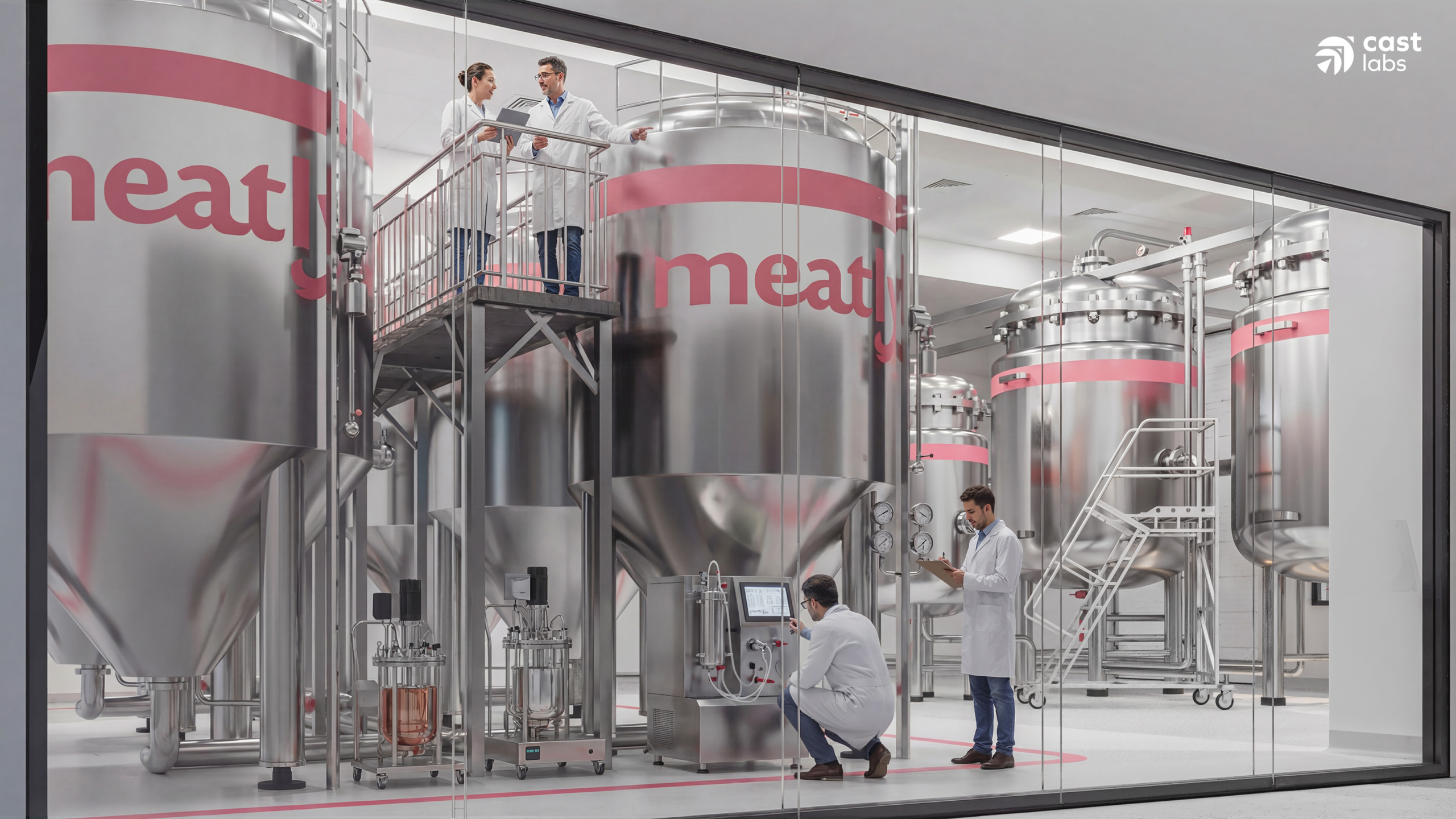
A bioreactor provides a controlled environment for cells to grow in a nutrient medium. Temperature, dissolved gases, mixing and nutrient delivery have to support cell growth while maintaining a suitable process environment. As vessels increase in scale, those operating conditions become more demanding to reproduce across the entire liquid volume. Mixing must distribute nutrients and gases without imposing damaging forces on the cells, while cleaning, contamination control and sampling remain part of the manufacturing system rather than occasional laboratory tasks.
The composition of the culture medium is also central to the economics of cultivated meat. Nutrients must support cell survival and multiplication, while medium consumption and the consistency of its formulation influence the material cost of each production batch. Meatly has developed an in-house medium, alongside its own bioreactors, with the aim of lowering costs. The new site provides space to integrate these components into a production process, while commercial-scale output and unit costs remain to be established.
The move follows Meatly’s £10.4 million Series A fundraising in May 2026, which is supporting the company’s expansion. That investment now underpins a physical transition from research premises towards a pilot and demonstration manufacturing environment. Equipment installation, process integration and commissioning will be the practical work between occupying Grapht Works and beginning production in 2027.
Owen Ensor, Meatly’s chief executive, has set out an ambition to build Europe’s largest cultivated meat facility. Production runs planned for 2027 will be the first opportunity to assess installed vessel capacity, repeatable output and operating costs at the new location. Grapht Works is providing the pilot and demonstration infrastructure for this next stage of the project as Meatly works towards its proposed manufacturing scale.
Pet food production will also require a consistently specified ingredient after cultivation and harvesting. The manufactured material must have predictable composition, microbiological quality and handling characteristics so it can be incorporated into the wider pet food formulation. Moisture content and physical form influence dosing, mixing and subsequent processing, while repeatable batches are needed for manufacturers to control finished-product quality. These requirements connect Meatly’s bioreactor work to the performance of the ingredient in a downstream factory.
Imperial’s investment director, Alice Sewell, has linked the development to keeping advanced manufacturing activity within London rather than seeing research businesses leave when they require larger premises. Grapht Works has been configured to support several technology sectors, including engineering biology, advanced materials and robotics. Meatly’s presence gives the cluster a direct food-manufacturing application, with the intended production process extending from cell cultivation towards an ingredient used by pet food companies.
Production runs planned for 2027 will provide the next operational indication of the facility’s progress. The key measures will be repeatable output, stable processing conditions and the relationship between production costs and the volumes supplied to pet food customers. Meatly has already brought cultivated pet food to the European market; Grapht Works is intended to help extend that early commercial activity into a larger manufacturing operation.