IN Brief:
- Metsä Group will invest about €25m in industrial Muoto production at Äänekoski.
- Valmet will supply a line with nominal capacity above 100 million moulded-fibre products a year.
- Start-up in 2028 will test whether pre-commercial fibre packaging can deliver repeatable food-packaging volumes.
Metsä Group will invest approximately €25 million in an industrial production line for Muoto fibre packaging at Äänekoski in Finland, giving the moulded-fibre format a defined route beyond its current demonstration and pre-commercial phase.
The line will be built beside the existing Muoto demo plant and is scheduled to start during 2028. Metsä says nominal capacity will exceed 100 million products a year, with Valmet supplying the production line. Äänekoski was selected over the previously considered Rauma site because of the mill area’s infrastructure, the existing Muoto operation, and the economics of the investment.
Muoto is formed directly from wet wood pulp without an intermediate converting stage. The pulp is moulded into a three-dimensional structure and dried into its final shape, creating lightweight, rigid packaging that can be adapted for foodservice and selected industrial food applications.
Commercial output changes the engineering test
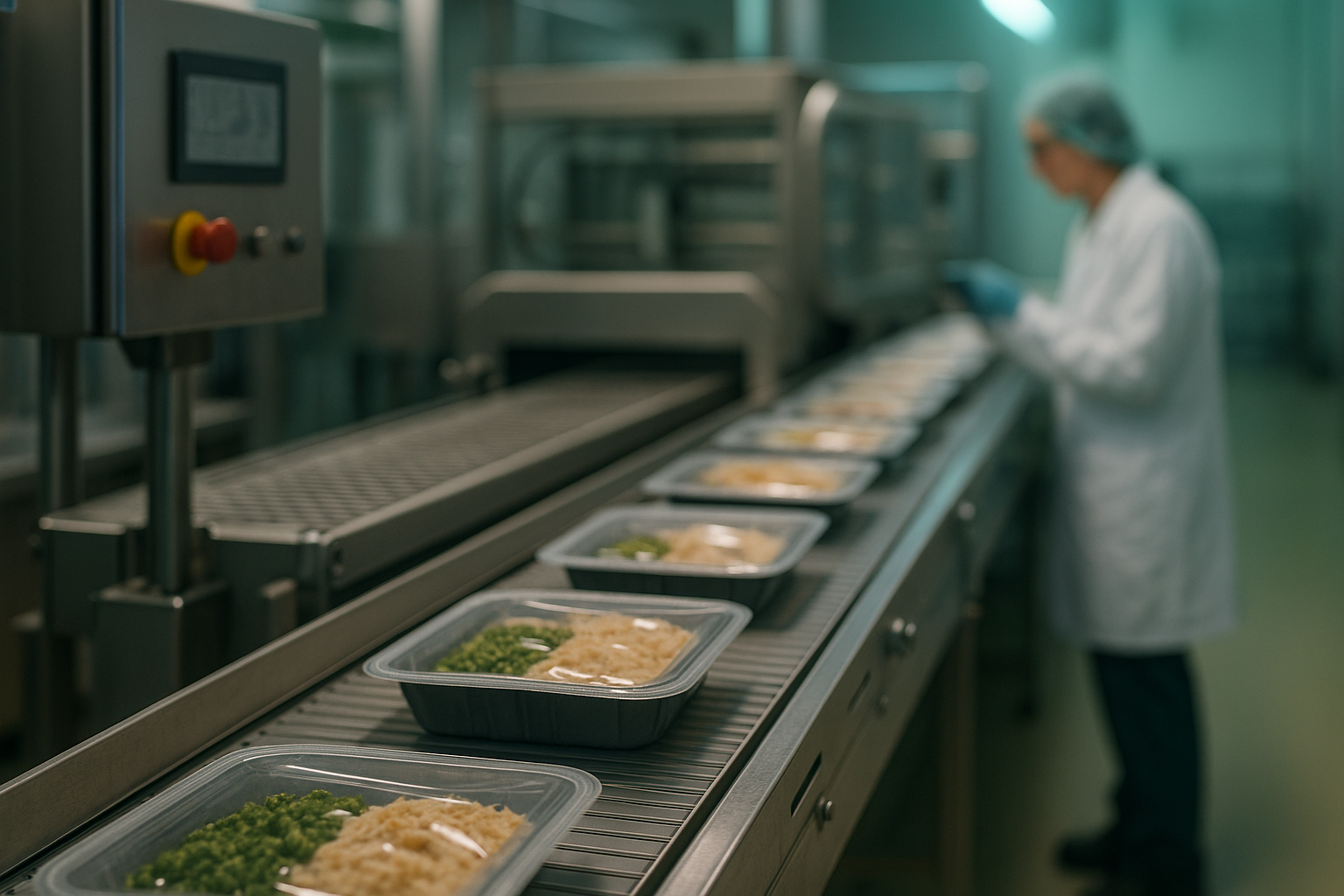
The €25 million decision moves the project into a different manufacturing problem. A demonstration line can prove forming, drying, tooling, and material behaviour; an industrial line has to repeat those results over long production runs while holding dimensional tolerances, surface quality, throughput, and unit cost.
Those constraints become harder when the pack is expected to run through existing food production equipment. In May, an Amcor, Metsä, and G Mondini chilled-food project paired a Muoto tray with a barrier liner and top web for protein and ready-meal applications. The system was developed around commercial tray-sealing equipment, putting seal performance, line compatibility, and pack handling alongside the material substitution itself.
That is the level at which a fibre format begins to compete with established plastic and paperboard systems. Food manufacturers do not buy a substrate in isolation: they buy a packaging specification that has to form, fill, seal, code, inspect, stack, chill, transport, and reach shelf without creating a new source of rejects or downtime.
Muoto’s wet-forming route gives Metsä freedom to create complex three-dimensional shapes, but commercial production will have to control that geometry consistently across tooling and batches. Where food applications require higher moisture, grease, or oxygen barriers, the fibre structure may also need coatings, liners, or lidding materials whose performance has to be validated as part of the complete pack.
Industrialisation will also require a broader quality-control regime than pre-commercial output. Formed-fibre parts have to be checked for dimensions, wall distribution, moisture, surface defects, and functional performance before they reach a customer’s line. Tool wear or changes in pulp behaviour that are tolerable during development can become expensive once the plant is producing at sustained volume, because a small deviation can affect millions of units before it is corrected.
Regulation raises the value of scalable alternatives
The timing places the project alongside the first application phase of the EU Packaging and Packaging Waste Regulation, which applies from 12 August 2026. Metsä says Muoto has been developed to meet the requirements relevant to the format, while the wider regulation is increasing pressure on packaging suppliers and food producers to document materials, recyclability, and substances of concern more systematically.
Regulation alone will not make a new format commercially viable. The larger test is whether the Äänekoski line can provide enough volume, consistency, and cost control for customers to qualify Muoto as a repeatable production material rather than a limited trial. More than 100 million units a year creates a credible supply base, but it also exposes any weakness in cycle time, tooling life, quality control, or downstream finishing much faster than a demonstration plant.
Locating the commercial line beside the existing demo operation should allow process knowledge, personnel experience, and infrastructure to carry into the scale-up. Valmet also returns as the technology supplier after working with Metsä Spring on the demonstration plant, reducing the distance between the development equipment and the industrial system.
Ramp-up will then determine how much of the nominal figure becomes dependable output. Start-up losses, tooling changes, maintenance intervals, and customer qualification can hold effective capacity below the headline number for some time, so 2028 will mark the beginning of commercial scaling rather than the end of development.
The investment remains modest beside the output of mature global packaging formats, yet it gives Muoto something many fibre-packaging concepts still lack: a named site, equipment supplier, start-up year, capital commitment, and quantified production target. Between now and 2028, the work is less about proving that moulded fibre can make a tray than proving that it can make the same tray reliably more than 100 million times a year.