IN Brief:
- Macfarlane Packaging and Lancaster University have developed optimisation software for businesses managing large packaging ranges.
- Macfarlane reports an average 15% reduction in packaging material use through Packaging Minimiser projects.
- A ProCook deployment analysed more than 25,000 order profiles before reducing the recommended range to five boxes.
Macfarlane Packaging and Lancaster University have developed software that analyses order profiles against available packaging formats, using an optimisation algorithm to identify excess material, avoidable empty space, and box ranges that no longer match the way a business actually dispatches goods. Macfarlane reports an average 15% reduction in packaging material use through Packaging Minimiser projects, although the result remains a company measure rather than an independent industry benchmark.
The software builds on operational research at Lancaster University, where a mathematical optimisation framework was created to determine which boxes could accommodate individual orders before selecting a smaller subset intended to improve packing efficiency across a large sample. Earlier versions produced significant improvements on real data but required specialist expertise and relatively high computing power, leading the researchers to develop a web based graphical interface that could make the model usable without recreating the analysis from scratch for every customer.
Macfarlane has turned that research into a commercial service for manufacturers, distributors, third party logistics providers, and retailers with large dispatch operations, combining customer order data with the packaging range already in use. The algorithm can test thousands of order and box combinations far more quickly than a manual review, after which packaging specialists can concentrate on a smaller number of formats that still need to be checked for protection, handling, and operational compatibility.
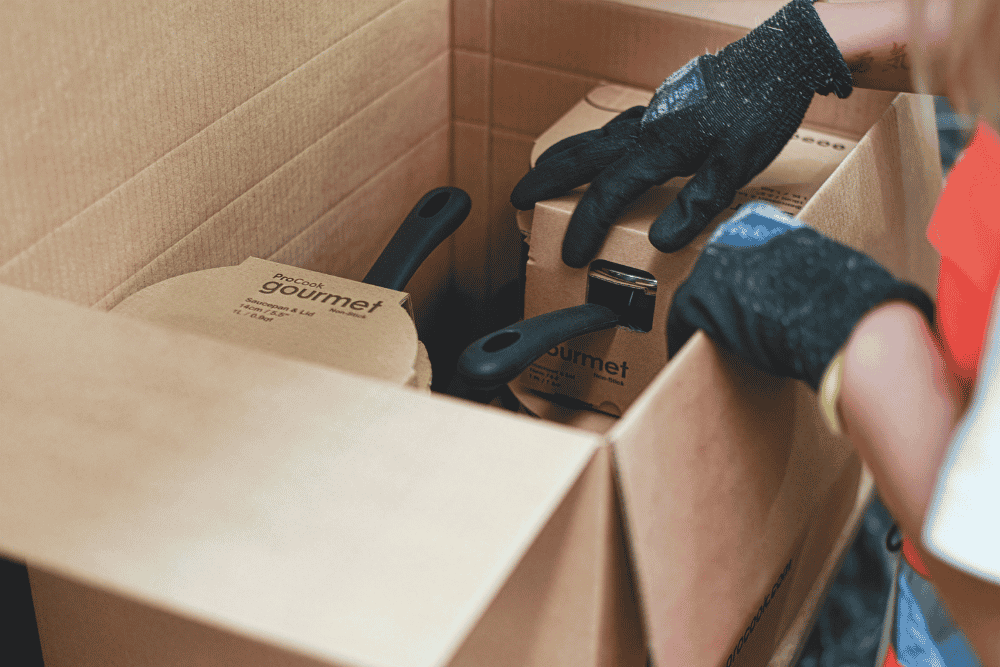
A ProCook deployment shows how the approach can affect a live packaging range, with Macfarlane analysing more than 25,000 order profiles before reducing the recommended range to five boxes. The company reports that the resulting changes removed 178 tonnes of packaging and 550,000 litres of void space annually, alongside a six-figure financial saving, figures that are useful as a case study but remain specific to one customer’s order mix and packaging operation.
Food and beverage businesses face the same problem across secondary and tertiary packaging, where case sizes, outer cartons, transit protection, promotional configurations, and customer-specific formats can accumulate over time until the range is larger than current demand requires. A box introduced for one product or retailer may remain in stock after the order profile changes, while a format that appears economical on unit price can create more void fill, poorer pallet density, or higher courier charges once the complete distribution pattern is considered.
Reducing the number or size of boxes still has to respect the physical demands placed on packaged food, particularly where compression strength, chilled conditions, automated handling, stacking, or long distribution routes are involved. A smaller carton that fails more often can erase material savings through damaged product and rework, while a theoretically efficient format can create a bottleneck if it does not erect, seal, label, or palletise reliably on the equipment already installed.
Order-level optimisation becomes more valuable as those variables multiply, because the software can compare a large population of shipments rather than judging performance from a handful of representative packs. The output does not remove the need for line trials or engineering judgement, but it can expose where a packaging range is carrying redundant formats and where excessive headspace or material use is systematic rather than incidental.
Transport and storage economics are closely connected to the same dimensions. Lower cubic volume can increase pallet or vehicle utilisation, fewer box types can reduce warehouse locations and replenishment complexity, and lower material tonnage can cut purchasing and disposal costs, although the size of each benefit depends on order mix, handling method, and how much of the original range can genuinely be consolidated.
UK extended producer responsibility adds another cost signal because qualifying producers are increasingly exposed to waste management fees linked to the packaging they place on the market. The EU Packaging and Packaging Waste Regulation is pushing in parallel towards tighter control of packaging design, composition, recyclability, and conformity documentation, encouraging businesses operating across both markets to maintain more accurate data on what each pack contains and how much material it uses.
Its performance will depend on the quality of the order and packaging data supplied to the model, since poor product dimensions, outdated box records, or unrepresentative order histories will weaken the recommendations before any physical trial begins. Accurate data gives packaging teams a faster way to test whether inherited formats still justify the material and space they consume, while design, distribution, and compliance checks remain part of the decision once a smaller range has been identified.
Macfarlane’s 15% average saving should be read in that context, since the software does not promise the same reduction for every operation and the ProCook result illustrates how widely the outcome can depend on starting conditions. The more useful measure for each deployment will be the change in packaging tonnage, void space, damage, transport utilisation, and fulfilment performance after the rationalised range has been introduced, because material reduction only holds its value when the rest of the operation continues to work as intended.