IN Brief:
- A new French baking lab links traditional bake tests with analytical data.
- The facility combines mixers, proofing, baking, rheology, NIR analysis, and vision measurement.
- Bakery quality control is moving toward objective process data and faster troubleshooting.
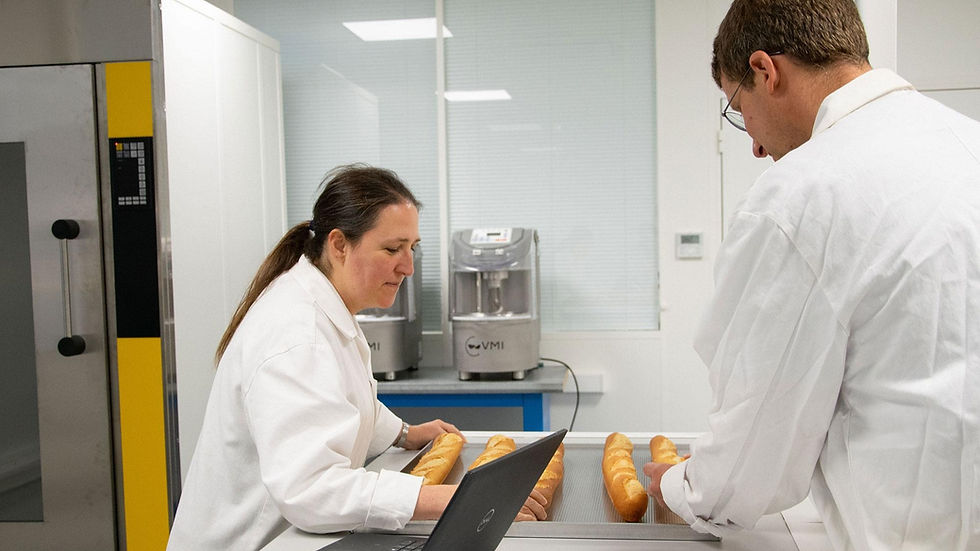
KPM Analytics has opened a baking lab at its Rheology Center of Excellence in Villeneuve-la-Garenne, France, giving millers, bakers, and ingredient manufacturers a practical environment for connecting flour data with finished product performance.
The facility sits within KPM Analytics France Headquarters and has been designed to replicate real baking conditions while linking finished product results back to flour composition, dough behaviour, and process variables. It includes industrial-grade mixers, a proofing chamber, an industrial oven, and supporting equipment for controlled test work.
Alongside the baking equipment, the lab brings together KPM’s rheology and quality-control technologies. Its systems include Mixolab, Alveolab, Rheo F4, SDmatic 2, SpectraStar XT for moisture and compositional analysis, and TheiaVu Vision measurement for finished product evaluation. The combined set-up allows developers to test raw materials, process response, and final product attributes within one connected workflow.
Baking tests have always played an important role in milling and bakery quality assessment, but they can leave unanswered questions. A loaf, bun, biscuit, or flatbread may show whether a formulation performs, yet the finished product alone does not always reveal whether the result came from protein quality, damaged starch, enzyme activity, water absorption, gas retention, mixing, proofing, or oven profile.
Lionel Bernard, General Manager for KPM Analytics France, said: “The baking test has always been a valuable tool, but it does not always tell the complete story.” He added that the lab is designed to help customers work from “final product to flour” and build a practical understanding of how analytical data relates to baking performance.
That ability to connect measurements is becoming more important as bakery manufacturers deal with greater raw material variation and tighter product specifications. Flour quality can shift with growing conditions, wheat origin, storage, milling behaviour, and supplier availability. Production lines, meanwhile, are expected to deliver consistent volume, crumb, colour, texture, bite, shelf life, and appearance across high-speed schedules.
The lab gives development and quality teams a route to pre-screen ingredients and formulations before committing to larger test bakes. Flour composition, damaged starch, protein behaviour, dough rheology, gas retention, proofing response, and finished product geometry can be assessed together. Faster diagnosis can reduce the need for reactive adjustments on the production line, where a single unstable flour batch can affect dividing, proofing, baking, slicing, wrapping, and waste.
Bakery and confectionery machinery suppliers are already pushing equipment development toward better control, lower energy use, and greater flexibility, with recent launches in chocolate, wafer, roasting, and bakery systems reflecting that direction. KPM’s lab addresses the same pressure from the quality and analytical side. Improved equipment performance is easier to realise when raw material and dough behaviour are understood before production starts.
For bakery plants, the value is not simply more laboratory data. The commercial gain comes when measurement changes factory decisions. If a flour batch absorbs water differently, weakens under mixing, or holds gas poorly during proofing, process settings can be adjusted before finished product quality drifts. If a reformulated recipe affects spread, colour, or texture, developers can identify the source before a full production trial consumes line time and ingredients.
The training element adds another practical layer. KPM plans to use the lab for hands-on customer work, allowing teams to see how instrument readings relate to baking outcomes. Many manufacturers already generate quality data, but the gap lies in translating those readings into action. A result on a rheology instrument, an NIR analyser, or a vision system only becomes useful when operators and technologists understand how it should influence formulation, process settings, or supplier decisions.
Ingredient complexity is also increasing across bakery and snacks production. Sugar reduction, fibre enrichment, protein fortification, clean-label demands, alternative grains, enzymes, emulsifier changes, and cost-driven reformulation can all affect dough handling and final product structure. A reformulated product may survive bench-scale work but fail once exposed to real line speeds, production tolerances, and storage conditions.
Objective measurement will not replace experienced bakers, millers, or process engineers. It can make their decisions more repeatable, reduce avoidable line trials, and give quality teams stronger evidence when raw materials drift. In high-volume bakery operations, where small deviations can create waste across thousands of units per hour, understanding why a product behaved differently can be as valuable as identifying that it failed.
KPM’s baking lab strengthens the role of application centres as part of manufacturing infrastructure. With raw material volatility, reformulation pressure, and energy constraints reshaping bakery operations, the ability to connect flour data, dough behaviour, process settings, and finished product quality is becoming a production advantage rather than a laboratory luxury.