IN Brief:
- Complete meat portioning lines now cover crust freezing through final case packing.
- The offer combines cutting, weighing, robotics, tray sealing, labelling, and line software.
- Labour pressure, yield control, and case-ready demand are pushing meat plants toward integrated automation.
JBT Marel has expanded its meat portioning line offer, combining the former JBT and Marel portfolios into end-to-end systems that run from crust freezing through to final case packing.
The new configuration brings together equipment for raw material stabilisation, portioning, check weighing, robotic tray loading, tray sealing, weigh price labelling, and case packing. Each line can be configured around product mix, required capacity, factory layout, and finished pack format, with the company targeting processors that want fewer integration gaps between cutting, weighing, packing, and labelling.
Fresh meat portioning sits at one of the most commercially exposed points in the factory. Raw material value, cutting accuracy, retail presentation, and pack consistency all converge in the same production zone, while labour availability continues to pressure manual handling and inspection roles. Small losses in yield or giveaway can accumulate quickly where high-value proteins are being converted into case-ready retail formats.
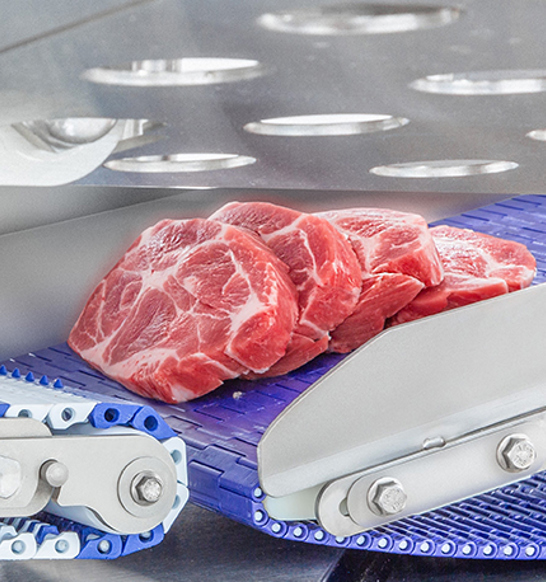
JBT Marel’s line starts with Frigoscandia ADVANTEC impingement freezing, which creates a fast, uniform crust before cutting. That stabilisation step helps control texture and firmness before portioning, giving cutting systems a more consistent product to work with. The company presents the system as a cost-efficient alternative to cryogenic freezing, with compact variants available where factory floor space is limited.
Once stabilised, meat moves through volumetric and anatomic portioning systems for beef and pork, with check weighing before products enter the packing section. The M-Weigher Process Check monitors unpacked protein products against target weight specifications and feeds information into the wider line, allowing plants to control rejects, giveaway, and manual rework before product reaches the final pack.
Robotic tray packing and styling follow through systems including RoboBatcher Flex and RoboPacker. Vision systems and styling programs place products into different tray formats, helping maintain presentation, reducing unnecessary handling, and supporting food safety. Tray sealing is handled through Proseal systems for pork and beef products, including steaks and marinated cuts, before intelligent weigh price labelling and robotic case packing complete the flow.
Dirk Gruyters, Industry Specialist Case Ready at JBT Marel, said: “Our customers need more than individual machines. They want a fully connected line where every step contributes to higher yields, greater consistency, and reduced manual handling.”
That connected-line approach is becoming more important as meat processors replace isolated automation projects with broader production redesign. A plant may improve cutting accuracy, add robotic packing, or upgrade labelling as separate projects, but the gains can be limited if transfer points, buffers, operator interventions, and rework loops remain unchanged. A configured line gives processors a clearer route to balancing throughput, yield, hygiene, and pack presentation across the full process.
The same investment logic can be seen across animal protein processing. Poultry equipment forecasts have already pointed to stronger automation spending, with inspection, high-capacity systems, robotics, and yield control expected to shape production investment through 2035. Red meat plants face different product characteristics, but the commercial pressures are similar: fewer manual interventions, better data, stronger traceability, and more consistent finished packs.
Software is also becoming a larger part of the value proposition. JBT Marel’s AXIN platform is used to monitor and optimise line performance, linking machine data with production control. That gives processors a way to examine where giveaway, rejects, downtime, or packing bottlenecks enter the line, rather than treating each machine as a separate operating unit.
For processors, the capital case will depend on live factory performance rather than headline equipment capability. Product variation, fat level, bone structure, temperature, operator skill, sanitation windows, retailer pack formats, and changeover frequency all influence whether a line delivers its expected return. A system that improves portion accuracy but creates constraints at packing or labelling still leaves margin exposed.
Cleaning and maintenance access will also shape adoption. Meat portioning lines operate in demanding environments where hygiene controls, allergen separation, blade handling, machine access, and rapid changeover all affect uptime. A highly automated system has to remain practical for engineers, hygiene teams, supervisors, and operators across multiple shifts.
JBT Marel’s expanded portfolio strengthens its position in case-ready meat automation at a point when processors are trying to protect yield while reducing labour dependency. As retailer specification pressure tightens and protein margins remain exposed, complete line design is becoming a practical route for plants that need consistency at industrial scale.