IN Brief:
- Solar Foods has secured €77.8m in public funding from Business Finland for its planned Factory 02 facility in Lappeenranta.
- The package supports construction, equipment procurement, installation, commissioning, and ramp-up for Solein production.
- The project strengthens Europe’s alternative protein pipeline as fermentation, hydrogen, and food manufacturing converge.
Solar Foods has secured a €77.8m public funding package from Business Finland to support the next phase of industrial scale-up for Solein, its air-based protein ingredient.
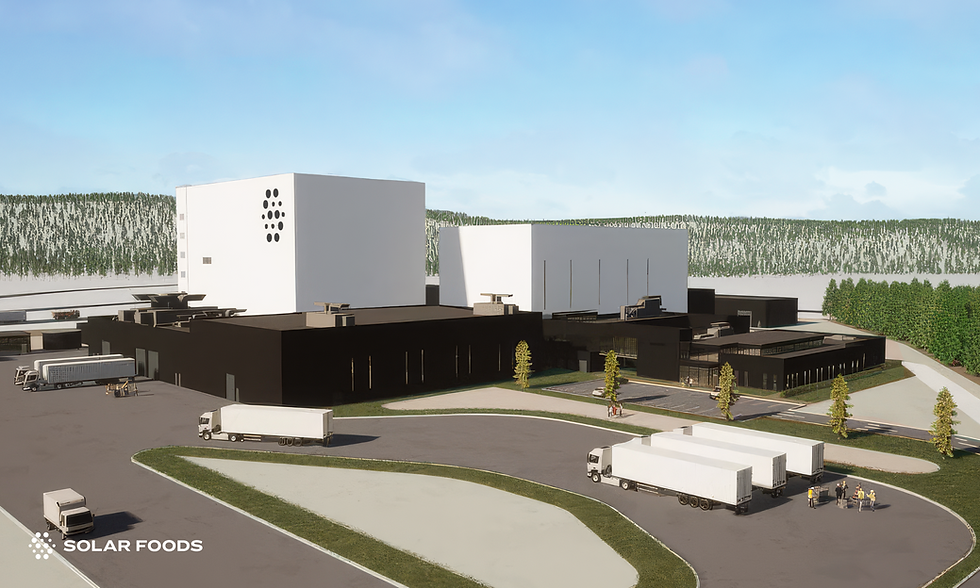
The funding is linked to the planned Factory 02 facility in Lappeenranta, Finland, where the company intends to move Solein from early commercial activity into larger-scale production. The package combines grant support and research and development loan funding, with money allocated to construction, equipment procurement, installation, commissioning, and ramp-up.
Factory 02 is expected to form the next major production step after Solar Foods’ earlier demonstration activity. Solein is produced using carbon dioxide, hydrogen, and electricity rather than conventional agricultural inputs, placing the process at the intersection of food manufacturing, clean energy, fermentation, and industrial biotechnology.
The company has said the new support strengthens its preparation for a final investment decision during 2026. That decision will still depend on commercial commitments, regulatory progress, equipment specification, and the company’s ability to align production economics with customer requirements.
Solein’s commercial promise rests on its ability to provide a protein-rich ingredient without relying on field crops or livestock production. Its value proposition is closely tied to resource efficiency, land-use reduction, and resilience against some agricultural supply pressures, but those benefits will only carry weight if the ingredient can be manufactured at dependable volumes and incorporated into real food formulations.
The latest package follows earlier progress around Solein patent protection and scale-up planning, including previous development work linking the ingredient platform to commercial production. That earlier phase helped establish the intellectual property and technology base behind Solein; the new funding pushes the focus towards plant execution, commissioning discipline, and market readiness.
Alternative protein has moved into a more demanding phase across Europe. Investment is still available for technologies with credible production pathways, but the market has become less tolerant of concepts that cannot show a route to scale, cost control, regulatory approval, and repeatable ingredient performance.
That shift gives greater weight to projects built around manufacturing infrastructure rather than brand positioning alone. A commercial-scale plant has to manage energy use, hydrogen supply, process control, contamination risk, downstream processing, drying, packaging, quality assurance, and customer specifications. Each stage influences whether a novel ingredient can move from early adoption into mainstream formulation.
Solar Foods’ model also links food manufacturing to the development of low-carbon energy systems. As hydrogen and renewable electricity become more central to industrial decarbonisation, food technology companies using those inputs will be exposed to the same questions as other energy-intensive manufacturers: availability, price, certification, and long-term infrastructure reliability.
Factory 02 will therefore be watched as more than a novel protein site. It is a test of whether energy-linked microbial protein production can become an industrial ingredient system, with the consistency, safety, and cost profile required by food manufacturers. Public funding gives Solar Foods more room to build that case, but the next stage will be decided by commissioning performance, regulatory clearance, and customer adoption.