IN Brief:
- GEA’s KOB homogeniser range delivers pressures of up to 400 bar.
- The series is designed for food, dairy, beverage, plant-based, and spray-dryer feed applications.
- Mid-sized plants are under pressure to combine formulation flexibility with stable, hygienic processing.
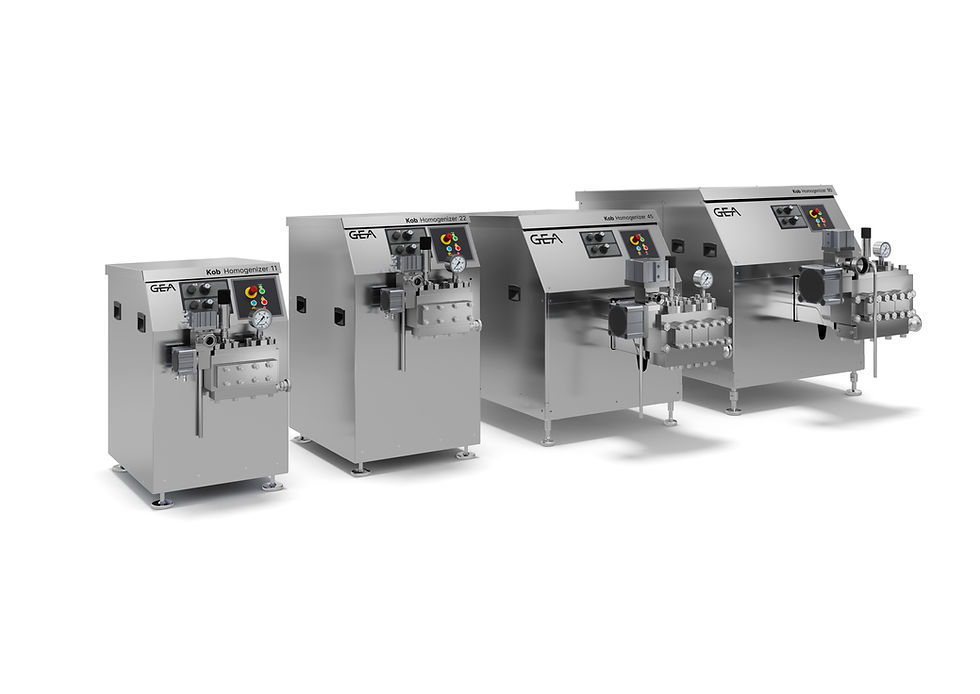
GEA has expanded its KOB high-pressure homogeniser series, giving small and medium production plants a wider route into industrial-grade homogenisation for food, dairy, beverage, ingredient, and plant-based applications.
The range is designed for operating pressures of up to 400 bar and is intended for processors handling demanding, moderately viscous, and abrasive formulations. Higher-efficiency homogenising valve technology and more wear-resistant materials are available as options, while the platform is designed to support hygiene requirements across food and beverage production environments.
Homogenisation remains a core operation in dairy, plant-based drinks, sauces, emulsions, infant nutrition, functional beverages, and ingredient processing. By reducing particle or fat globule size, the process improves emulsion stability, mouthfeel, dispersion, and product consistency. Those characteristics become harder to control as manufacturers introduce more proteins, fibres, minerals, botanicals, emulsifiers, and reduced-sugar systems into products that still have to run reliably through filling, packaging, storage, and distribution.
Smaller production plants have often had to choose between equipment scaled for much larger volumes and lower-pressure systems with limited headroom for more technical formulations. The KOB range is positioned in the space between those extremes, where manufacturers need industrial performance but also require compact installation, controlled capital cost, and enough flexibility to support changing product portfolios.
That requirement is becoming sharper as product development cycles compress. Dairy processors are moving into high-protein formats, premium milks, clear whey systems, and fermented products with tighter texture and stability expectations. Beverage producers are adding functional claims, plant proteins, fibres, and minerals to formats that must remain drinkable, visually stable, and commercially viable. Plant-based categories continue to place pressure on suspension, viscosity, particle size, and sensory performance.
The factory-level challenge is visible in the growing interest around clear protein beverage formulation, where stability, solubility, taste, foaming, and cost-in-use are all tightly connected. A beverage can meet its nutritional brief in the laboratory and still fail once pressure, heat treatment, filling, storage, and ambient variation expose the limits of the processing route. Equipment selection has therefore become part of formulation strategy, not a late-stage engineering detail.
Within that context, homogenisers are judged on more than pressure ratings. Valve geometry, pump reliability, cleanability, seal integrity, operator access, wear rates, automation, and integration with upstream and downstream systems all influence yield and product release. Plants producing shorter runs or multiple product families also need equipment that can recover quickly between recipes, withstand frequent cleaning cycles, and provide repeatable process control without creating excessive maintenance demand.
Energy use and cleaning performance are becoming equally important. Homogenisation can be energy-intensive at higher pressures, and the true operating cost sits across electricity, water, chemicals, product losses, downtime, spare parts, and engineering labour. A lower purchase price offers little advantage if the system increases cleaning burden, creates variable product quality, or struggles with abrasive formulations.
The KOB series reflects the wider move toward scalable process architecture. A growing manufacturer may need a system that supports early commercial volumes before a larger line is justified, while a multinational group may want dedicated capacity for higher-value or more specialised products that do not fit efficiently on a main production line. Compact, hygienic, automated systems allow plants to separate innovation work from high-throughput commodity production while still maintaining industrial control.
As food and beverage factories become more varied, the ability to manage technical products at mid-scale will become more valuable. Homogenisation is a mature process, but its role is changing. It now sits at the intersection of product development, quality assurance, energy management, and capital planning, where equipment decisions directly shape how quickly new formulations can move from concept into stable production.