IN Brief:
- Polytag and MCC Global IML are integrating UV tag technology into in-mould labelled packaging.
- The tags can carry material, recycled-content, manufacturing, and origin data for recovery and sorting systems.
- Connected packaging is expanding beyond bottles as EPR and recycling evidence demands increase.
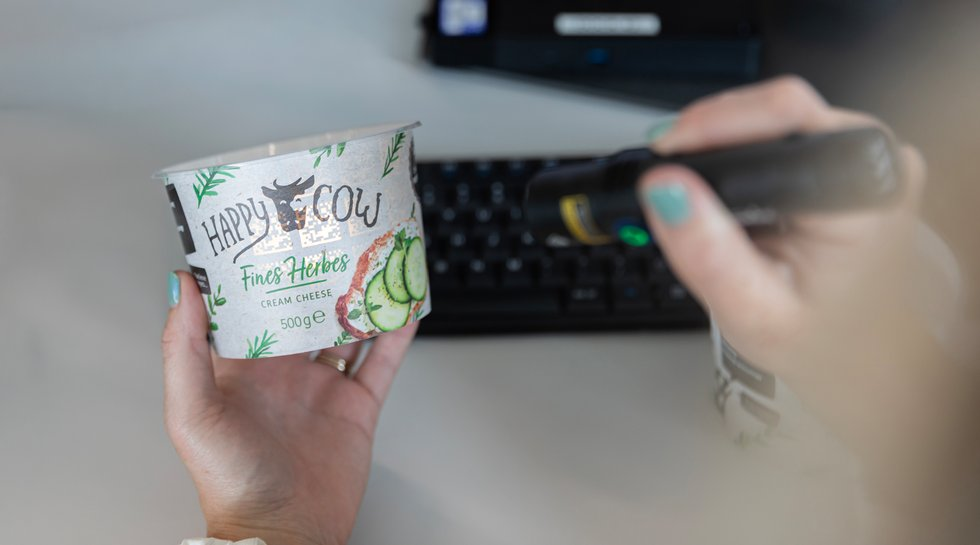
Polytag has partnered with MCC Global IML to integrate UV tag technology into in-mould labelled packaging, extending digital traceability into food packs used in frozen and other demanding retail applications.
The collaboration allows Polytag’s invisible UV tags to be embedded directly into IML packaging. Each tag acts as a digital fingerprint that can be read by detection units installed at material recovery facilities, giving the pack an identity beyond what can be determined by camera recognition or visual sorting alone.
The system can carry data covering material composition, recycled content, manufacturing information, and material origin. That information can then support sorting, recycling analysis, and post-consumer packaging data capture, while giving brands a clearer view of how packs behave after use.
In-mould labelling is already established across food packaging because the label and container are fused during the moulding process. The format produces a durable, moisture-resistant, highly decorated pack, which makes it suitable for chilled, frozen, and high-handling environments. Integrating UV tag technology at this stage adds traceability without relying on a separate label that may not survive the product’s full life cycle.
Food packaging is moving steadily from passive containment toward data-enabled compliance. EPR fees, packaging regulation, retailer requirements, and recycling targets are increasing the value of evidence on what a pack is made from, how it is sorted, and whether design choices improve recovery. A pack that can carry machine-readable information into the waste stream gives producers and recyclers a stronger basis for measurement.
The IML format broadens the reach of connected packaging beyond bottles and conventional labels. Frozen-food tubs, spreads, chilled pots, and rigid plastic containers often face harsher moisture, abrasion, and temperature conditions than standard labelled packs. In those categories, a durable decorated container with embedded traceability can support both brand requirements and recovery-system data.
Digital marking is already being explored across other food packaging formats, including flexible snack packs, where watermarking is being used to improve identification of polypropylene structures in sorting facilities. The common objective is to give recycling systems a clearer view of pack composition at the point where mixed post-consumer waste is separated. That becomes more valuable as packaging portfolios shift toward mono-materials, recycled content, and more detailed product passports.
Polytag’s existing deployments on milk bottles have shown how invisible identifiers can be used to track packaging after consumption. IML takes that principle into packs that are less straightforward than bottles and more likely to contain varied decoration, shapes, and product residues. The technology’s value will depend on the scale of detection infrastructure, the consistency of data standards, and the willingness of brands to connect packaging specifications with post-use evidence.
Sorting accuracy remains one of the weaker points in packaging circularity. A technically recyclable pack can still be lost if recovery systems cannot identify it correctly, if local infrastructure is limited, or if contamination moves it into a lower-value stream. UV tagging does not remove those barriers on its own, but it can reduce uncertainty where detection systems are installed and data is properly managed.
Food manufacturers are also facing a heavier documentation burden around packaging. Material declarations, recycled-content evidence, recyclability assessments, and EPR reporting are becoming part of routine specification work. Connected packaging can link the physical pack with a data trail, allowing post-consumer performance to inform future design and compliance decisions.
The Polytag and MCC Global IML partnership places traceability directly inside the packaging format rather than treating it as an after-market add-on. As regulatory pressure and recycling data demands rise, the strongest packaging systems will be those that protect the product, run efficiently on filling lines, and remain identifiable after disposal.