IN Brief:
- Sveba Dahlen will join Midera Food Processing as Middleby separates its food processing business.
- Midera will bring together more than 30 equipment and automation brands across protein, bakery, and snack production.
- Bakery equipment markets are consolidating around full-line processing, thermal, automation, and packaging capability.
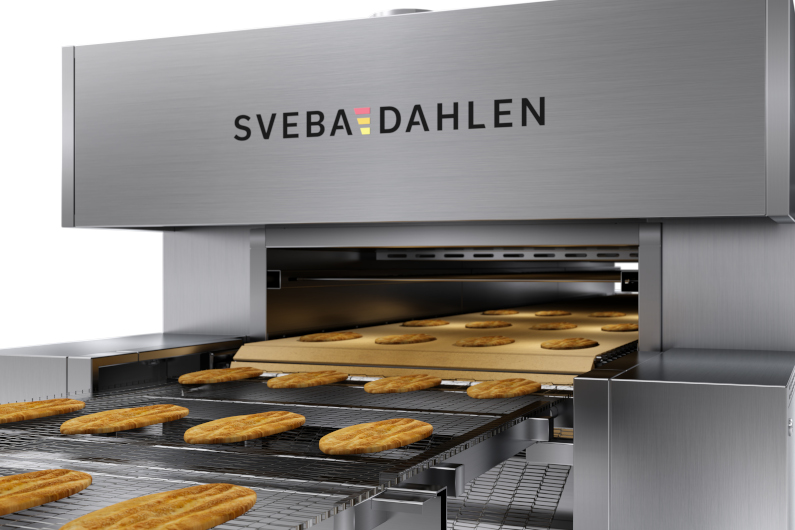
Sveba Dahlen will become part of Midera Food Processing as The Middleby Corporation separates its food processing business into a standalone company.
The separation is expected to complete in July 2026, subject to customary conditions. Midera Food Processing is planned as an independent publicly listed company, bringing together more than 30 equipment and automation brands serving industrial protein, bakery, and snack production.
Sveba Dahlen’s established brands, including Sveba Dahlen and Glimek, will remain in place. Product ranges, service routes, and customer contact channels are set to continue, with the company moving into a more focused food-processing group rather than operating inside Middleby’s broader structure.
The new group will cover preparation, thermal processing, packaging, automation, and full-line solutions. That mix is important in bakery production, where ovens, proofing, dough handling, cooling, slicing, and packaging increasingly have to be engineered as connected stages rather than separate assets.
Bakery manufacturers are dealing with a difficult combination of labour constraints, energy costs, quality demands, and SKU expansion. Production lines need to handle artisan-style products, frozen bakery, foodservice supply, packaged retail formats, and premium ranges while maintaining repeatability. Equipment suppliers are therefore being judged on process integration as much as individual machine performance.
Ovens remain one of the most energy-intensive and process-critical assets in bakery production. Bake quality depends on heat transfer, airflow, humidity, belt behaviour, dwell time, and product loading. As energy prices and carbon targets remain high on factory agendas, oven manufacturers need to demonstrate efficiency, temperature control, and product consistency under commercial production conditions.
Dough handling adds another layer of technical complexity. Dividing, moulding, resting, proofing, and transfer operations can determine final structure before the product reaches the oven. A high-quality oven cannot correct poor dough handling upstream, just as a well-controlled bake can be undermined by inadequate cooling or packaging downstream.
Equipment markets are responding with more grouped capabilities. A supplier able to connect preparation, thermal treatment, automation, and packing support can help reduce integration risk for manufacturers planning upgrades. That does not remove the value of specialist brands, but it does increase the importance of coordination between machines, controls, service, and process support.
The same direction is visible across other food equipment markets, where suppliers are widening access to industrial-grade technology for different plant sizes and product categories. Homogenisers, robotic cells, inspection systems, and packaging machinery are all being offered with greater attention to scalability, operator support, and line integration. Bakery is following that path as producers look for higher uptime and fewer process handoffs.
Midera is expected to operate with approximately 2,800 employees globally and to serve customers across six continents. Middleby’s food processing business generated about US$850m in revenue in 2025, with a 2026 forecast of US$915m to US$945m. That gives the new group scale in a market where capital investment decisions increasingly involve long-term service, spare parts, training, and equipment roadmap planning.
Sveba Dahlen’s move gives its bakery equipment portfolio a clearer industrial food processing context. Its customers will continue to work with familiar brands, but with access to a group built around factory equipment rather than a wider mix of foodservice and residential technologies.
The bakery equipment sector is likely to keep moving toward integrated platforms that reduce labour dependence, improve energy performance, and protect product consistency across more varied production schedules. Sveba Dahlen’s move into Midera places the brand inside that consolidation pattern, where ovens and dough systems are part of a broader processing and automation conversation.