IN Brief:
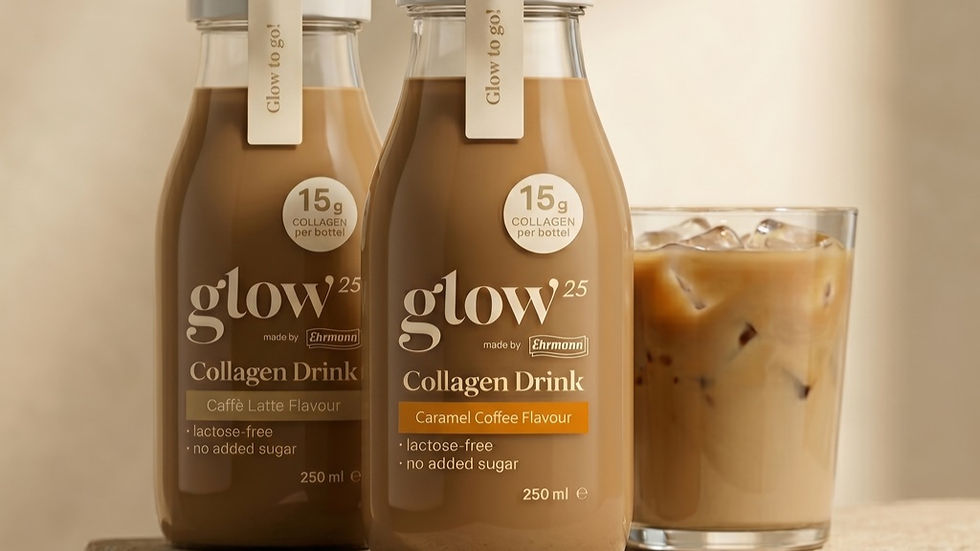
- Ehrmann and Glow25 will launch Glow To Go Coffee in Caramel and Caffé Latte flavours from 3 August.
- Each 250ml glass bottle contains 15g of bovine collagen hydrolysate.
- The products will be sold through German grocery, drugstore, online marketplace, and direct-to-consumer channels.
Ehrmann has partnered with Glow25 to launch a collagen ready-to-drink coffee range in Germany, combining dairy beverage production with the country’s fast-growing ingestible beauty market.
The Glow To Go Coffee range will launch on 3 August in Caramel and Caffé Latte flavours. Each 250ml glass bottle contains 15g of bovine collagen hydrolysate, alongside coffee, caffeine, and added micronutrients. The products will be available through German food retailers including REWE, Edeka, and Kaufland, selected drugstores, Amazon, and Glow25’s online shop.
The collaboration brings together Ehrmann’s dairy manufacturing and distribution capability with Glow25’s collagen brand platform. Ehrmann is one of Germany’s established dairy groups, while Glow25 has built its position through collagen supplements and beauty-from-within products.
The product shifts collagen further into mainstream chilled beverage territory. Powdered supplements and capsules remain important parts of the category, but an RTD coffee gives collagen a more familiar daily consumption occasion. That creates a different set of formulation and manufacturing demands, especially where the product carries a meaningful protein dose in a visible glass bottle.
Collagen beverage development is technically unforgiving. Protein behaviour, flavour masking, sweetness, coffee bitterness, heat treatment, sediment control, viscosity, mouthfeel, and shelf-life stability all have to be balanced. A product that tastes like a supplement will struggle outside specialist channels; a drink that loses its functional identity risks becoming another flavoured coffee in a crowded fixture.
The 15g collagen dose gives the range a clear functional profile, but it also increases the burden on processing control. Ingredient hydration, mixing sequence, thermal stability, filling accuracy, closure performance, and chilled distribution all affect product quality. Glass packaging adds premium cues, although it also requires careful line handling, impact control, and logistics discipline.
Chilled coffee has become a more active manufacturing space as brand owners pair familiar beverage occasions with new processing and distribution models. The launch of chilled RTD coffee from Lavazza and Müller showed how established coffee and dairy capability can be combined to build a refrigerated beverage platform, while Nescafé launches linked to Nestlé’s Dalston investment connected coffee NPD with factory capability and scale.
Ehrmann and Glow25 are working in the same direction, although with a stronger functional nutrition layer. RTD coffee already offers convenience, flavour familiarity, and retail visibility. Adding collagen moves the product into a cross-category space covering chilled dairy, beauty nutrition, functional drinks, and premium convenience.
That cross-category structure can help distribution, but it also complicates merchandising and price architecture. Grocery shoppers may compare the bottle with chilled coffees, while supplement users may compare it with collagen powders or sticks. The product therefore has to justify its price through flavour, dose, convenience, and credibility rather than relying on novelty alone.
Functional beverage launches also depend on claims discipline. Beauty-from-within products are exposed to scrutiny around nutritional messaging, ingredient evidence, and consumer expectations. The presence of collagen, biotin, niacin, selenium, and caffeine creates a layered product proposition, but labelling and communication must remain within regulatory boundaries.
Dairy processors are increasingly seeking higher-value beverage routes as conventional formats face margin pressure. Functional RTD coffee offers one route, combining existing chilled capability with premium ingredients and branded partnerships. The manufacturing challenge is to make those ingredients behave like part of the drink rather than a supplement dispersed into a bottle.
The Ehrmann and Glow25 launch gives the German market another test of whether collagen can move from supplement routine into everyday chilled beverage consumption. Its success will depend less on the presence of collagen itself than on whether the product can deliver stable quality, strong flavour, and repeatable manufacturing performance at retail scale.