IN Brief:
- Six national associations have established a European federation for processing and packaging machinery.
- EUROPAMA will address PPWR implementation, machinery regulation, automation, artificial intelligence, and industrial competitiveness.
- The organisation will give equipment manufacturers a coordinated voice as European technical and environmental rules develop.
EUROPAMA has been established as a European federation for the processing and packaging machinery industry, bringing together six national associations to coordinate their work on regulation, technology, and industrial policy.
Automate UK has joined Germany’s VDMA, Italy’s UCIMA, France’s EVOLIS, Spain’s AMEC, and Switzerland’s Swissmem as founding members. The federation was formally established during interpack 2026 in Düsseldorf and will represent machinery manufacturers, automation suppliers, system integrators, and associated engineering businesses in discussions with European institutions.
Its initial agenda includes the Packaging and Packaging Waste Regulation, machinery safety, automation, robotics, artificial intelligence, sustainability, trade, and the competitiveness of European manufacturing. Although each association will continue to represent its domestic membership, EUROPAMA will provide a common platform where policy decisions affect equipment suppliers across several markets.
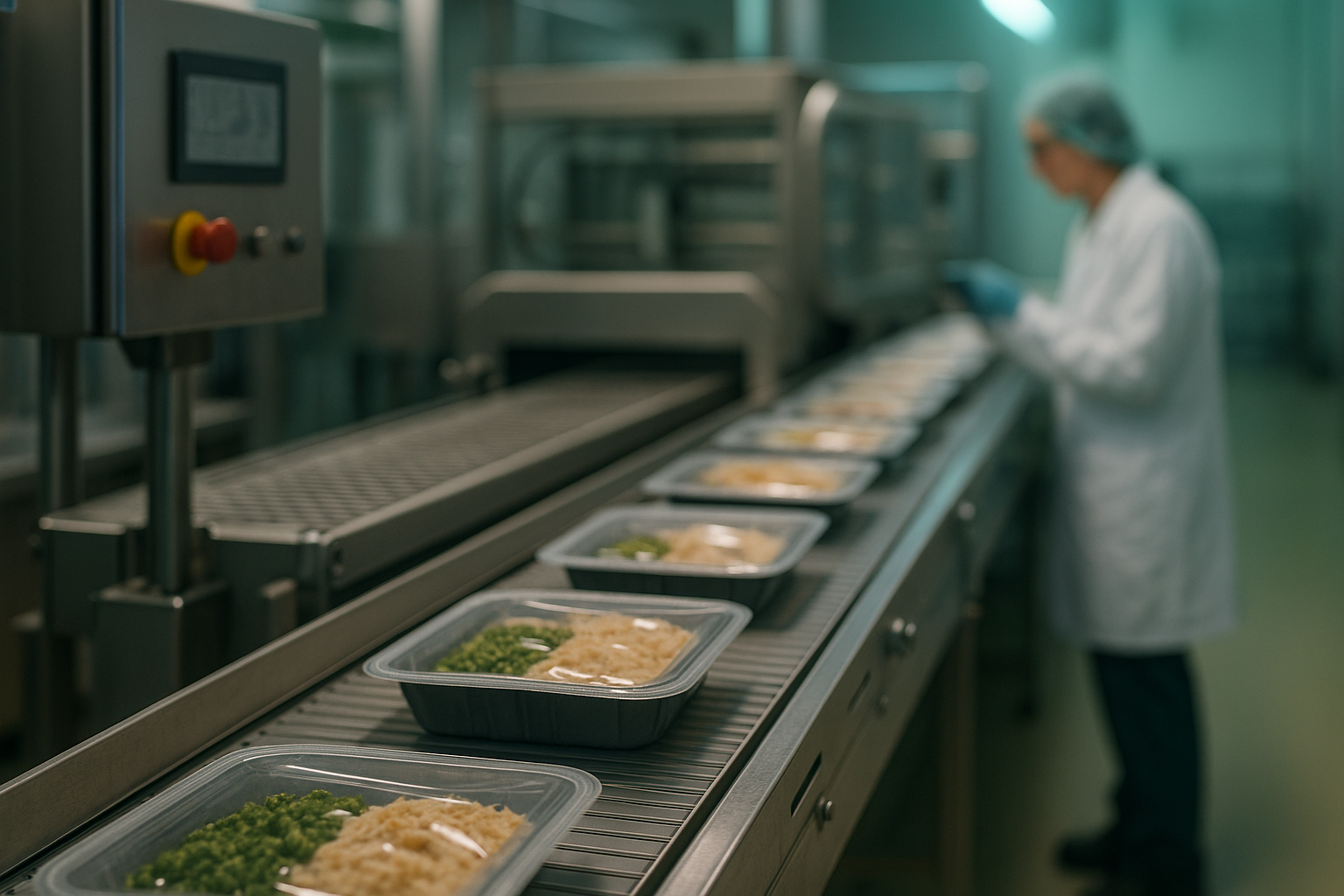
Processing and packaging machinery increasingly sits at the intersection of environmental regulation, product safety, digital policy, and factory productivity. Food manufacturers are being required to reduce packaging, increase recyclability, improve material reporting, cut energy consumption, and provide more detailed production data, while maintaining hygiene, line speed, shelf life, and product protection.
Many of those requirements ultimately become engineering specifications. A change from one packaging material to another can alter sealing temperature, dwell time, stiffness, friction, electrostatic behaviour, forming performance, coding quality, and inspection accuracy. Even apparently modest lightweighting projects can affect how packs are denested, conveyed, filled, closed, and palletised.
Packaging regulation reaches machinery design
The EU Packaging and Packaging Waste Regulation will be one of EUROPAMA’s most substantial areas of work as detailed implementation measures are developed. Requirements covering packaging minimisation, recyclability, reuse, recycled content, and labelling will influence the materials and formats that production machinery must accommodate.
Food packaging presents particular engineering constraints because its environmental performance cannot be separated from barrier properties, seal integrity, migration controls, contamination risk, and shelf life. A format that uses less material may still increase total waste if it causes more seal failures, product damage, or premature spoilage.
Equipment suppliers are consequently becoming involved earlier in packaging development, rather than receiving a completed pack specification shortly before a line trial. Machinery must often operate across a wider processing window, store more product recipes, capture more quality data, and switch between materials that behave differently under heat, pressure, and mechanical handling.
The expansion of aluminium wine-bottle production at Kingsland Drinks demonstrates how material selection extends into filling capability, container handling, freight weight, breakage risk, and producer responsibility costs. Comparable interactions are appearing across fibre trays, recyclable films, mono-material laminates, lightweight containers, and reusable packaging systems.
Common technical positions could help prevent European rules from being interpreted differently in individual countries. Divergent national requirements increase documentation, conformity assessment, software configuration, line validation, and service costs, particularly when equipment is sold into several markets.
Software becomes part of machinery compliance
Automation policy will run alongside the packaging agenda as connected machinery, remote diagnostics, vision inspection, predictive maintenance, and artificial intelligence become more widely embedded in production systems. These technologies can increase throughput and reduce unplanned downtime, although they also introduce questions around data ownership, cybersecurity, software updates, and responsibility for automated decisions.
A filling or packaging line may remain in service for two decades, while its network architecture, control software, and regulatory environment change repeatedly. Machinery builders must support installed equipment without weakening security or creating compatibility problems between newer software and older control platforms.
Artificial intelligence adds another layer because machine-learning systems can change how inspection, process adjustment, and maintenance decisions are made. Regulators and manufacturers will need to distinguish between systems that merely support an operator and those that directly alter a safety- or quality-critical process.
Smaller machinery companies face the same obligations as larger groups but have fewer internal resources for regulatory analysis, cybersecurity, software governance, and international compliance. A coordinated federation could reduce duplicated work by producing common interpretations, technical guidance, and evidence for policymakers.
European equipment manufacturers retain strong positions in specialist engineering, hygiene, automation, and after-sales support, yet higher labour, energy, and compliance costs continue to narrow margins. Competition from lower-cost suppliers is also increasing, particularly where buyers prioritise initial capital price over lifetime performance and support.
EUROPAMA will be judged by the technical detail it brings to policy discussions and the practical guidance it provides once regulations are adopted. Its founding associations already hold substantial sector knowledge; combining that expertise should give machinery manufacturers greater influence over rules that will shape factory investment for years to come.