IN Brief:
- Germany’s reusable beverage packaging share reached 34.5% in 2024, up 0.2 percentage points year on year.
- Beer achieved 78.1% reuse, while water reached 45.8% and soft drinks remained at 22%.
- Higher reuse will require filling, washing, standardised container pools, retail returns, and reverse logistics rather than deposit collection alone.
Germany’s Environment Agency has found that reusable containers accounted for 34.5% of beverages covered by the national deposit framework in 2024, leaving the market less than halfway towards the 70% objective set in the Packaging Act.
The share increased by 0.2 percentage points from 2023, yet the longer trend remains weak. Reusable packaging represented 63.7% of the relevant beverage market in 2003, when the deposit system was introduced, while the rate moved within a narrow band of 33.2% to 34.5% between 2020 and 2024.
Ready-to-drink products in pack sizes up to ten litres are included in the assessment, which draws on official statistics, market research, industry data, imports, and exports. The results divide the market between reusable glass, reusable plastic, single-use plastic, cans, cartons, and other formats.
Beer remained the strongest category, with 78.1% sold through reusable packaging in 2024, although the rate declined by 0.4 percentage points from the previous year. Reusable glass accounted for 4.831bn litres, while reusable kegs of up to ten litres represented a smaller but growing volume.
Water recorded a reusable share of 45.8%, covering 6.282bn litres. Reusable glass gained both volume and share, whereas reusable plastic increased slightly in volume but lost 0.1 percentage points of market share.
Soft drinks remained considerably lower at 22%, with consumption in reusable plastic bottles falling as beverage cans and cartons gained ground. Juice and nectar recorded a reusable share of approximately 12.3%, while milk and milk-based drinks stood at about 2.1%.
Several of those categories have historically relied on cartons, lightweight PET, and single-use containers rather than refillable bottle pools. Their filling plants, retail routes, and distribution networks were developed around different handling and storage assumptions, leaving a larger investment requirement if reuse is to expand.
Across the overall packaging mix, single-use plastic bottles fell to 38.6% of beverage consumption in 2024, down 2.1 percentage points from 2020. Beverage cans continued to gain share, reaching 5.8%, while cartons accounted for 13.1%.
Reuse depends on filling and return capacity
The legal objective has not rebuilt the infrastructure needed to wash, inspect, refill, store, and redistribute containers. Brewers and mineral-water companies with established bottle pools, crate fleets, regional distribution, and high return rates can operate reuse at scale, whereas categories built around aseptic cartons or long-distance supply face a different cost base.
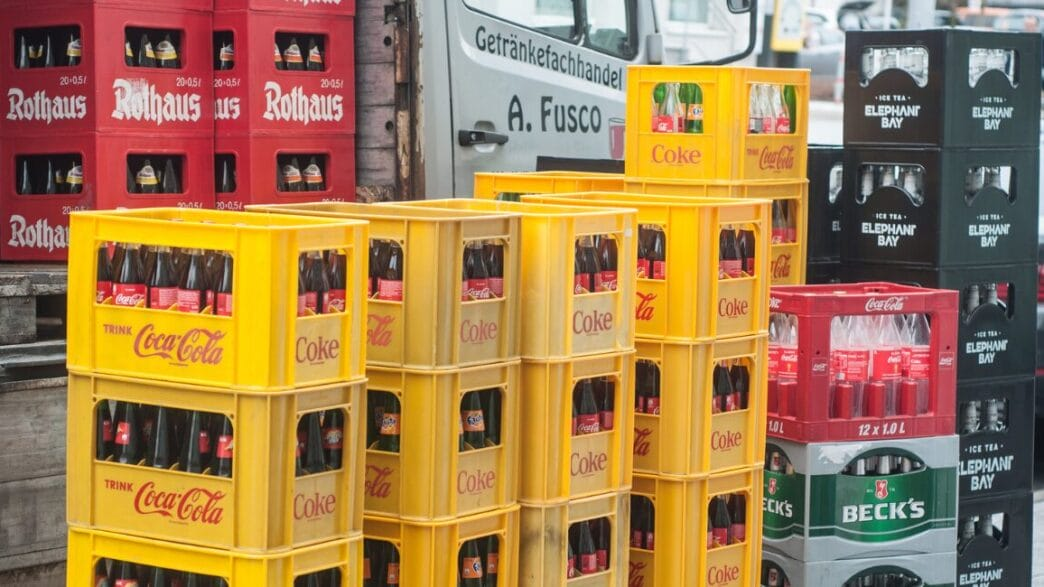
Returnable glass is durable and familiar but heavy, so its performance depends on transport distance, vehicle utilisation, rotation count, washing efficiency, and breakage. Reusable PET lowers transport weight, although bottles need controlled inspection and retirement criteria as repeated washing and filling affect appearance and material condition.
Every returned container must be sorted, depalletised, inspected, washed, filled, closed, packed, and dispatched again. Mixed pools, proprietary bottle shapes, damaged labels, scuffing, and foreign objects can slow those stages, while standard formats improve automated handling and reduce the number of change parts held at the plant.
The contrast between beer and soft drinks reflects category structure as much as consumer preference. Beer retains strong regional and on-trade reuse systems supported by crates, returnable glass, and kegs, while soft drinks rely more heavily on national distribution, convenience formats, multipacks, and cans.
Deposit collection supports recycling but does not automatically increase reuse. A can or single-use PET bottle may achieve a high collection rate and still leave the packaging system after one filling cycle, whereas reusable containers must return in suitable condition and re-enter production several times.
European packaging policy is developing alongside these national systems, and Joint Research Centre estimates on packaging volumes have reinforced the scale of the reduction, recycling, and reuse work accompanying the Packaging and Packaging Waste Regulation.
Retail networks carry a substantial part of the operational burden because stores need collection points, storage space, staff procedures, and scheduled backhaul. Distributors must return empties without compromising outbound vehicle utilisation, while fragmented convenience channels can make the reverse leg expensive and difficult to consolidate.
Hygiene requirements also differ between products. Refillable packs need reliable caustic washing, residue detection, foreign-object inspection, closure control, and traceability, while dairy and juice applications may require more demanding cleaning and microbiological validation than water or standard beer.
Manufacturers cannot add reuse capacity through filling equipment alone. Bottle and crate pools, washers, inspection systems, storage, wastewater treatment, utilities, return logistics, and retailer participation all have to grow together, with enough container rotations to recover the additional capital and operating cost.
Germany already possesses one of Europe’s most developed deposit and return systems, yet its reusable share has settled at roughly half the statutory objective. Reversing that pattern will require coordinated investment across plants, container pools, washing operations, retail returns, and transport rather than another target applied to infrastructure that has continued to contract.