IN Brief:
- KHS has updated its Innokeg Contikeg and Combikeg cleaning and filling platforms.
- The Contikeg can process returnable containers from approximately five to 58 litres at up to 1,200 kegs an hour.
- Hygiene, resource control, machinery safety, and connected-system security have been integrated into the redesign.
KHS has redesigned its Innokeg Contikeg and Combikeg systems, updating keg cleaning and filling around higher availability, improved hygiene, safer operation, and tighter control of energy and process media.
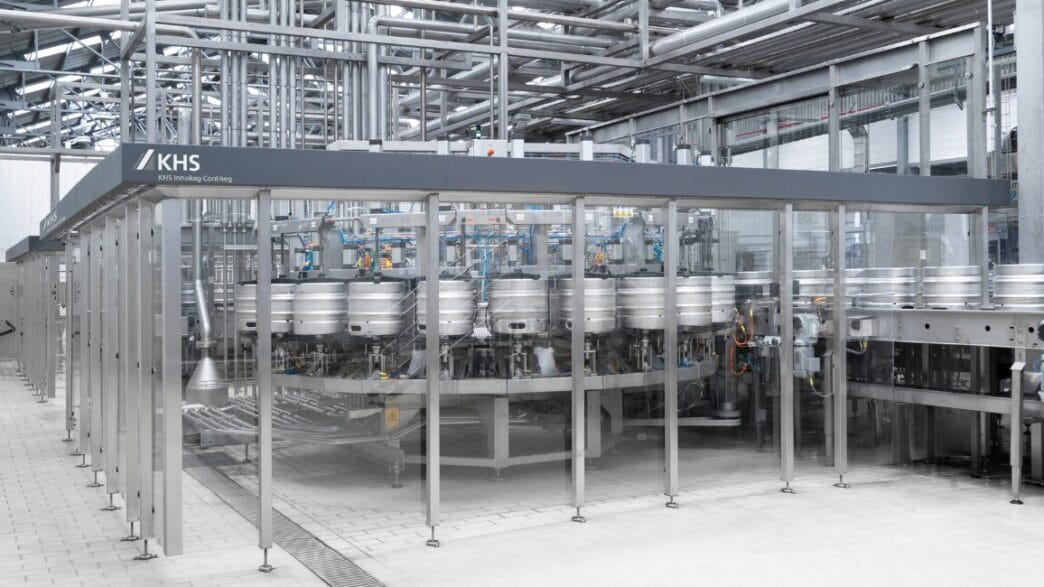
The new generation handles returnable containers from approximately five to 58 litres. At the higher-output end, the Innokeg Contikeg uses a continuous carousel to clean and fill as many as 1,200 kegs an hour, allowing large breweries and beverage plants to sustain draught production without dividing the process across several smaller machines.
Kegs remain connected throughout the circular machine sequence as they move through the required cleaning and filling stages. That continuous flow supports process stability at high speed, while an integrated central manifold controls media movement and reduces the number of individual valve actuations required during the core cycle.
Media supply has been revised through a new valve manifold drawn from KHS filling technology, replacing the previous L-shaped transfer arrangement. Fewer complex transfer points can simplify cleaning, maintenance, and fault finding, provided the manifold continues to deliver the pressure, temperature, and chemical concentration required at each stage.
Hygienic performance centres on a hydromechanical cleaning process that uses pulsating spray and as many as three chemical cleaning agents. Returnable kegs arrive with an uncertain history, so residual product, external contamination, damaged fittings, and incomplete drainage must be controlled before filling begins.
The product range extends beyond conventional beer to mixed beer drinks, wine, whisky and soda, water, soft drinks, and juice. As breweries add alcohol-free and 0.0% products, lower alcohol content removes part of beer’s natural microbiological protection and places greater weight on validated cleaning, filtration, pasteurisation, hygienic transfer, and oxygen management.
Machine safety has also been revised through improved door switches, protective enclosures, and carbon dioxide extraction. Keg lines operate around pressurised containers, chemicals, hot cleaning media, wet floors, moving machinery, and gas, so operator access and maintenance routines must be designed into the equipment rather than added after installation.
Connected kegging raises new control demands
Controls and security provisions have been developed with the direction of the EU Machinery Regulation, Cyber Resilience Act, and radio equipment requirements in mind. Modern filling assets exchange recipes, production orders, maintenance records, quality data, and remote-service information with wider plant systems, bringing software governance into day-to-day line reliability.
That connectivity can shorten diagnosis and improve production visibility, although remote access and machine interfaces have to be managed without weakening segregation between operational technology and corporate IT. Account control, patching, backups, and defined service permissions now sit alongside mechanical and hygienic maintenance.
Draught alcohol-free beer is expanding beyond specialist packaged ranges, and the acquisition of Days Brewing by Sunrise Beverages brought a 0.0% brand with a growing draught presence into a larger brewing and distribution platform. Greater on-trade availability increases demand for kegging systems capable of protecting sensitive products throughout filling and distribution.
Returnable containers connect filling performance with asset management. Each keg has to be returned, identified, inspected, cleaned, filled, tracked, and released back into circulation, while damaged spears, poor seals, residual pressure, and identification errors can interrupt the line or create quality failures.
Resource consumption accumulates across every rotation. Water, steam, compressed air, electricity, carbon dioxide, cleaning chemicals, and product losses all contribute to the cost of a filled keg, so more precise control of cleaning recipes and filling sequences can release savings across a large container pool.
Efficiency cannot be separated from validation, however, because shorter cleaning cycles or reduced chemical use must still achieve the required microbiological result. Plants need repeatable evidence from temperature, concentration, contact time, flow, and final-rinse controls before modifying established cleaning programmes.
Access for inspection and maintenance carries similar weight. Keg machines work in chemically aggressive, wet environments, and availability can deteriorate quickly when valves, seals, sensors, or pipework are difficult to reach. Better access can shorten intervention times and improve overall equipment effectiveness even when headline filling speed remains unchanged.
The Combikeg platform gives lower and medium-output producers access to the same design priorities without installing the largest continuous-carousel system. Regional breweries, contract packers, and beverage manufacturers can handle a wider product and container mix, although frequent changeovers still require controlled recipes, verified cleaning separation, and trained operators.
Europe’s returnable keg system is already one of the most established forms of packaging reuse, but the products moving through it are becoming more varied and microbiologically demanding. KHS has responded by treating hygiene, mechanical availability, connected control, and operator safety as a single equipment problem rather than separate upgrades.