IN Brief:
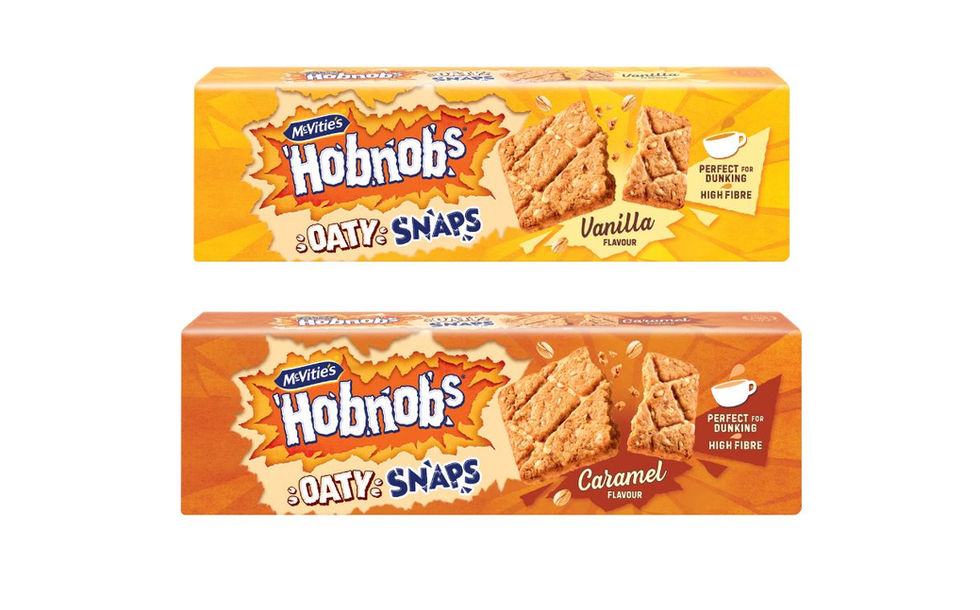
- Hobnobs Oaty Snaps will launch in Vanilla and Caramel using 100% wholegrain oats.
- The 167g packs are high in fibre, non-HFSS, and carry a recommended retail price of £1.49.
- Dough behaviour, baking, breakage, moisture control, and pack protection will determine whether the thinner format scales efficiently.
pladis is extending McVitie’s Hobnobs with two high-fibre, non-HFSS Oaty Snaps biscuits, using wholegrain oats and a thinner rectangular format to broaden the brand’s position in everyday sweet snacking.
Vanilla and Caramel variants are rolling out in 167g packs with a recommended retail price of £1.49. Both products use 100% wholegrain oats and are being listed across multiple retailers and discounters, including Tesco, Morrisons, and Iceland.
Oaty Snaps retain the cereal-led profile associated with Hobnobs while moving away from the established round biscuit. The rectangular shape, crisp texture, fibre content, and non-HFSS specification create a separate production and commercial proposition without changing the recipe of the core range.
Annalisa Fanali, marketing manager at pladis UK and Ireland, said: “Hobnobs Oaty Snaps offer a delicious and more permissible way to enjoy a biscuit break, bringing together great taste, satisfying texture and the benefits of wholegrain oats in every bite.”
Sweet biscuits depend on the interaction between flour, oats, sugar, fat, water, leavening, and heat for dough handling, spread, browning, flavour, and final structure. Reformulating around wholegrain ingredients and nutrient-profile limits can alter that balance before the product reaches the oven.
Wholegrain oats contribute fibre and flavour but also affect water absorption and dough consistency. Particle size, oat composition, flour blend, fat distribution, and mixing time can determine whether a thin biscuit remains crisp or becomes dense, fragile, unevenly coloured, or difficult to form.
The rectangular profile requires controlled sheeting, cutting or forming, transfer, and oven loading. Long edges and corners may be more exposed to breakage than a compact round biscuit, particularly during cooling, stacking, wrapping, case packing, and transport.
Texture has to be managed across that process because a pronounced snap depends on low and consistent moisture without making the biscuit excessively hard or brittle. Oven temperature, bake time, airflow, thickness, and cooling conditions influence both eating quality and mechanical strength.
Vanilla and caramel products may share a base dough, yet flavour systems can still change colour, sweetness, aroma release, and baking behaviour. Where the variants use common equipment, recipe management and line clearance must prevent unintended flavour carryover while keeping changeover losses proportionate to campaign size.
Fibre moves further into mainstream biscuits
Biscuits provide a familiar route for increasing fibre because cereal ingredients already form the structural base, but additional fibre can increase water demand, reduce spread, alter colour development, and create a dry or gritty finish. Successful formulations must deliver the claim without narrowing the processing window or weakening consumer acceptance.
The competition around fibre formulation is bringing more specialised ingredients into bakery and snacks, including systems intended to support texture, prebiotic positioning, sugar reduction, and the use of cereal or fruit side streams.
Non-HFSS status introduces a wider optimisation exercise because nutrient profile models consider several elements rather than fibre alone. Energy, saturated fat, sugar, sodium, fibre, protein, and qualifying fruit, vegetable, or nut content interact within the calculation, so one improved component cannot compensate indefinitely for the rest of the recipe.
Manufacturers are increasingly creating new extensions around revised formulations instead of changing long-established products. A separate shape or flavour can signal a different eating experience while protecting the sensory profile of the core line, reducing the risk that loyal buyers interpret reformulation as a loss of quality.
The £1.49 price point places Oaty Snaps within a competitive part of the biscuit aisle, leaving limited room for expensive ingredients or inefficient processing. Wholegrain inputs, formulation work, trials, packaging, and retailer margins have to be supported by high line utilisation and low waste.
Pack design must preserve the low-moisture texture produced in the oven. Moisture ingress can soften a crisp biscuit, while inadequate mechanical protection increases broken pieces and crumbs. Film barrier, seal integrity, internal arrangement, and headspace therefore influence both shelf life and distribution performance.
Packaging reduction can complicate that balance if thinner films or fewer protective components leave a fragile shape more exposed. Material savings need to be tested through line trials, transit work, and shelf-life studies rather than assessed by pack weight alone.
A broad retail rollout creates an immediate forecasting challenge because launch fills can be followed by uneven repeat demand. Production teams must balance promotional volume, freshness, ingredient stocks, and packaging inventories while retaining enough flexibility for the established Hobnobs portfolio.
Shared ingredients and equipment can reduce some exposure, although shape-specific tooling and dedicated printed packaging still require sufficient volume. Campaigns that are too short raise changeover losses, whereas campaigns that are too long increase finished-goods stock and the risk of slower sell-through.
Oaty Snaps give pladis a wholegrain, fibre-led extension with a visibly different shape and a formulation capable of wider promotional placement. Its durability on the line and through distribution will be as important as flavour, since a thin biscuit must retain its snap without arriving at retail as crumbs.