IN Brief:
- Food Process Engineering Ltd has been fined £50,000 following the death of worker Steven Tervit.
- Cleanroom wall panels collapsed after roof removal left the structure without adequate lateral support.
- Risk assessment, temporary works, communication, and dismantling planning were found to be deficient.
Food Process Engineering Ltd has been fined £50,000 after a worker died when unsupported cleanroom wall panels collapsed during dismantling work at a technology facility in Renfrew.
Steven Tervit, aged 32, was working from a scissor lift approximately four metres above the floor when the panels fell on 9 November 2022. The collapse struck the platform and ejected him onto the concrete floor.
Tervit sustained a traumatic brain injury, rib fractures, lung contusions, and fractures to his right thigh and left shin. He died in hospital the following day.
The work was taking place at the National Manufacturing Institute Scotland facility in Westway Business Park, where Food Process Engineering had been subcontracted to remove a cleanroom enclosure previously used to house a welding robot.
Constructed around a steel frame, the cleanroom had walls and a roof made from polyurethane composite panels measuring approximately 6.1 metres in height. Once the roof was removed, sections of the remaining wall system no longer had enough lateral restraint to remain stable.
The company’s risk assessment and method statement did not adequately address the possibility of an uncontrolled structural collapse. Although the method referred to A-frame props or supports where required, no such supports were being used when the incident occurred.
Visual inspections had been carried out before work began, after which the structure was assumed to follow a standard construction arrangement. That assumption failed to account for hidden defects, previous alterations, unknown fixings, and the changing load path as components were removed.
The investigation also found that the risk assessment and method statement had not been effectively communicated to the employees undertaking the dismantling. Food Process Engineering pleaded guilty to breaches of health and safety legislation and received a £50,000 fine with a £3,750 victim surcharge.
Dismantling creates a changing structure
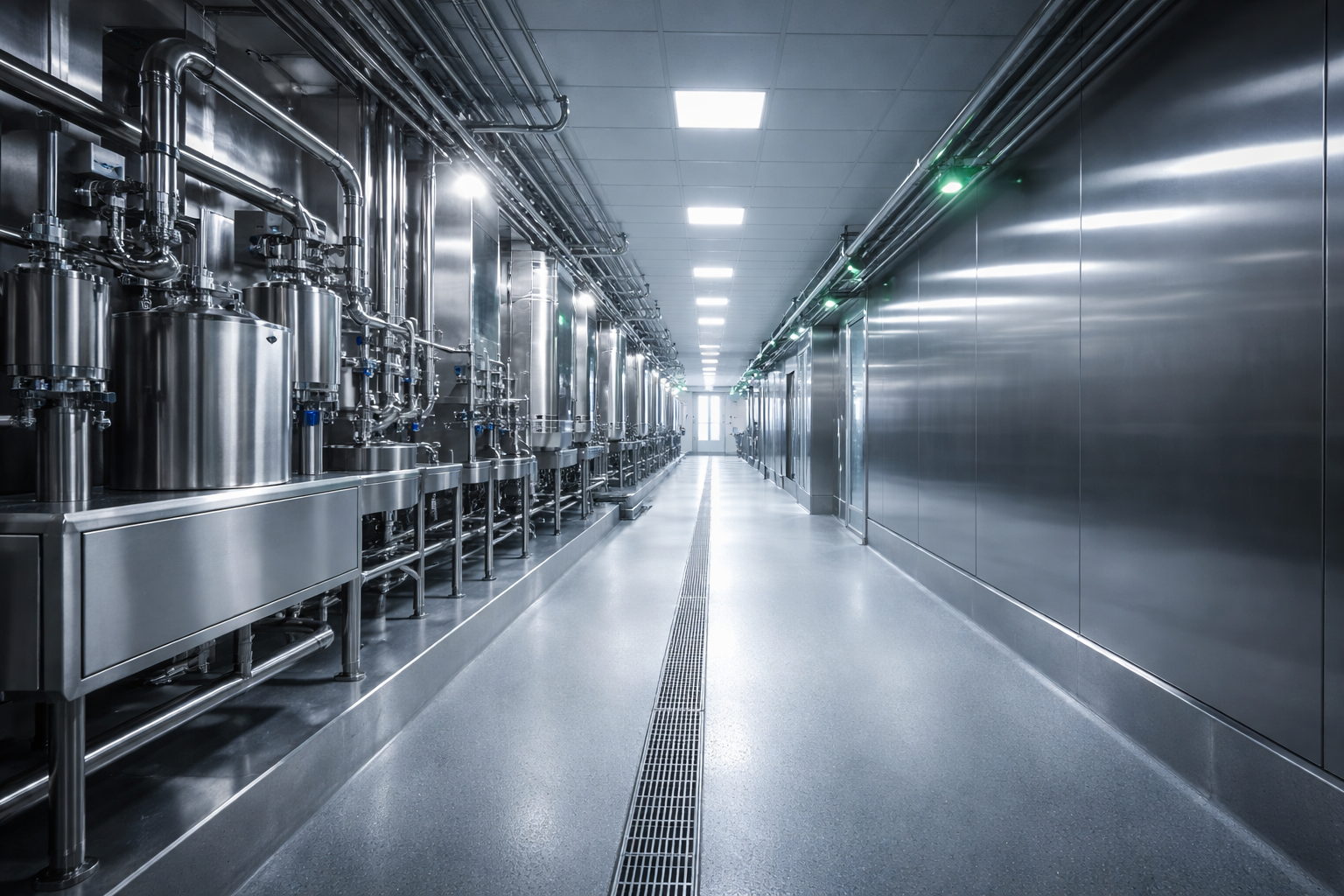
Cleanrooms, cold rooms, hygienic enclosures, fire-rated partitions, and insulated processing areas can appear modular, although their stability may depend on the completed assembly. Roof panels, walls, frames, fixings, and adjoining structures can provide mutual restraint.
During construction, each new support or connection moves the structure towards its finished condition. Dismantling reverses that sequence, leaving temporary arrangements that may never have existed in the original build.
Removing one component can transfer load into another or release restraint that is not visible from the outside. A wall that has remained stable for years can become vulnerable immediately after the roof, adjoining panel, or fixing is removed.
Food and beverage plants frequently alter hygienic enclosures during their operating lives. Doors, service penetrations, ceilings, conveyors, refrigeration equipment, drainage, cable routes, and local repairs may change the way loads move through the structure.
Original drawings may be incomplete or unavailable, while a panel system installed by one contractor can be modified later by several others. Visual inspection alone cannot establish every fixing, hidden defect, corrosion point, or previous alteration.
Temporary works should address that uncertainty through bracing, propping, exclusion zones, controlled sequencing, lifting plans, and inspection hold points. Supports must be designed and installed before permanent restraint is removed.
The scissor lift introduced a connected risk rather than a separate one. Mobile elevating work platforms provide access at height, but they do not protect an operator when an adjacent structure can collapse into or strike the platform.
Work-at-height controls therefore need to account for falling components, platform position, escape routes, exclusion areas, and the behaviour of the structure being dismantled. A stable access platform cannot make unstable surrounding work safe.
Food factories often schedule panel removal and installation during short shutdowns because temperature-controlled or hygienic areas cannot remain open for extended periods. Production deadlines, refrigeration work, electrical isolation, sanitation, and several contractors may compete within the same programme.
Time pressure cannot change the engineering sequence. Where the remaining structure needs temporary support, that support has to be installed, verified, and retained until the relevant panels are safely removed.
Composite panels also present handling difficulties because their relatively light construction can disguise their overall dimensions. Large panels can move suddenly once fixings are released, while their surface area makes them vulnerable to air movement and difficult to control manually.
A suitable method statement should identify the exact removal sequence, support arrangement, lifting method, worker position, exclusion zone, supervision, and stop points. Generic wording about safe dismantling provides little control when the structure changes after every operation.
Communication then turns the written method into the physical task. Briefings, drawings, permits, supervision, and confirmation of each hold point allow workers to understand what must remain supported and when the next stage may begin.
Manufacturers commissioning shutdown work retain an interest even where a specialist contractor controls the activity. Available drawings, site modifications, service information, access constraints, and coordination between contractors all affect whether the project can proceed safely.
Falls from height accounted for 31 workplace deaths in Britain during 2025/26, approximately one-quarter of the annual total. The Renfrew incident also shows that the initiating failure may lie in structural stability rather than the access equipment itself.
Before dismantling began, the essential questions were whether the panels depended on the roof for restraint, what would replace that restraint, and who would verify the temporary support. Those questions remained unresolved when workers entered the scissor lift.
Cleanrooms are built to create tightly controlled environments, but their removal demands equally controlled engineering. Once permanent restraint is disturbed, assumptions about standard construction are no substitute for a verified dismantling design.