IN Brief:
- Fortress Technology is marking 30 years since it began developing food inspection systems.
- Metal detection has moved from standalone end of line control towards automated, connected, and data-driven verification.
- Future systems are expected to combine multiple inspection technologies within smaller, more intelligent equipment footprints.
Fortress Technology is marking its 30th anniversary as food inspection moves from manually supervised metal detection towards connected systems operating on highly automated lines.
When the business was established in 1996, packaging lines commonly employed between 10 and 15 people to monitor machinery, adjust settings, conduct checks, and respond to stoppages. Inspection was frequently treated as a reactive safeguard positioned near the end of production.
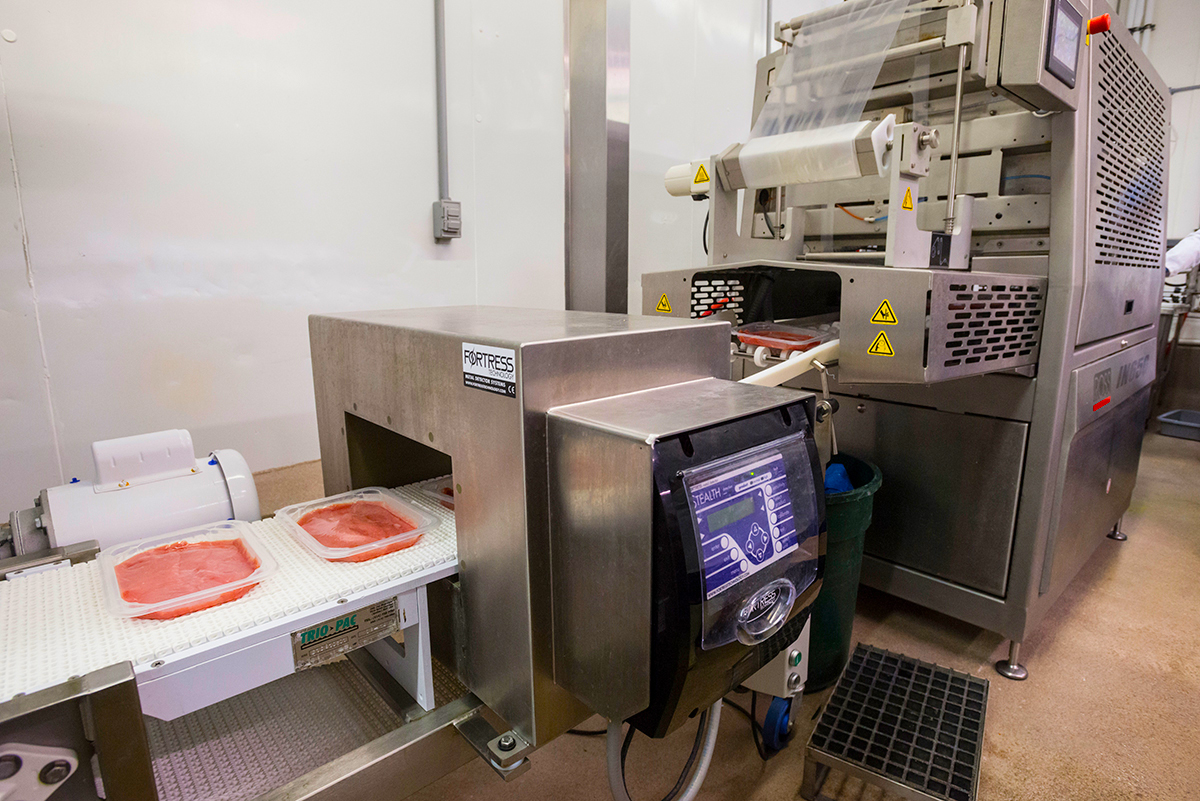
Fortress Technology now supplies metal detection, X-ray, checkweighing, conveyors, reject systems, and data-reporting technology across international food markets. Modern plants may process between 200 and 300 packs per minute with considerably less direct operator intervention.
Founder and president Steve Gidman describes the contrast as a move towards factory floors resembling a “ghost town”, where fewer people supervise more equipment and each manual intervention carries greater operational significance.
The company’s early development concentrated on straightforward operation at a time when inspection interfaces were becoming increasingly complicated. Additional functions could lengthen training, increase setting errors, and make routine maintenance more difficult when they were poorly matched to production tasks.
Gidman said: “One of the things we really concentrated on from the outset was to make a machine that you could walk up to without a manual, look at the buttons and know what to do.”
That philosophy has continued into the touchscreen interface unveiled at Interpack 2026. Its controls are designed to manage more products, audit functions, test routines, user permissions, and data requirements without turning a routine changeover into a specialist engineering task.
Food-safety regulation has developed alongside the equipment. The US Food Safety Modernization Act increased the emphasis on prevention in 2011, while retailer standards, certification schemes, customer codes, and traceability rules have expanded the evidence expected from inspection systems.
Detection must demonstrate its own performance
A metal detector cannot be considered compliant solely because it is installed and operating. Manufacturers must demonstrate that the machine achieved the required sensitivity, received tests at defined intervals, operated with an effective reject system, and prevented rejected packs from returning to production.
Manual challenge testing becomes more difficult on high-speed lines with limited staffing. An operator may have to introduce certified test pieces, retrieve them safely, confirm the reject, record the result, and restore production without losing control of the surrounding products.
Fortress developed its Halo Automatic Testing System to automate parts of that process before Industry 4.0 terminology became widely used. Automatic testing can reduce interruption and operator exposure while creating a more consistent record.
Gidman said: “When we look back to 1996, food processing staff had the ‘extra bandwidth’ to calibrate a machine and perform tests manually. Now, fewer employees are expected to manage more high-priority systems. On a high-speed line, asking an employee to manually insert and retrieve test pieces is a liability risk and inefficient.”
Automated tests still require validation against the contaminants, products, speeds, and reject conditions represented by the programme. A successful electronic sequence does not compensate for a damaged belt, blocked reject, incorrect recipe, or test piece that no longer represents the required standard.
Digital records have become increasingly important as retailers and restaurant groups request detailed evidence covering tests, setting changes, alarms, rejects, and corrective action. The US Food Traceability Final Rule, now scheduled for implementation in 2028, is expected to reinforce the move away from disconnected paper logs.
Upstream inspection has also gained prominence. A large contaminant can be relatively straightforward to detect in an agricultural product or bulk ingredient, whereas grinding, chopping, or mixing machinery may fragment it into many smaller pieces distributed through a far larger volume of food.
Inspection after harvest, before primary processing, or at ingredient intake can remove contamination before machinery multiplies the problem. Final-pack inspection remains necessary, but it becomes one layer within a wider system rather than the only barrier.
The relationship between inspection accuracy and manufacturing waste extends beyond recalls. False rejects, excessive giveaway, repeated manual tests, and poorly diagnosed faults consume material and production time even where no unsafe food leaves the factory.
Fortress has developed its “Never Obsolete” approach around modular upgrades to software, electronics, communications, and sensing capability. Some early analogue systems remain in operation after digital upgrades, avoiding complete replacement of mechanically serviceable equipment.
Future systems are expected to place metal detection, checkweighing, X-ray, and vision within more compact frames. Data from one module could inform another, allowing weight, orientation, density, contamination, and pack presentation to be considered together.
AI may improve the distinction between acceptable product variation and defects, although its performance will still depend on representative data, controlled rejects, validated limits, cleaning, belt condition, and operator understanding.
The hardware has changed substantially over three decades, but the objective remains constant: detect contamination, prove that the control operated, and stop affected food from moving forward. Future systems will be judged by how consistently they achieve that with less floor space, less manual intervention, and stronger evidence.