IN Brief:
- Nurmo is designed to produce around 100 GWh of liquefied biogas annually from manure and food-industry by-products.
- Suomen Lantakaasu, Atria, Valio, and St1 Biokraft connect agricultural residues, food production, transport fuel, and nutrient recycling through the project.
- Raw biogas production is under way, while the liquefaction stage is scheduled to start later this autumn.
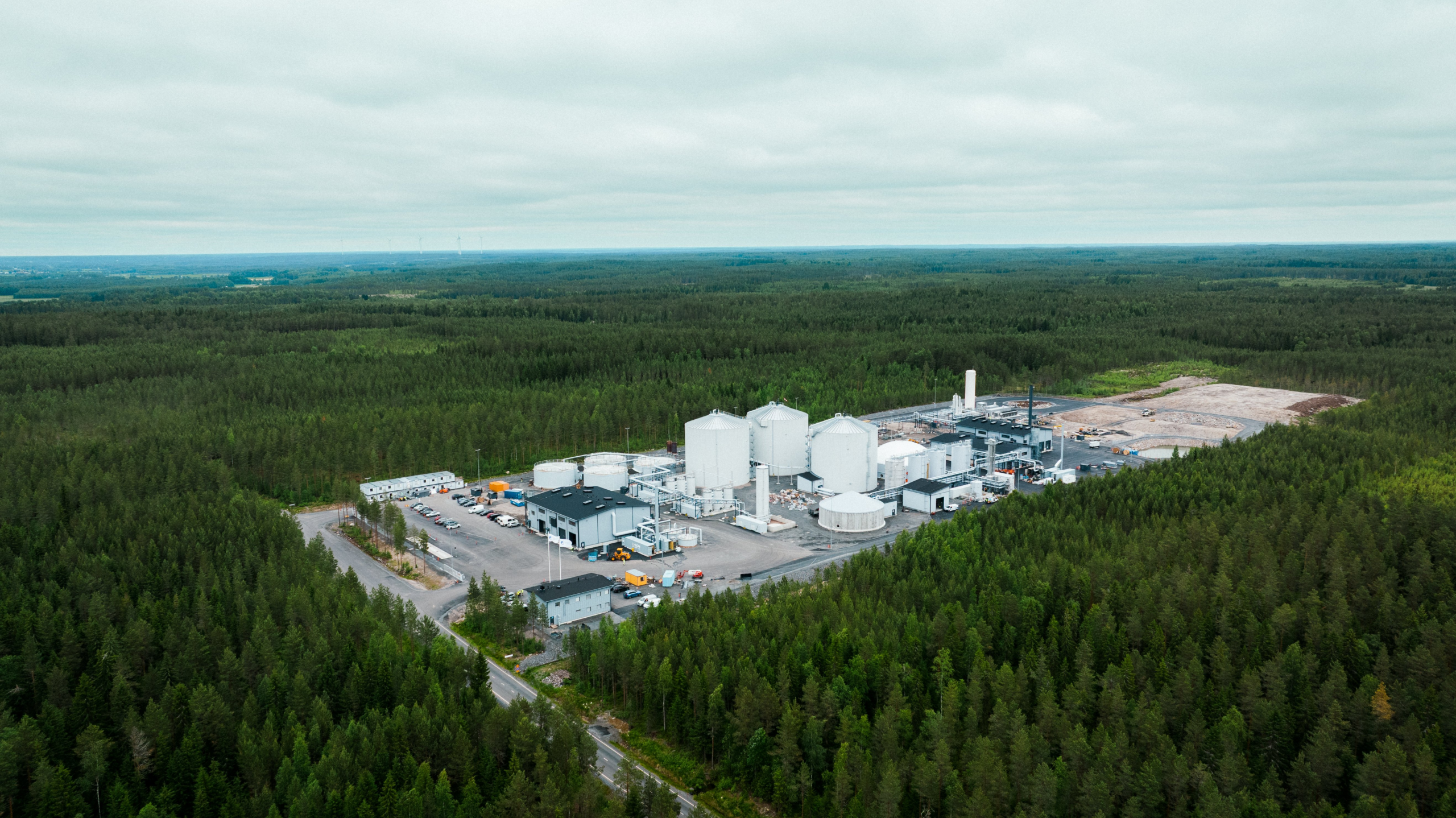
Suomen Lantakaasu has inaugurated Finland’s first industrial-scale liquefied biogas production facility at Nurmo in South Ostrobothnia, creating a new processing route for manure and food-industry by-products from one of the country’s main food-producing regions. The plant is designed to produce around 100 GWh of liquefied biogas annually, equivalent to approximately 10 million litres of diesel.
The development has been delivered through Nurmon Bioenergia Oy, which is majority-owned by Suomen Lantakaasu, with Atria Finland as a minority shareholder. Suomen Lantakaasu is itself a joint venture between St1 Biokraft and Valio, linking agricultural supply, dairy production, meat processing, energy, and transport within the same project.
Commercial commissioning is taking place in stages. More than 30,000 tonnes of manure have already been received, and raw biogas production is under way, while liquefaction is scheduled to begin later this autumn. The 100 GWh figure therefore represents designed annual capacity rather than current finished-fuel output.
Feedstocks include manure from local farms alongside agricultural and food-industry by-products. Anaerobic digestion converts that material into biogas, while the remaining digestate is processed for use as recycled fertiliser, keeping nutrients within agricultural production rather than treating them solely as waste.
Leena Helminen, CEO of Suomen Lantakaasu, said: “The project brings together food and energy production in a way that strengthens both security of supply and domestic renewable energy production.” She also linked the plant with new business opportunities around Finnish food production and lower dependence on fossil fuels.
The connection with Atria puts food manufacturing directly into the operating model. The company has a major production presence at Nurmo, and suitable food-industry side streams can now enter a regional treatment system designed to turn them into fuel and fertiliser products instead of remaining a disposal requirement.
Valio brings another large feedstock base through its dairy farmers. Manure that would otherwise be managed primarily at farm level can be collected into a larger industrial process, while participating farms can receive recycled fertiliser products produced from the digestate.
That approach builds on a wider expansion of biogas activity around Finnish dairy production. Valio has already been developing energy and nutrient-recycling activities alongside its core dairy business, an area also reflected in its broader growth and operational strategy.
The Nurmo installation is considerably more complex than a stand-alone farm digester. Industrial liquefied-biogas production requires feedstock reception and storage, digestion, gas treatment and upgrading, liquefaction, finished-fuel handling, digestate processing, and a logistics system capable of feeding and emptying the plant continuously.
Reliable raw-material supply is critical because unused capacity quickly affects project economics. Positioning the facility within a dense agricultural and food-production region gives it access to multiple sources of manure and industrial by-products, reducing dependence on a single producer or seasonal stream.
Liquefaction adds another layer of capital and energy demand but increases the usefulness of the finished gas for applications where compressed gas is less practical. Suomen Lantakaasu and its partners are targeting heavy transport and other energy users that require a fuel with sufficient energy density for longer operating ranges.
Government support has helped bring the project to commissioning. Finland’s Ministry of Economic Affairs and Employment granted €9.4 million in energy investment aid, while the Ministry of the Environment provided €101,800 towards the biofertiliser loading tank.
The project also gives the participants a commercial test of nutrient recycling at scale. Digestate has to be handled as a usable agricultural input, with attention to nutrient value, storage, transport, application, and farm demand. Producing biogas alone does not close the loop if the remaining material becomes difficult or costly to manage.
Suomen Lantakaasu intends Nurmo to form part of a much larger national network. The company’s longer-term target is to develop a Finnish biogas ecosystem capable of producing one terawatt-hour of domestic renewable energy each year.
Reaching that scale will require additional plants, dependable feedstock contracts, fuel customers, logistics, and a market for recycled fertilisers. Nurmo provides the first industrial operating reference for that model, allowing the partners to test material collection, plant availability, liquefaction, and nutrient handling under commercial conditions.
The next milestone is straightforward: the liquefaction equipment has to enter operation later this autumn. Once that stage is running, the facility will complete the route from agricultural and food-production residues to liquefied fuel, providing a clearer measure of whether the 100 GWh design can be translated into reliable annual output.