IN Brief:
- Purina has opened a more than $550 million, 1.3 million-square-foot dry pet-food factory in Batavia, Ohio.
- The plant uses automated storage and retrieval, digital manufacturing technology, robotics, and advanced food-safety systems.
- More than 430 people currently work at Batavia, with employment expected to exceed 500 at full operation.
Nestlé Purina PetCare has opened a more than $550 million dry pet-food factory in Batavia, Ohio, combining automated storage, digital manufacturing, robotics, and advanced food-safety systems across a 1.3 million-square-foot site. The factory is Purina’s first new US plant built from the ground up since 1975.
The facility opened officially on 31 August following several years of construction and workforce development. It is already producing Purina Pro Plan, Purina ONE, and Dog Chow products and currently employs more than 430 people, with that number expected to rise beyond 500 when the plant is fully operational.
Located approximately 30 miles east of Cincinnati, Batavia becomes Purina’s 24th US factory and its second manufacturing site in Ohio alongside Zanesville, which has operated since 1973. The new plant has been designed to add capacity and flexibility to the company’s dry pet-food production network.
The internal logistics architecture is one of its more substantial manufacturing features. The plant rises more than ten storeys and includes an automated storage and retrieval system, allowing pallet and inventory movements to be managed through high-density automated storage rather than depending entirely on conventional warehouse handling.
At this scale, storage automation affects more than labour requirements. It can influence line replenishment, stock accuracy, traceability, finished-goods flow, forklift traffic, and the amount of floor area required around production. Integrating that system into a purpose-built factory also allows storage and production controls to be developed together rather than retrofitted around an existing building.
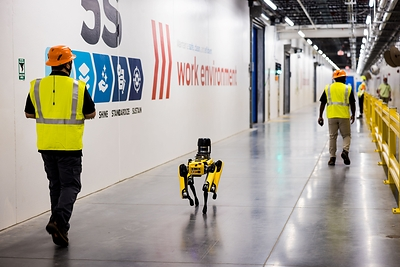
Purina has combined that infrastructure with digital manufacturing systems, robotics, and advanced food-safety controls. Boston Dynamics Spot robots are being used for thermal and acoustic inspections of machinery as part of the factory’s digital manufacturing programme.
The robots provide a mobile platform for collecting condition information from equipment while moving through production areas. Thermal and acoustic data can help maintenance teams identify abnormal heat or sound associated with developing faults in motors, bearings, pumps, conveyors, fans, and other machinery before a problem escalates into an unscheduled shutdown.
That application is more relevant to food production than the novelty of a four-legged inspection robot might suggest. High-throughput plants are vulnerable to relatively small equipment faults because a failed motor or bearing can stop upstream and downstream equipment, interrupt production planning, and create additional cleaning, product-loss, and restart costs.
Condition monitoring only becomes useful, however, when it feeds an effective maintenance system. Automated inspection can increase the frequency and consistency of machinery checks, but engineering teams still need appropriate alarm thresholds, asset histories, work-order processes, and experienced technicians capable of deciding when intervention is justified.
The same principle applies to the wider digital factory. Data collection, automated handling, and robotics can improve operational visibility, yet their value depends on whether they contribute to stable throughput, quality, maintenance response, and changeover performance rather than simply increasing the number of connected systems on the plant floor.
Food safety remains integral to that architecture. Dry pet-food production requires controlled ingredient handling, thermal processing, contamination prevention, traceability, sanitation, and finished-product quality systems. Purina describes Batavia as its most advanced manufacturing facility, but the industrial test will be whether the combined automation and control systems deliver repeatable output over sustained operation.
The scale of the site raises that bar. Purina says Batavia will help feed approximately eight million pets each year, meaning production machinery has to operate alongside inbound ingredients, packaging materials, warehousing, dispatch, utilities, maintenance, and staffing as one manufacturing system.
Greenfield construction gave the company more freedom to design those flows around automation from the start. Retrofitting automated warehouses or mobile robotics into existing food factories can be constrained by floor loading, ceiling height, hygiene zoning, access routes, legacy control systems, and the position of existing process equipment.
A new plant avoids some of those limitations, but commissioning remains demanding because machinery, software, operators, maintenance routines, quality systems, and material flows all have to reach stable production together. Batavia’s workforce plan also makes clear that a highly automated food factory still depends on engineers, operators, technicians, planners, and maintenance specialists.
The factory is already producing commercial product, moving the focus from construction into operating performance. As employment grows towards the planned 500-plus level, the useful measures will be throughput, asset utilisation, quality performance, maintenance effectiveness, and the extent to which the automated storage and digital systems deliver the flexibility for which the plant was designed.