IN Brief:
- ProAmpac developed the fibre-based tray around Circle K's Flamin' Hot boneless chicken recipe and portion size.
- The packaging brief covered heat retention, moisture loss, grease resistance, product visibility, and extended hot holding.
- The development links packaging structure directly to the operating conditions created by heated food display.
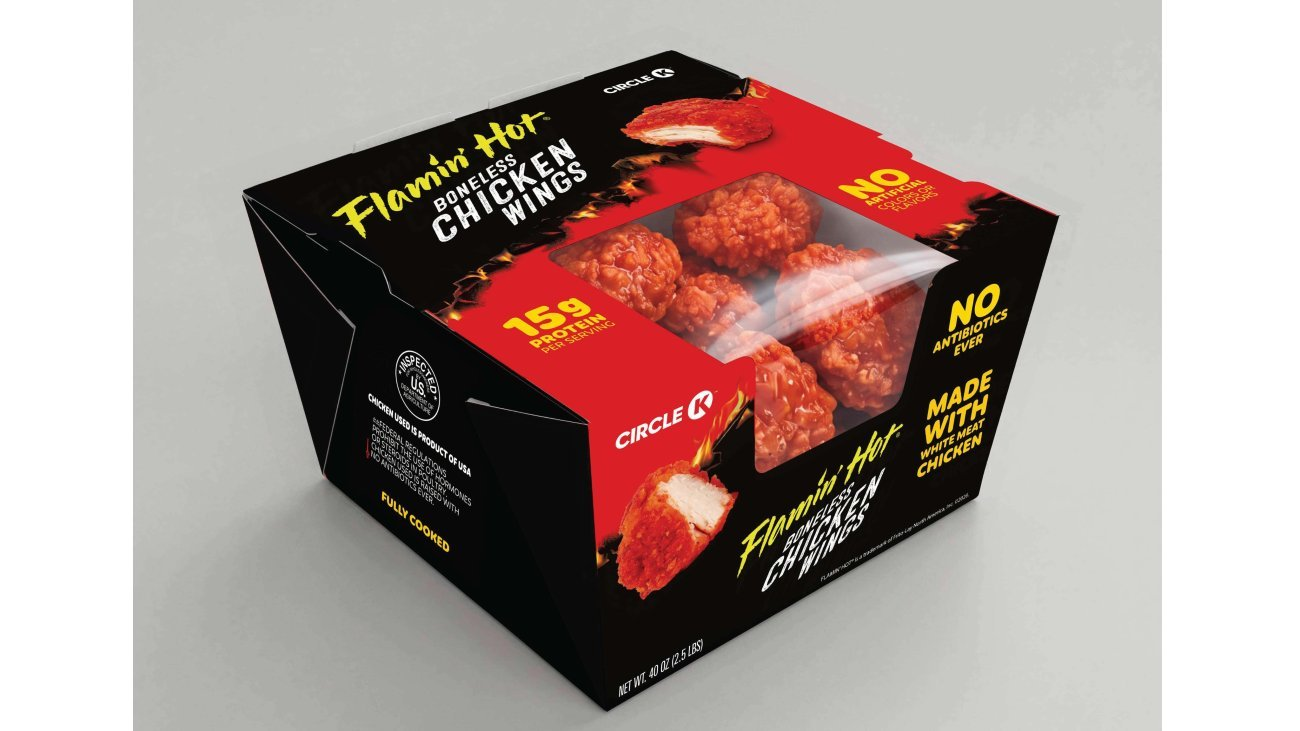
ProAmpac has developed a custom fibre-based tray for Circle K’s Flamin’ Hot boneless chicken wings, engineering the package around heat retention, moisture loss, grease resistance, visibility, and the operating conditions inside a heated display cabinet.
The pack was developed for a specific recipe and portion rather than selected from a standard foodservice range. ProAmpac worked from an initial PepsiCo brand design and adapted the structure for production while addressing Circle K’s requirements for longer hot holding and a clearer view of the chicken.
Hot food creates a difficult balance for packaging. A relatively closed structure can slow heat loss but may trap steam, increasing condensation and softening breaded or fried surfaces. Greater ventilation can protect texture but also lets heat and moisture escape faster, shortening the period over which the product remains acceptable for sale.
Grease adds another constraint. The fibre structure has to resist oil migration without losing stiffness or allowing visible staining to undermine presentation. Barrier performance also has to survive elevated temperatures and direct contact with a product whose surface condition changes throughout the holding period.
The package therefore operates as part of the food process after cooking has finished. Temperature, vapour movement, grease, airflow, pack geometry, and holding time continue to affect product quality while the food sits in the cabinet, even though no further cooking operation is intended.
Portion size changes those conditions. A heavier portion carries more stored heat and produces a different moisture load from a smaller serving. Piece arrangement influences air circulation inside the tray, while sauces, coatings, and surface oil can alter both grease exposure and the amount of vapour released after packing.
ProAmpac’s decision to develop the tray around the particular chicken recipe reflects that interaction. A structure proven around one hot-food product cannot be assumed to deliver the same performance with pizza, bakery items, fried potatoes, sauced foods, or a different portion of coated chicken.
Fibre substrates create their own engineering limits. Paper and board can provide useful stiffness and printability, but heat, water, steam, and oil can weaken untreated structures quickly. Barrier layers, coatings, fibre selection, forming geometry, and board weight have to provide enough protection without making the package unnecessarily heavy or difficult to convert.
Material suppliers are increasingly separating those requirements rather than treating foodservice paper as a single category. Recent grease-resistant foodservice papers distinguish between added water holdout and applications requiring greater grease resistance and heat retention, illustrating how different hot-food conditions increasingly lead to different material specifications.
The ProAmpac project adds pack geometry to that equation. A tray designed to improve the view of the food may require windows, openings, folds, or structural changes that affect stiffness and heat flow. Product visibility can improve merchandising while creating another variable for the engineer controlling temperature and condensation.
Production performance also has to survive outside the packaging development laboratory. Fibre trays have to convert consistently, stack or nest efficiently, withstand transport to stores, and remain easy for staff to fill and close. A structure that slows handling or arrives distorted can offset gains made in thermal or barrier performance.
Heated display adds another operational test. Staff repeatedly open cabinets, replenish products, move packs, and remove individual portions while temperature and humidity change through the trading period. Packaging has to remain mechanically stable under those conditions and continue to present the product cleanly until the approved hold time expires.
Longer holding can affect waste as well as availability. A pack that preserves acceptable product quality for more of the authorised service window can reduce the pressure to discard food simply because texture or presentation deteriorates early, although ProAmpac has not disclosed a numerical extension to the holding period and the announcement does not support a quantified waste-reduction claim.
The absence of published thermal data also limits what can be concluded about the design. ProAmpac says the tray helps keep the chicken hot and moist for longer and extends hot-hold performance, but it has not released comparative temperature curves, moisture measurements, or a detailed material construction.
No recyclability claim should be inferred solely from the fibre-based description either. Finished-pack recovery depends on coatings, windows, adhesives, barriers, food contamination, collection systems, and the ability of local recycling infrastructure to process the complete structure. Those details are not specified in the announcement.
What the project does establish is a development process that starts with the food and holding environment rather than substituting one substrate for another. Heat, steam, oil, serving size, visibility, store handling, and production conversion were all part of the brief before the pack reached commercial use.
That approach becomes increasingly important as fibre packaging moves into applications once dominated by foil or polymer structures. Dry ambient products give material developers a relatively forgiving environment; hot, greasy food held for sale does not. The tray has to behave predictably throughout the holding period while remaining practical to manufacture, transport, fill, display, and handle.
ProAmpac’s Circle K package is therefore a modest but useful example of packaging being treated as process equipment at the final stage of food service. Its success will be measured less by the fibre label than by whether the structure can manage heat, moisture, grease, and presentation repeatedly under normal store conditions.