IN Brief:
- Amcor will present UniPak Luma alongside PET bottles, jars, thermoformed trays, cups, flexible formats and other food and beverage packaging.
- FoodTech 2026 takes place from 27 to 29 October at MCH Messecenter Herning in Denmark.
- The portfolio combines lightweighting, post consumer recycled materials and recyclability work with packaging intended to maintain product and production performance.
Amcor will use FoodTech 2026 in Denmark to present a broad food and beverage packaging portfolio spanning rigid containers, flexible formats, closures and specialty solutions, with its recently launched UniPak Luma dairy platform among the products being highlighted.
The exhibition runs from 27 to 29 October at MCH Messecenter Herning, where Amcor will occupy stand M9768. Rather than centring the display on a single new launch, the company is bringing several packaging formats together around product protection, production performance, material reduction and recyclability.
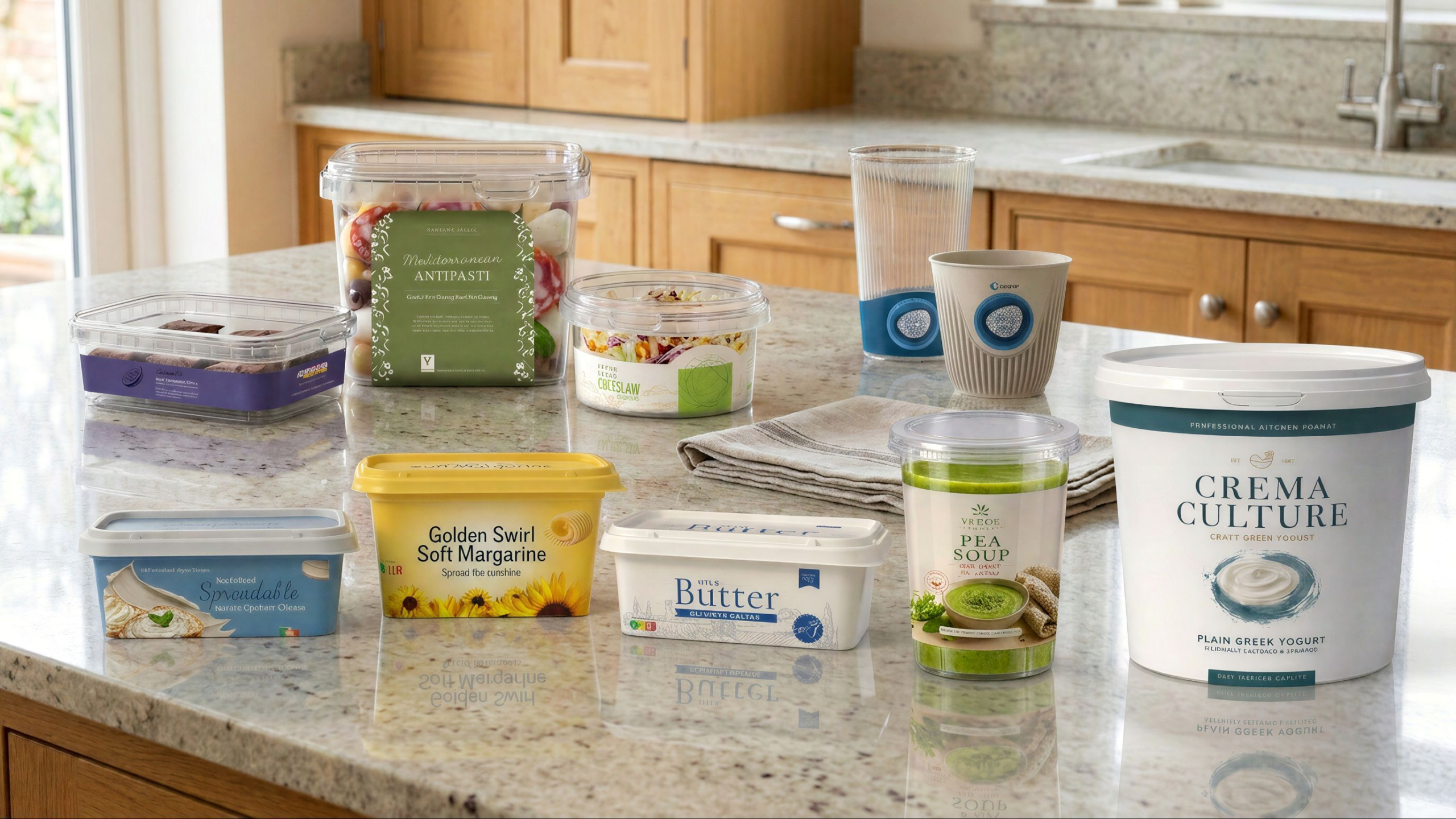
UniPak Luma is the newest element in the dairy range. The lightweight platform has been developed for cold and ambient filled dairy products alongside chilled and dry food applications, extending the wider UniPak family across products requiring rigid packaging and repeatable performance on commercial filling equipment.
The UniPak Luma platform was introduced earlier in September as a scalable round polypropylene container system. Amcor describes the format as designed for recycling where suitable polypropylene collection and reprocessing infrastructure exists, while its wider UniPak development has focused on reducing material without undermining filling-line compatibility.
That distinction matters because lightweighting is constrained by machinery as much as by material science. A thinner or lighter container still has to denest cleanly, remain stable during filling and lidding, withstand conveyor transfers and case packing and arrive at retail without unacceptable deformation.
The commercial limit is therefore not the lowest possible pack weight but the lowest weight that can still survive manufacturing and distribution consistently. Excessive material reduction can simply move waste elsewhere if line stops, damaged packs or rejected product increase.
Amcor will also present lightweight PET bottles and jars for juices, dairy drinks, water and carbonated beverages. Those formats face a different group of engineering demands because wall strength, neck finish accuracy and top load performance have to remain within operating limits during blowing, filling, capping and downstream handling.
Carbonated products add internal pressure, while filling temperature and product chemistry can alter the mechanical demands placed on the container. A bottle can therefore meet a material reduction target in isolation while still requiring further development before it is suitable for sustained industrial production.
Thermoformed trays and cups for yoghurt, snacks and ready meals will broaden the stand beyond bottles and dairy tubs. These formats bring further requirements around gauge control, flange consistency, sealing surfaces, stack behaviour and resistance to distortion through filling, cooling and distribution.
The range reflects the number of competing requirements now being built into food packaging specifications. Manufacturers are being asked to reduce material, use more recycled content and improve recyclability while protecting shelf life and maintaining line efficiency on equipment that may remain in service for many years.
Thue Foged, Sales Director Northern Europe at Amcor, said: “Food and beverage manufacturers are under increasing pressure to deliver packaging that protects products, supports efficient production and responds to changing consumer expectations.”
That pressure increasingly reaches several departments at once. Procurement teams look at material and conversion cost, technical teams assess food contact and performance, operations teams need stable machinability and sustainability teams are expected to demonstrate progress against material and recycling targets.
Packaging changes can expose the tension between those objectives. A container containing less polymer may offer an immediate material saving, but a lower stiffness can alter denesting or conveying behaviour. Recycled content may support circularity targets while introducing variation in colour or processing behaviour that has to remain within an acceptable production window.
Food contact compliance adds another layer. The permitted use of recycled material depends on the polymer, source, process and application, while suppliers need sufficient evidence to show that material and conversion routes meet the requirements of the market in which the pack will be used.
Recyclability is similarly dependent on more than the main polymer. Labels, inks, adhesives, closures, residual food and local collection systems can affect whether a technically recyclable pack is actually recovered and reprocessed after use.
Those variables make trial work important. Manufacturers changing a package need to assess not only laboratory properties but line speed, reject rate, seal performance, handling through secondary packaging and behaviour during palletisation and transport.
The FoodTech presentation gives Amcor a setting in which several material routes can be compared against those operating requirements. PET bottles, polypropylene tubs, thermoformed trays and flexible structures each offer different combinations of barrier performance, weight, rigidity, manufacturing method and end of life options.
Technical and commercial specialists will be available on the stand to discuss material selection, design and packaging objectives with manufacturers. Amcor says its work in the sector also covers incorporation of post consumer recycled material and recyclability validation.
For Nordic and wider European food producers, those decisions are increasingly shaped by regulation alongside retailer and brand requirements. Packaging development has therefore become less about replacing one material with another and more about finding a format that performs across manufacturing, logistics, compliance and recovery systems at the same time.
The useful measure for the products shown in Herning will remain factory performance. A lighter or more recyclable pack still has to protect the food, move through established equipment consistently and withstand the commercial distribution chain without increasing product loss.
Amcor’s FoodTech display is consequently a portfolio presentation rather than a single technology launch, but it illustrates the engineering problem now facing packaging development: environmental objectives increasingly have to be delivered through formats that behave at least as predictably as the structures they replace.