IN Brief:
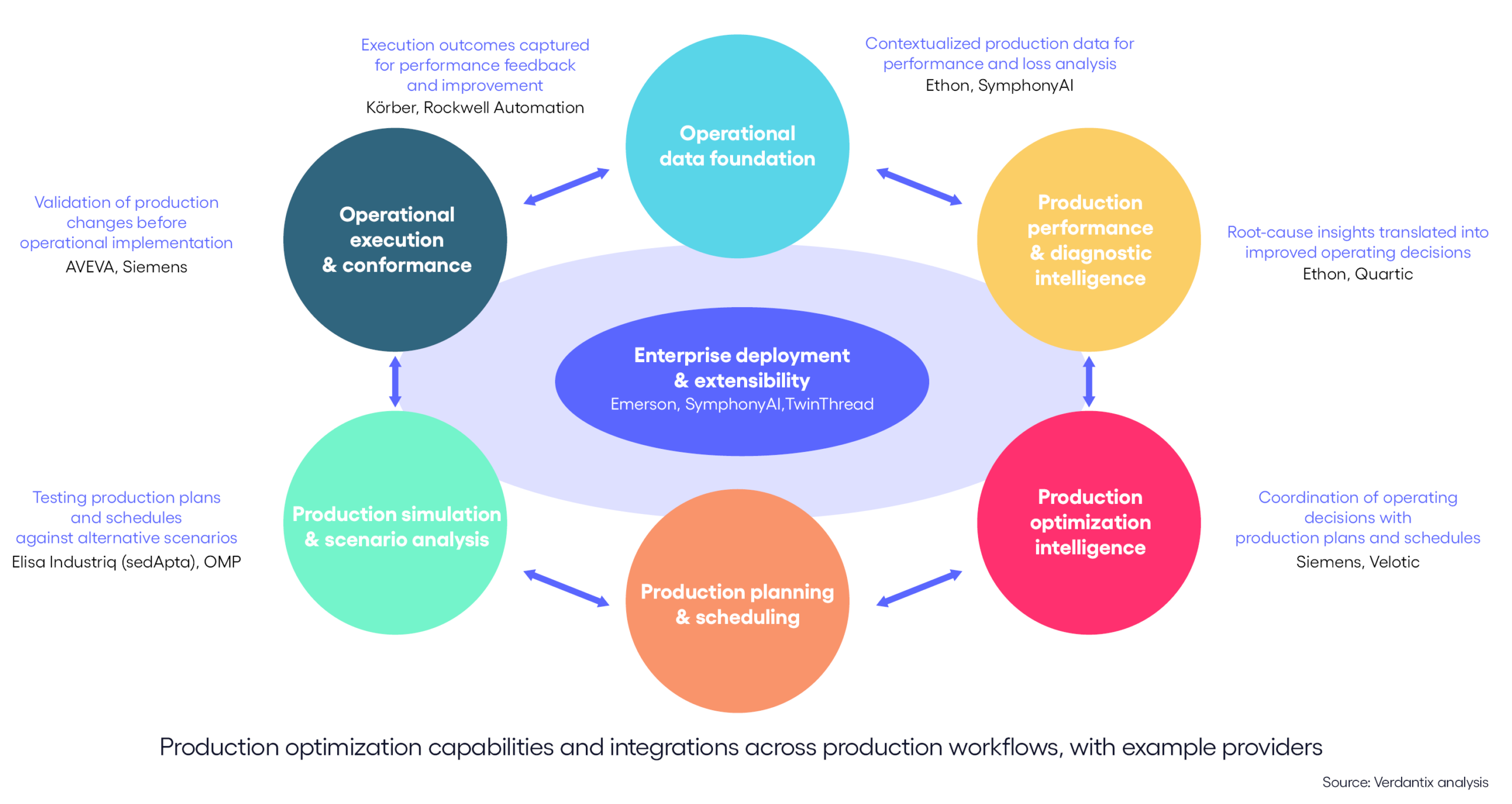
- Verdantix assessed 27 FMCG production optimisation software providers across seven capabilities linking operational data, decisions, execution and deployment.
- TwinThread says it alone earned a market-leading rating for operational execution and conformance, and was one of four rated market-leading for enterprise deployment and extensibility.
- The company cites moisture optimisation across a pet nutrition manufacturer's global dry food lines, without naming the customer or publishing independently verified savings.
TwinThread says it was the only provider rated market-leading for operational execution and conformance in a Verdantix assessment of production optimisation software for fast-moving consumer goods manufacturing. The US industrial AI company announced the finding on 22 October 2026, following research that evaluated 27 suppliers across seven connected capabilities.
TwinThread also reports that it was one of four providers rated market-leading for enterprise deployment and extensibility. Verdantix published its Smart Innovators assessment on 30 September. Verdantix’s public executive summary confirms the scope of the evaluation and the importance of linking production decisions to execution, while TwinThread’s individual ratings are drawn from the provider assessment available to subscribers.
The study examines how manufacturing software supports a sequence of activities, beginning with the organisation of operational data and the diagnosis of losses. Other capabilities cover production optimisation, planning and scheduling, simulation, the execution of recommended actions, and the ability to deploy and extend applications across multiple sites. The functions overlap in practice, but each addresses a different part of improving a production process.
Food manufacturing presents difficulties for systems that evaluate operating data without sufficient production context. An apparent loss of line performance may coincide with a different recipe, a change in raw material properties or restrictions imposed by equipment elsewhere in the process. Information about the asset, product and production event is needed before measurements from different runs can be compared reliably.
Such information may be distributed between machine controllers, supervisory systems, quality records and maintenance applications. A temperature or motor load reading describes a particular condition, but its relationship to yield or product quality depends on what was being manufactured at the time. The software must associate those measurements with the relevant batch, line or operating state to support a useful recommendation.
Verdantix identifies operational execution and conformance as comparatively less differentiated among the suppliers it assessed. The category concerns the connection between deciding what should change, applying that decision and establishing what happened afterwards. TwinThread’s company-reported rating relates specifically to this part of the process, rather than an overall first-place ranking across all seven capabilities.
TwinThread says recommendations from its platform can be presented through a plant’s human-machine interface, allowing operators and engineers to consider changes within their normal workflow. Its Thread Builder technology can support closed-loop adjustments to equipment setpoints, while the company describes engineering review and the ability to validate or override recommendations as part of its approach.
A change to an operating setpoint can influence several production outcomes at once. A setting associated with higher throughput may not be suitable if it moves product quality outside an accepted specification or conflicts with a safety constraint. Historical results can inform a proposed adjustment, but the current process conditions and the plant’s approval arrangements determine whether it can be used.
When an issue relates to equipment condition, a finding can also be directed towards a computerised maintenance management system to initiate a work order. Manufacturing execution systems can provide another route for recording or coordinating a response. TwinThread identifies its Anomaly Action Center as a means of organising these interventions so that subsequent results can inform future operating procedures.
Connecting these systems does not demonstrate that a recommended action always produces a saving. A maintenance intervention may remove one source of lost production while another constraint remains. To establish the effect, the plant needs to record the action taken, the conditions under which it occurred and a comparable measure of the result. TwinThread has not published independently verified intervention success rates or downtime reductions in connection with the assessment.
The company also describes using Digital Twin Classes and reusable trained models to extend applications across similar assets and processes. Instead of rebuilding an analytical model for each line, a manufacturer can seek to adapt one that has already been developed and tested. The degree of reuse depends on the similarity of process equipment, measurement definitions, products and operating limits.
A dry pet food application is among the examples cited by TwinThread. It says a pet nutrition manufacturer deployed moisture optimisation across production lines in its global operations, adapting established process knowledge to additional sites. The manufacturer was not named, and the company did not disclose the number of lines, the moisture variation achieved or an independently measured change in scrap or energy use.
Moisture management provides a useful example of the constraints involved. Dry pet food lines must control the properties of material passing through processing and drying stages while meeting the required finished product specification. Variations in incoming ingredients, feed rates or thermal conditions can change the relationship between process settings and final moisture content.
A model transferred between lines would therefore need to account for the relevant differences rather than assume that one set of operating values is appropriate everywhere. Measuring the result also requires consistent sampling and product specifications. The pet nutrition example establishes a reported deployment approach, not a verified universal reduction in moisture variation at every factory.
TwinThread’s Perfect Centerline product addresses consistency between production runs. Introduced in January 2026, it uses historical data to identify preferred process settings and presents recommendations alongside previous operating results. The company says engineers can compare suggested values with past runs before deciding whether to adopt them, maintaining oversight of changes made to the process.
Perfect Batch, launched in March, applies related analysis to batch manufacturing. The software examines past batch records to identify preferred operating profiles and can update its recommendations as further production information becomes available. TwinThread describes monitoring utilisation, cycle time, quality, process control and yield, with optional links to workflows that can initiate corrective action.
Batch production introduces additional variation because the ingredients, recipe, sequence of operations and processing duration can differ between orders. A batch that performed well under one set of conditions may not provide an appropriate reference for another product. Meaningful comparisons require the software to distinguish the relevant materials and operating circumstances rather than rank every completed batch together.
The commercial value of reusable optimisation also depends on governance across factories. Equipment names, measurement units and quality definitions may vary between sites, while permissions to change control settings can be held by different personnel. TwinThread’s reported enterprise deployment rating concerns its ability to support wider administration and extensibility, but the full provider scorecard is not publicly available to assess the claim independently.
The recognition concerns software already developed and deployed, rather than a newly signed food manufacturing contract, installed production line or completed factory investment. TwinThread has described the use of moisture optimisation across dry pet food production, but has not supplied verified performance figures for that deployment. Measurements from identified installations, covering consistency, yield or equipment availability, would be needed to establish the results achieved beyond the company’s account.