IN Brief:
- A staged Kronen line can begin with semi-automatic handling of up to 200kg/hour and expand through four configurations.
- Conveyors, additional washers and dryers, multihead weighing and a continuous horizontal drying system support later expansion.
- The highest-capacity illustrated configuration is rated at up to 1,500kg/hour, with actual throughput dependent on product and pack size.
Kronen has detailed a modular processing and packaging line that can be expanded from semi-automatic fresh-cut vegetable production to a more automated arrangement without discarding every earlier machine. The German equipment manufacturer has illustrated four stages of investment covering raw-material preparation, cutting, washing, drying, weighing and bagging. It has also pointed to established customer partnerships in Germany and Colombia to demonstrate the wider practice of adding machinery as production changes. The published four-stage design is an example configuration rather than a newly commissioned line at either customer.
The entry configuration is rated at up to 200kg per hour, with preparation handled by operators before produce moves through a belt cutter, washer, basket spin-dryer and packaging machine. Kronen’s example then progresses to lines rated at up to 600kg, 900kg and 1,500kg per hour. These are maximum capacities for four proposed configurations, with actual output dependent on the crop, cut, drying settings and bag size. Each expansion has to preserve the flow between machines; a higher-capacity cutter alone cannot overcome a bottleneck at washing or drying.
At the first stage, up to four workers prepare the raw produce at a trimming table before it reaches a GS 10-2 belt cutter. A HEWA 3800 washer then handles the cut material, discharging it through a vibration-assisted outlet while filtering and reusing wash water within the specified arrangement. Baskets filled from a carousel are transferred by an operator into a KS-100 PLUS spin-dryer and then emptied into the FLEX L packing machine supplied by GKS Packaging. The presence of manual basket handling limits the degree of automation, but the basic line covers the steps from preparation to bagging without requiring the largest drying installation.
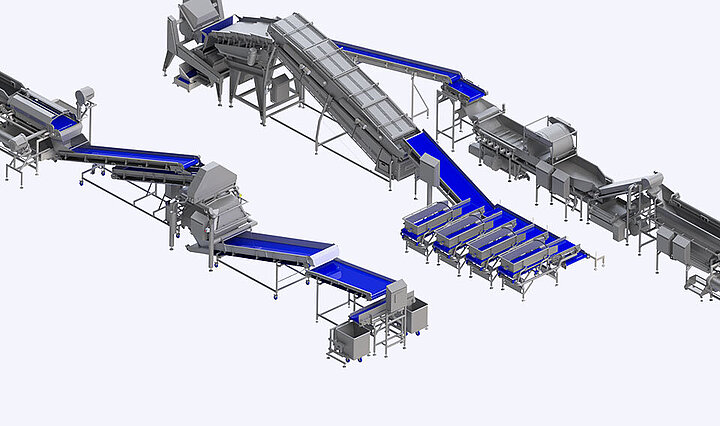
At the next stage, a conveyor can connect cutting directly to washing, avoiding one transfer between machines. A second cutter, a raised pre-washer and another spin dryer can be incorporated, expanding the kinds of cuts that can be produced and the rate at which washed produce reaches the packaging area. Kronen indicates a nominal capacity of up to 600kg/hour for this arrangement. A third stage adds a further dryer and multihead weighing equipment, with a specified upper processing rate of around 900kg/hour.
The fourth configuration substitutes a K1040H horizontal drying system for the separate basket spin-dryers. Introduced earlier in 2026, this centrifuge receives washed produce from a belt and uses an integral buffer to accept a continuing upstream flow even though the spin-drying operation takes place in cycles. The manufacturer rates the machine at up to 1,500kg an hour under appropriate conditions, matching the maximum figure for the illustrated fully automated line. Its optional discharge conveyor can feed subsequent weighing and packing machinery, eliminating the routine manual transfer of drying baskets.
Drying is more than a final cosmetic operation in fresh-cut manufacture. Leafy vegetables leave the washing stage carrying free surface water, and the removal of excess moisture affects handling, pack presentation and the conditions within the final bag. Kronen says its K1040H can achieve residual moisture values as low as 2–4% for suitable products, but the result depends on product characteristics and operating settings. More delicate leaves also place constraints on how aggressively centrifugal force and handling stages can be used without damage.
Hygienic design is another constraint on expanding a line. Additional conveyors, dryers and weighers create more product-contact surfaces and more points where residues can collect unless the system is accessible for cleaning. Kronen presents the machines as coordinated units, while providing for frequent changes between product types and cutting requirements. Optional equipment includes gas-flushing connections for modified-atmosphere packaging, a coding printer, a metal detector and a buffering turntable. Those components are configuration choices rather than standard specifications for every installed line.
Keeping existing machines in service while adding new equipment also changes the engineering challenge. The connections between units must maintain appropriate product flow, and an increased cutter output is of limited value if washing, drying or weighing remains the limiting stage. Conveyors may reduce handling and allow closer coordination, but their layouts must match the floor space, sanitation regime and intended packaging rate. A modular upgrade therefore involves checking the throughput of the complete process, rather than simply adding together the nameplate capacities of individual machines.
Kronen’s 9 November account discusses long-standing customer relationships in Germany and Colombia, but does not claim that either customer has bought the precise four-stage configuration now illustrated. A separate October case study describes Pentz’s expansion of ready-cut lettuce production, which is a distinct earlier installation. The new information is the detailed account of how a processor could add equipment progressively, with rated capacities for each configuration. No order value, commissioned location or universal return-on-investment figure accompanies the staged proposal.
The machines can be retained through successive stages only where their condition, hygiene design and throughput remain suitable for the intended product mix. Moving beyond basket drying also calls for a planned connection between washer discharge, the K1040H’s intermittent internal cycle and the packing operation. Kronen’s four rated stages provide reference points for that design work, from 200kg to 1,500kg per hour, but product characteristics and the plant layout still determine the attainable output.