IN Brief:
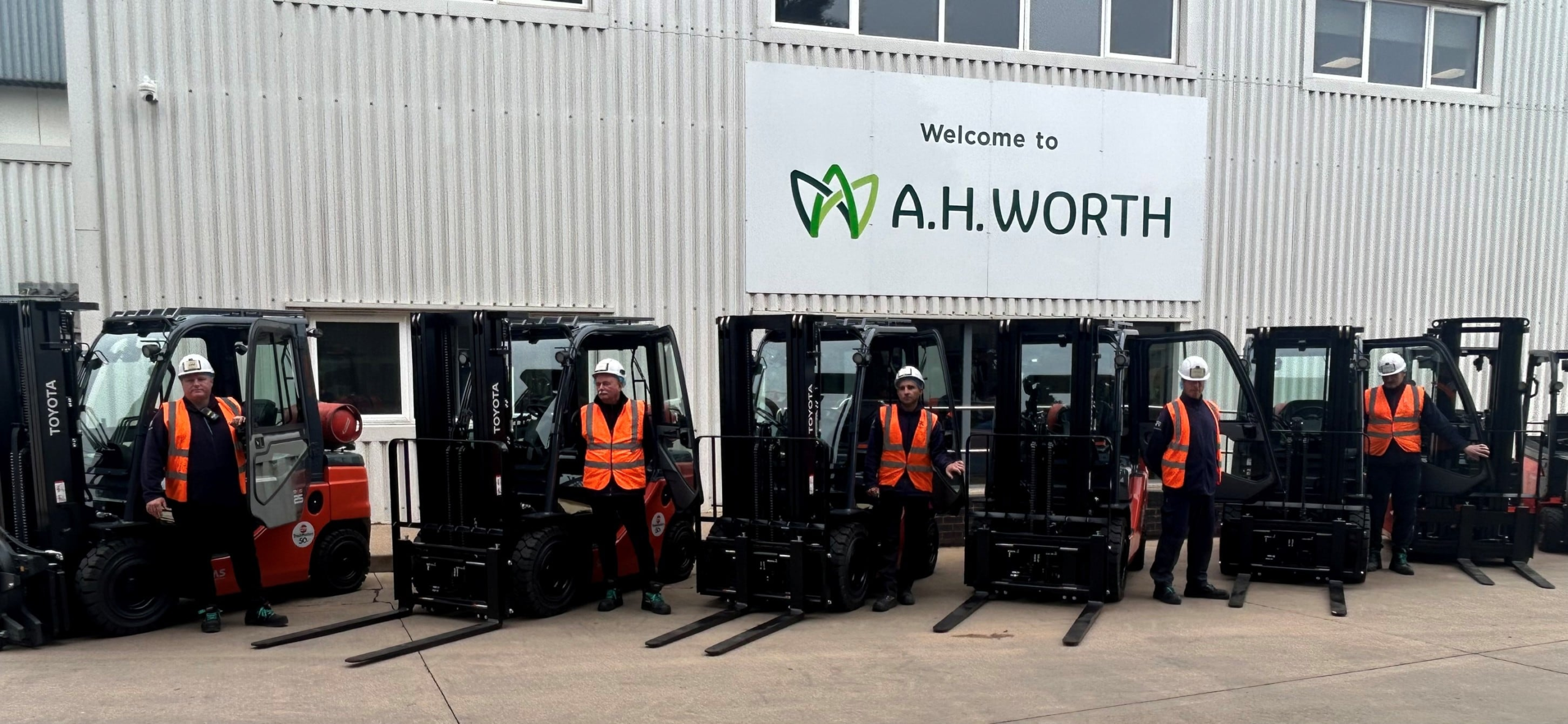
- AH Worth has taken delivery of nine Toyota forklift trucks at its Fosdyke site near Spalding.
- The fleet includes six 2.5-tonne gas trucks and three 1.6-tonne electric trucks for fresh produce operations.
- Onboard weighing, cameras, lighting, and handling upgrades are designed to improve safety, efficiency, and flow control.
AH Worth has invested in a new forklift fleet at its Fosdyke site near Spalding, strengthening materials-handling capacity across one of Lincolnshire’s major fresh produce operations.
The fleet includes nine Toyota forklift trucks: six Toyota 8FGF25 2.5-tonne gas trucks and three Toyota 9FBE16T 1.6-tonne electric trucks. The trucks have been specified for a fresh produce environment where speed, safety, hygiene, and yield control are closely connected.
Three of the gas trucks are fitted with onboard weighing systems. Loads can be weighed in real time on the forks, reducing the need for separate weighing stages, double handling, and unnecessary vehicle movements. In fresh produce, fewer handling points can protect productivity and quality by reducing delay, damage, temperature exposure, and process inefficiency.
The fleet also includes camera systems, safety lighting, and support features designed to improve visibility and operator control. AH Worth has linked the investment to safety, efficiency, and resilience across its Fosdyke operations.
Fresh produce handling often sits between field logistics, processing, cold storage, and dispatch. Incoming crop, graded produce, intermediate materials, packaging, waste, finished goods, and outbound loads all depend on reliable movement. If forklift capacity is constrained, production efficiency can be lost between intake, processing, storage, and loading.
Onboard weighing is especially useful where yield, inventory, and movement data need to be tightened. Fresh produce businesses operate with variable raw material weights, seasonal peaks, tight retailer windows, and product quality that can deteriorate quickly. Weighing at the point of lift removes unnecessary process steps and can improve the accuracy of internal stock, batch movement, and production planning.
The combination of gas and electric trucks reflects the mixed requirements of food operations. Gas trucks can provide robust outdoor and heavy-duty handling, while electric trucks can support quieter, lower-emission movement in suitable indoor or controlled areas. Choosing both technologies allows a site to match equipment to task rather than force one powertrain across every movement.
Safety is a central part of the investment case. Forklift operations remain one of the higher-risk areas of industrial and food manufacturing sites, particularly where pedestrians, chilled environments, narrow routes, racking, wet floors, reversing manoeuvres, and peak seasonal traffic interact. Cameras and lighting do not replace training or traffic management, but they improve operator awareness and make vehicle movement more visible.
The same risk profile is being addressed in wider logistics and materials-handling operations, where equipment design, process control, and automation are increasingly used to reduce exposure. Automated approaches to safer forklift operations in container loading show how materials-handling safety is becoming a systems issue rather than a driver-only responsibility.
Material movement is becoming a stronger productivity lever in food processing. Automation often receives attention at the primary processing or packing line, but the line can only perform if goods flow into and out of it predictably. Forklifts, pallet flows, weighing points, staging areas, and dispatch routines shape the effective capacity of the whole site.
Labour availability adds another layer. Well-specified trucks can reduce strain, improve driver confidence, and support retention in operational roles that are physically demanding and time-sensitive. Better visibility and handling aids can also help newer operators work safely within structured procedures, provided training and supervision remain strong.
The investment sits within a fresh produce sector exposed to labour cost, retailer service pressure, energy demand, packaging changes, and weather-driven crop variability. Incremental handling improvements can have a disproportionate effect in a category where waste and delay are expensive.
AH Worth’s new fleet is a site-level investment rather than a headline automation project, but fresh produce processing depends on physical flow. Safer, better-measured, and better-matched handling systems can improve performance across intake, production, storage, and dispatch.