IN Brief:
- Greenpeace-commissioned testing found microplastics in baby food sold in plastic spout pouches.
- Products tested included Nestlé Gerber and Danone Happy Baby Organics ranges.
- The findings increase pressure on flexible packaging validation, polymer selection, and food-contact risk assessment.
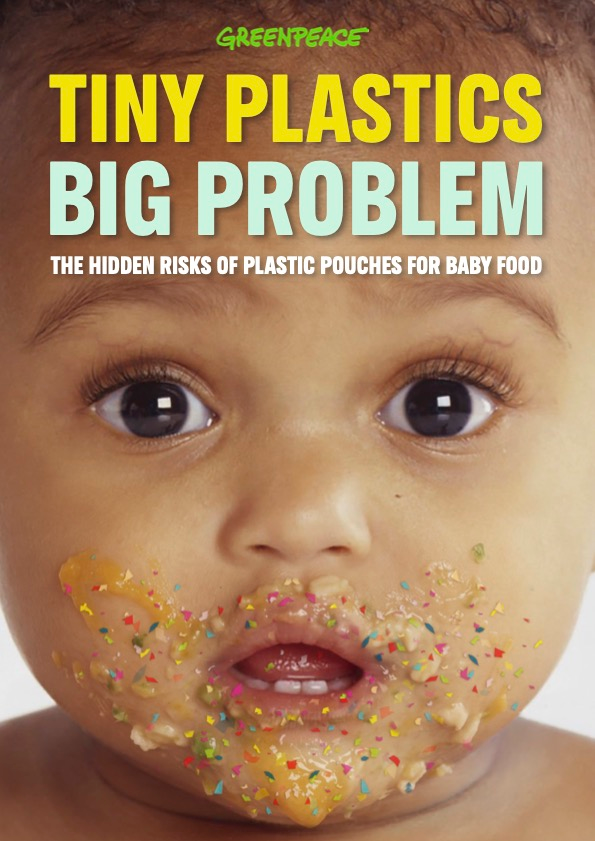
Plastic baby food pouches used by Nestlé and Danone brands are facing renewed scrutiny after testing commissioned by Greenpeace International found microplastic particles in pouch-packed infant food.
The tested products included Nestlé’s Gerber yoghurt-based puree and Danone’s Happy Baby Organics fruit-based puree, both packaged in plastic spout pouches. Laboratory analysis found microplastic particles in every sample tested and identified plastic-associated chemicals in both the packaging and the food.
Spout pouches have grown rapidly in infant nutrition because they are lightweight, portable, resealable, and efficient to ship. The format gives brands a convenient pack for retailers and households while using less material by weight than many rigid alternatives. For manufacturers, pouches can support high-speed filling, retorting or other stabilisation routes, compact secondary packaging, and shelf-ready distribution.
Those advantages now sit alongside a more difficult materials question. If polymer particles or associated chemicals can migrate into food during processing, storage, squeezing, or shelf life, pouch performance has to be assessed beyond strength, seal quality, barrier properties, and convenience. Food-contact safety, polymer composition, layer adhesion, spout and cap materials, filling conditions, and real-use handling all become part of the validation burden.
The issue is particularly sensitive in infant and toddler foods because exposure questions are judged differently where young children are involved. Even where regulatory limits remain under development, the direction of travel is clear: packaging manufacturers and food producers are being asked for stronger evidence that food-contact materials remain stable under intended use, including processing temperature, product acidity, fat content, storage time, and mechanical stress.
Flexible pouches are rarely a single material. They may combine layers designed for barrier performance, printability, sealability, stiffness, oxygen control, and compatibility with spouts. That complexity is commercially useful, but it can make migration assessment harder. A pouch designed to solve shelf life, weight, and convenience can create new questions over recyclability, chemical migration, and microplastic release.
Scrutiny of pouch materials sits alongside broader pressure on food-contact packaging, including FAO warnings on recycled packaging safety. Sustainability transitions are increasingly being tested against chemical safety, migration control, and material traceability, rather than being judged only by recyclability or material reduction.
The likely technical response is stronger material characterisation, migration testing, supplier declarations, and application-specific validation. Baby food producers may also need to compare pouches with glass jars, metal packs, fibre-based systems with barriers, and emerging reusable or refillable formats. None of those alternatives is simple. Glass adds weight and breakage risk, metal changes line design and thermal behaviour, and fibre-based formats still depend on coatings or barriers in many wet-food applications.
Operationally, pouches have become deeply embedded in modern baby food production. Lines, pack designs, retail formats, logistics models, and consumer habits have adapted around them. A sudden move away from the format would be expensive and technically disruptive, making incremental redesign, better evidence, and tighter supplier controls more probable than an immediate wholesale switch.
Convenience formats are entering a period of harder performance questioning. Barrier strength, shelf appeal, and transport efficiency are no longer enough for infant foods. The next phase of pouch development will need to prove that lightweight packaging can also meet rising expectations on chemical safety, particle release, material transparency, and end-of-life impact.