IN Brief:
- Brainr has secured a €1.5m seed extension from Portugal Ventures.
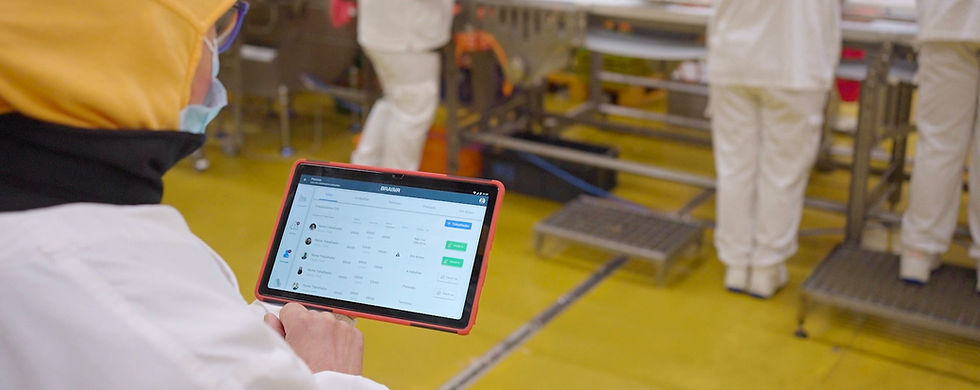
- The company’s Meat Factory Operating System supports production, planning, quality, traceability, warehousing, and operational intelligence.
- The funding strengthens Brainr’s international expansion plans across Europe, the US, Brazil, and additional food production sectors.
Brainr has secured a €1.5m extension to its seed round as the Portuguese food manufacturing software company expands its cloud-native operating system for meat processors.
The Leiria-based business has received the additional backing from Portugal Ventures, adding further capital to a funding round first announced in 2025. Brainr has developed a Meat Factory Operating System designed to bring production, planning, quality, traceability, warehouse management, and operational intelligence into a single platform.
The company says its system is already used by manufacturers responsible for more than 65% of Portugal’s poultry production, while deployments are also under way in several European markets. The new investment is intended to support international expansion, including activity in the US and Brazil, and to extend the platform into other areas of food manufacturing.
Meat plants are difficult environments for generic manufacturing software. Raw material variability, cutting yields, temperature controls, shelf-life windows, animal welfare requirements, by-product streams, customer specifications, and labour deployment all interact during production. A planning system that cannot follow those variables through the plant leaves teams working from partial information, even when headline output appears stable.
Brainr’s platform is aimed at that execution layer. By connecting live production data with quality, stock, planning, and traceability functions, the company is targeting the gap between enterprise systems and the realities of a processing floor. In meat production, that gap can be expensive: trim losses, giveaway, blocked stock, unbalanced labour, quality holds, and poor batch visibility all erode margin before products leave the site.
Digital systems are becoming more central as meat processors face tighter cost control and greater scrutiny over product movement. Traceability is no longer a compliance archive built after production has finished. It increasingly needs to operate as a live control function, connecting batch identity with stock status, processing stage, customer allocation, quality checks, and corrective action.
As protein manufacturers explore more complex product routes, including hybrid meat formats and alternative protein inclusions, factory data systems will have to manage more ingredient streams, formulation controls, and production specifications. The pressure already visible in hybrid meat development is not limited to the R&D kitchen; it eventually reaches batching, portioning, labelling, inspection, and distribution.
Brainr is also moving into a market where artificial intelligence has to prove its usefulness through practical operating gains. Forecasting, production scheduling, anomaly detection, yield analysis, and labour planning can all benefit from machine learning, but only where the underlying data is consistent. Inconsistent scanning, weak master data, poor process ownership, or fragmented line records will limit any system, regardless of the sophistication of its analytics.
The commercial case for factory operating systems therefore depends on implementation discipline as much as software capability. A meat plant cannot digitise around unclear workflows. The strongest deployments tend to begin with tight definitions around product flows, batch identity, line responsibilities, warehouse movements, and quality checkpoints, before automation and intelligence are layered on top.
Brainr’s funding arrives as food manufacturers reassess the value of plant-level visibility. Enterprise systems remain important, but they often sit too far above the line to solve production problems while they are still happening. Execution platforms that capture live manufacturing detail can help bridge the gap between commercial planning and factory performance.
If Brainr can maintain sector-specific depth while scaling internationally, the company could benefit from a wider shift in food manufacturing software. Meat processors are under pressure to run leaner plants without losing control of quality, traceability, or yield. Software that can connect those variables in real time is moving from optional upgrade to operating infrastructure.